Learn · Electrical
Short-Circuit Current and AIC Ratings
Part of Journeyman Electrician Exam Prep · step 52 of 73 · next: Selective Coordination
Part of Master Electrician Exam Prep · step 5 of 12 · next: Commercial Load Calculations
In learning paths: Journeyman Electrician Exam Prep · Master Electrician Exam Prep
Assumes you know: Circuit Breakers
Available short-circuit current is the current the electrical system can deliver into a bolted fault at a given point, and the interrupting rating (AIC, ampere interrupting capacity) is the maximum fault current a device can safely open. The safety rule the entire subject hangs on: every overcurrent device must have an interrupting rating at least equal to the available fault current where it is installed. The NEC states this in 110.9, with equipment short-circuit current ratings addressed alongside in 110.10.
Why it matters on the job
A breaker asked to interrupt more current than its rating may not open at all: it can arc across, weld shut, or explode, while the fault keeps burning. This failure is invisible until the day of the fault, which is why the check is a design responsibility, yours, at master level, not something an inspector can see by looking at a wall of breakers. Fault-current studies, series ratings, and equipment labels all flow from this one comparison.
Where fault current comes from, and where it goes
The utility transformer is the spring behind the fault. How hard it can push is set by its size (kVA) and its percent impedance (%Z), stamped on the nameplate. The worst-case estimate, called the infinite-bus calculation, assumes the utility can supply the transformer without limit:
Fault current = transformer full-load amps ÷ %Z
From the transformer outward, every foot of conductor adds impedance, so available fault current falls as you move downstream. Highest at the service, lower at every subpanel, lower still at the receptacle. This is why service equipment carries the highest AIC ratings in the building, and why standard 10 kAIC breakers are usually fine deep in the system but must be verified at the service.
Two ratings to keep straight: a device’s interrupting rating (what the breaker or fuse can clear) and equipment’s short-circuit current rating, SCCR (what an assembly, a panel or machine, can withstand while its protection clears). Both must meet or exceed the available fault current at their point of install. Series ratings are the listed exception: a tested combination where a high-AIC upstream device protects lower-rated downstream breakers, legal only as a listed, labeled combination.
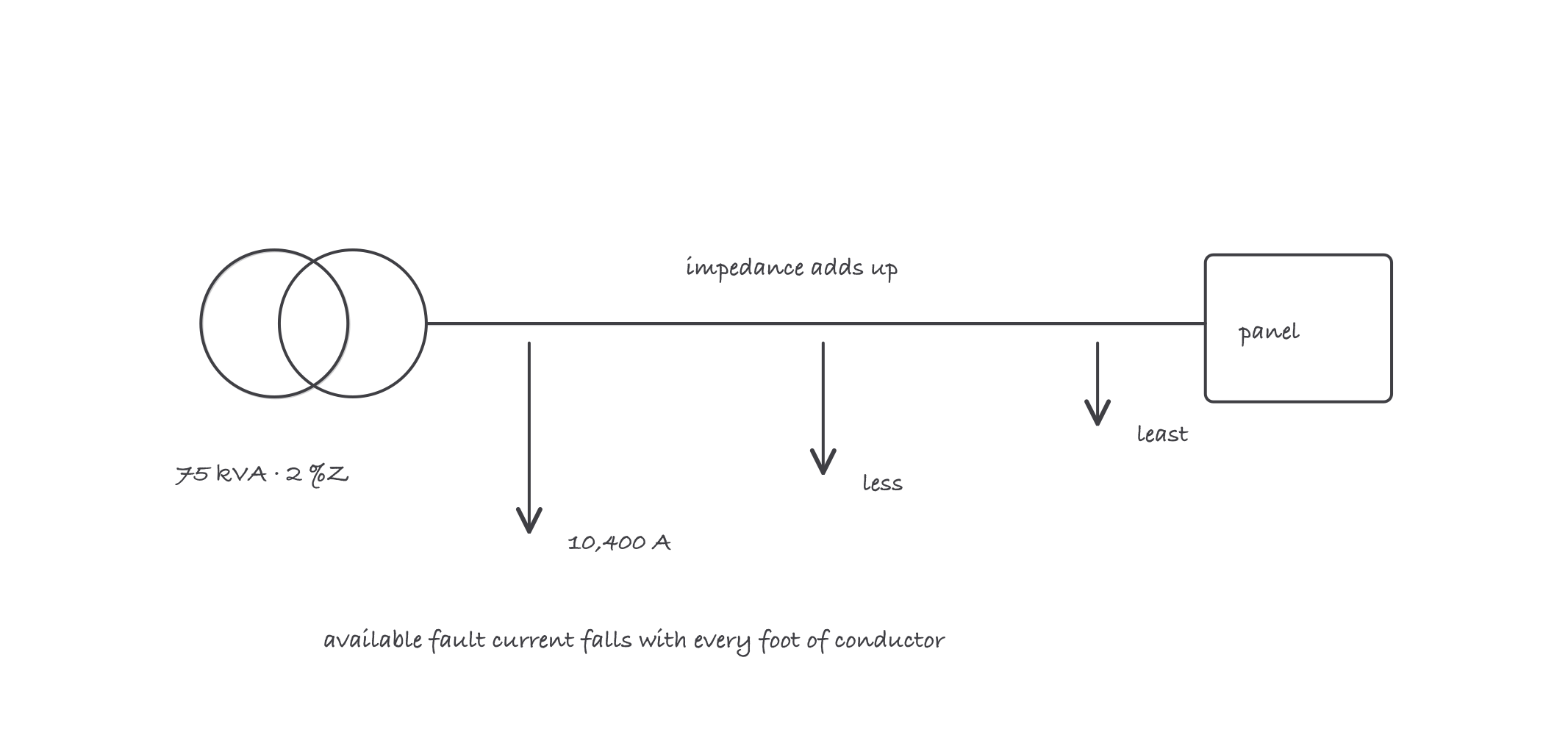
The spring is the transformer: every foot of wire between you and it softens the blow
Worked example
A building is served by a 75 kVA three-phase transformer at 208 V, nameplate impedance 2%.
Full-load amps: 75,000 ÷ (1.732 × 208) = 75,000 ÷ 360 = 208 A.
Infinite-bus fault current: 208 ÷ 0.02 = 10,400 A available at the transformer secondary terminals.
A standard 10 kAIC (10,000 A) breaker at the service fails the comparison: 10,400 > 10,000. You specify 22 kAIC service breakers, or a listed series-rated combination, and document it. Fifty feet of feeder later, conductor impedance has knocked the available current down substantially, and 10 kAIC devices downstream verify comfortably. The infinite-bus number is deliberately conservative: real utility source impedance only lowers it, so passing against the conservative number is always safe.
Where it bites
- Interrupting rating is not trip rating. A “20 A, 10 kAIC” breaker trips at 20 A and can safely interrupt up to 10,000. The two numbers answer different questions, and exams love the confusion.
- Transformer upgrades reset the math. The utility swapping in a bigger or lower-impedance transformer raises available fault current at your unchanged service gear. A study done once is not a study done forever.
- Series ratings are combinations, not components. The listing covers a specific upstream-downstream pairing, marked on the equipment. Mixing brands or models outside the listing voids it.
- SCCR is the machine-panel trap. An industrial control panel full of 5 kA-rated components has a 5 kA SCCR no matter what breaker feeds it. Check the assembly label, not just the breaker.