Learn · Electrical
Electrical Energy and kWh
Part of Electrical Foundations · step 7 of 19 · next: Series Circuits
In learning paths: Electrical Foundations
Assumes you know: Electrical Power
Energy is power sustained over time: what the work actually costs. Power says how fast electricity is doing work right now; energy says how much work got done altogether. The utility meter on the wall counts energy, in kilowatt-hours, and every electric bill in the country is written in that unit.
Why it matters on the job
Customers do not ask about watts; they ask why the bill went up. Being able to turn a nameplate and a habit into a dollar figure is one of the most useful five-minute calculations in the trade: it settles arguments about which appliance is the culprit, justifies replacing an old motor, and tells a customer what that always-on heat tape really costs. It also keeps you from confusing the two quantities the meter world splits apart: demand (power) and consumption (energy).
The concept
Energy equals power multiplied by time:
Energy = P × t
The everyday unit is the kilowatt-hour (kWh): 1,000 watts running for one hour. A 1,000 W load for one hour, a 500 W load for two hours, a 100 W load for ten hours: each is exactly 1 kWh, and the meter cannot tell them apart. That indifference is the point. The meter integrates whatever you draw, moment by moment, into one running total.
Keep the units straight and the concept stays honest. A kilowatt is a rate, like miles per hour. A kilowatt-hour is a quantity, like miles driven. Saying a heater “uses 1.5 kWh” with no time attached is as meaningless as saying a truck “went 60 miles per hour far.”
Worked example
A 4,500 W electric water heater element actually heats for about 3 hours a day in a typical household.
- Daily energy: 4.5 kW × 3 h = 13.5 kWh
- Monthly energy: 13.5 kWh × 30 days = 405 kWh
- At a rate of $0.15 per kWh: 405 × 0.15 = $60.75 per month
Every number is checkable, and the structure never changes: kilowatts, times hours, times rate. Run the same arithmetic on a 9 W LED lamp left on around the clock: 0.009 kW × 24 h × 30 = 6.48 kWh, about 97 cents a month. The water heater question and the lamp question are the same question with different numbers in it.
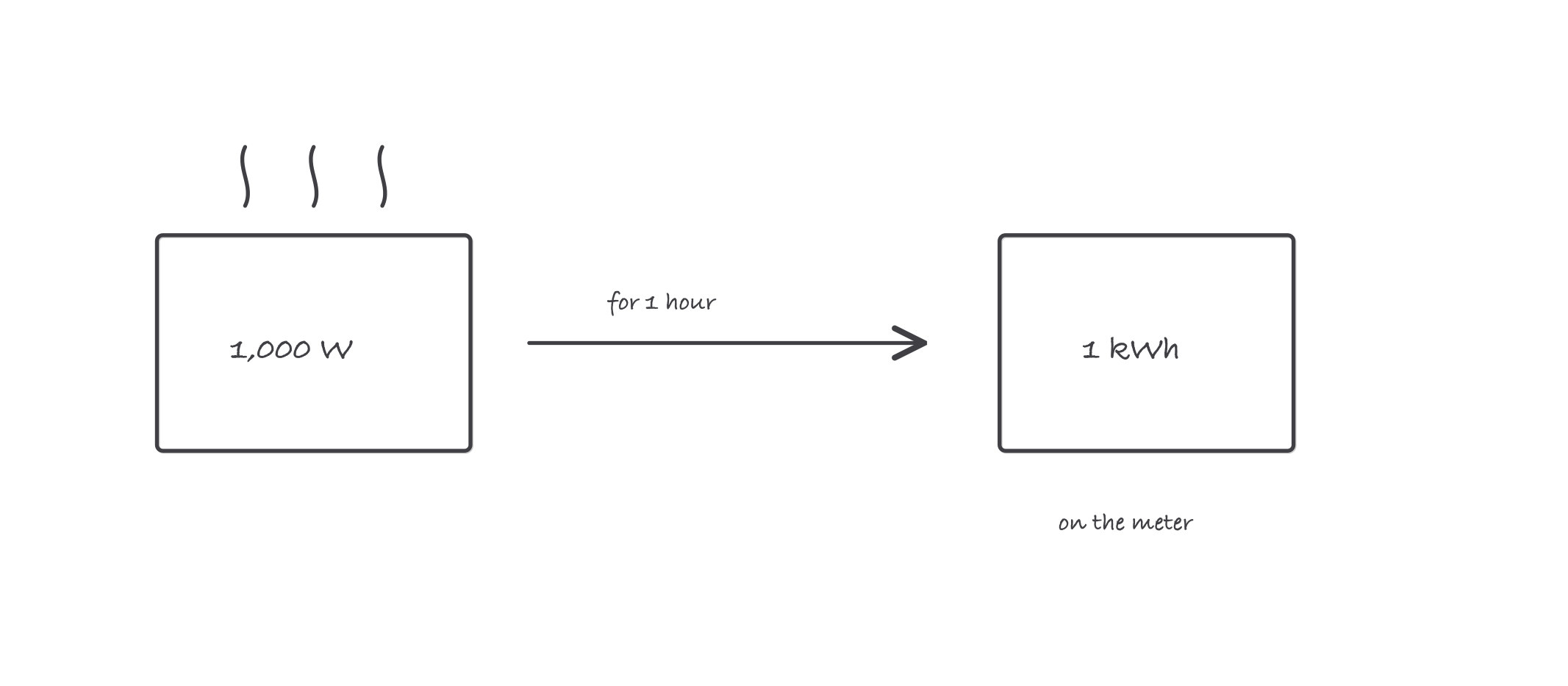
A kilowatt-hour is a quantity: this much power, held for this long
Where it bites
- kW and kWh get swapped constantly, in conversation and on paper. A rate cannot appear on a bill’s usage line, and a quantity cannot appear on a nameplate. When a number looks absurd, check which unit it is wearing.
- Duty cycle is the hidden variable. A water heater rated 4,500 W does not draw 4,500 W all day; the thermostat cycles it. Nameplate power times 24 hours overestimates wildly. Estimate with realistic running hours, or measure with a logging meter over a real day and let the number settle the argument.
- Demand charges are about power, not energy. Commercial customers can pay for their single worst 15-minute draw as well as their total kWh. Two shops using identical energy can see very different bills; that distinction is the seed of the power factor lesson later.
Exam relevance
Energy questions on journeyman exams are usually one honest multiplication dressed in a word problem: watts to kilowatts, hours to the billing period, then the rate. The trap is unit conversion under time pressure, so practice moving between W and kW until it costs you nothing.