Learn · Electrical
Service Sizing Calculations
Part of Master Electrician Exam Prep · step 7 of 12 · next: Transformer Calculations
In learning paths: Master Electrician Exam Prep
Assumes you know: Commercial Load Calculations
Service sizing converts a finished load calculation into hardware: a standard service rating, service conductors, and the service disconnect. The load calculation produced volt-amperes; this step turns them into amperes, rounds up to a rating you can buy, and sizes the wire that feeds it.
Why it matters on the job
The service is the most expensive single decision on the project and the hardest to change later. Sizing it is also where three different numbers meet, calculated load, service rating, and conductor ampacity, and keeping them straight is the skill. A service sized right leaves room for the heat pump and the car charger the customer has not bought yet; one sized wrong is a change order with your name on it.
The method
Convert the load to amperes. Calculated VA ÷ service voltage. For a 120/240 V single-phase service, divide by 240. For three-phase, divide by line voltage × 1.732.
Round up to a standard rating. Services and their disconnects come in standard ampere ratings: 100, 125, 150, 200, 400 and up. The rating must equal or exceed the calculated amperes, and a dwelling service can never be smaller than 100 A.
Size the service conductors. Conductors must carry the calculated load. For single-phase dwelling services and the feeders that carry the whole dwelling load, your code book permits conductors at 83 % of the service rating, a standing acknowledgment that a dwelling never sustains its full rating. Nondwelling services size conductors from the ampacity tables directly.
Check everything downstream agrees. Grounding electrode conductor, bonding jumpers, and the panel busbar all key off the service size; a service is a set of matched parts, not one number.
Worked example
The dwelling from the residential lesson calculated to 34,415 VA.
- Amperes: 34,415 ÷ 240 = 143.4 A.
- Next standard rating up: 150 A service and disconnect.
- Dwelling conductors at 83 %: 150 × 0.83 = 124.5 A required. From the 75 °C copper column, #1 AWG at 130 A covers it (and your code book’s dwelling service table lists #1 copper for a 150 A service directly).
- Result: 150 A disconnect, #1 copper service-entrance conductors, panel rated 150 A.
For contrast, run a nondwelling total of 42,700 VA at 240 V single-phase: 177.9 A → 200 A service, and the conductors must genuinely carry the 177.9 A calculated load from the table with no 83 % allowance: 3/0 copper at 200 A is the comfortable choice.
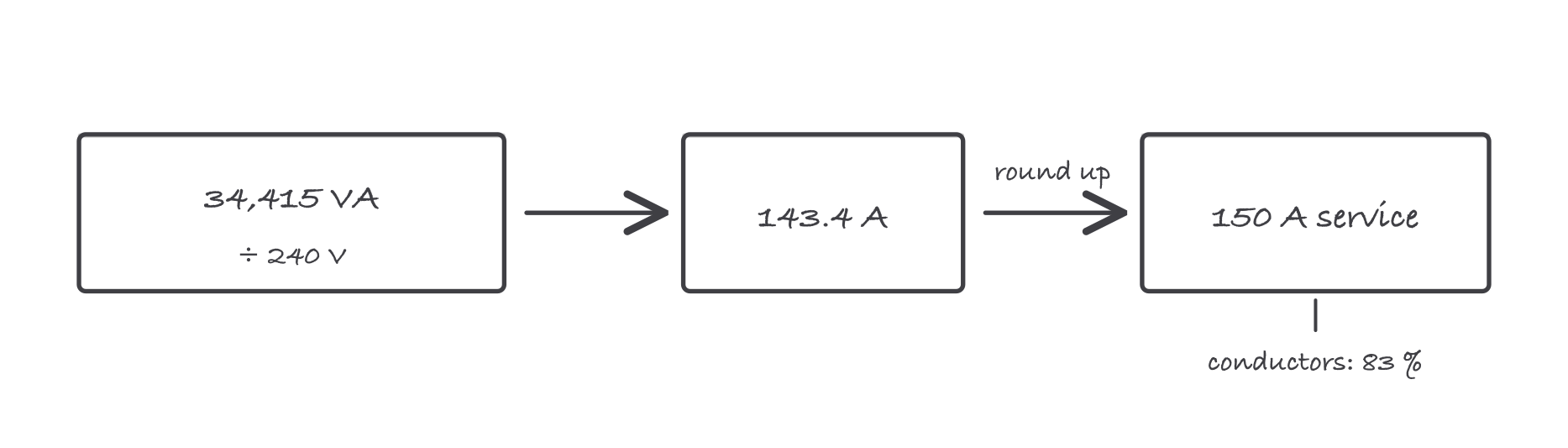
Volt-amperes to amperes to the next standard rating: the conductor then follows the rating, not the load
Where it bites
- The 83 % rule is for dwellings only, and only for the conductors carrying the entire dwelling load. Applying it to a commercial service or a subfeed undersizes real copper.
- Round the service up, never the load down. 143.4 A on a 125 A service is not close, it is a violation. The standard-ratings ladder only climbs.
- The panel busbar is part of the service size. A 200 A disconnect feeding a 125 A-bus panel is a mismatch inspectors catch on the first look.
- Future load is a design decision, not a code requirement. The calculation gives the minimum. Standard practice on dwellings today is to ask about EV charging and electrification plans before committing; the code book’s minimum and the right answer are not always the same number.
Exam relevance
Service sizing is the final line of every load-calculation problem: the exam wants the standard rating, and sometimes the conductor from the dwelling services table. The 83 % rule is heavily tested in both directions, when it applies and when it must not. Watch for problems that give the load in amperes directly and test only the rounding: the ladder of standard sizes is the whole question.
Verified requirements
| Where | Expires | Renewal | Continuing education |
|---|---|---|---|
| Texas | Yes | 1 year | 4 hours per annual renewal cycle |
Information comes from issuing-authority sources. Confirm current rules, fees and eligibility with the authority before acting.