Learn · Electrical
Main Bonding Jumper
Part of Journeyman Electrician Exam Prep · step 16 of 73 · next: Bonding at Service Equipment
In learning paths: Journeyman Electrician Exam Prep
Assumes you know: System Grounding
The main bonding jumper is the single connection between the grounded (neutral) conductor and the equipment grounding system, made at the service disconnect. It is often just a green screw or a factory strap, and it is the most important conductor in the building: every ground fault in the premises must cross it to get home. No main bonding jumper, no fault clearing, anywhere.
Why it matters on the job
Fault current returns to the transformer that sourced it, and from the service disconnect back to the transformer there is exactly one conductor available: the service neutral. The equipment grounding network collects fault current from all over the building, but that network is a dead end unless something connects it to the neutral. The main bonding jumper is that something. Forget to install the green screw in a new panel, and every EGC in the building becomes a road to nowhere: faults energize enclosures and sit there at 4 or 5 amps through the electrode system, forever, tripping nothing.
The one point where the systems meet
Think of the premises wiring as two separate networks. The neutral network carries load current every minute of the day. The equipment grounding network carries current only during a fault. The main bonding jumper joins them at one deliberate point, the service, and the discipline of the whole system is keeping them separate everywhere else.
Why only one point? Connect neutral to ground anywhere downstream and the two networks become parallel paths. Ordinary load current then divides between the neutral and every bonded surface, conduit, water pipe, enclosure, that parallels it. Metal that should be dead carries current all day, connections corrode under load, and a person or a sensitive instrument bridging two “grounded” objects finds a voltage between them. One point gives faults their path without giving load current any alternatives.
This is why service equipment has the neutral bar bonded to the can, while every subpanel keeps neutrals isolated on an insulated bar and grounds on their own bar. The green screw that bonds a panel is installed at the service and left in the parts bag everywhere else.
Worked example
Trace a fault in a house: a hot conductor contacts the metal frame of a dishwasher.
- Fault current leaves the frame on the branch-circuit EGC, 12 AWG copper, back to the panel’s ground bar.
- Ground bar to neutral bar across the main bonding jumper.
- Neutral bar out the service neutral to the utility transformer’s center tap, completing the loop.
- Total path impedance about 0.1 Ω: current = 120 V ÷ 0.1 Ω = 1,200 A. The 20 A breaker opens in about a cycle.
Now remove step 2. The only remaining route is EGC to ground bar to grounding electrode to soil to the utility’s electrode: 25 Ω or more. Current = 120 V ÷ 25 Ω = 4.8 A. Nothing trips, and the dishwasher frame holds 120 V until someone leans on it with a wet hand.
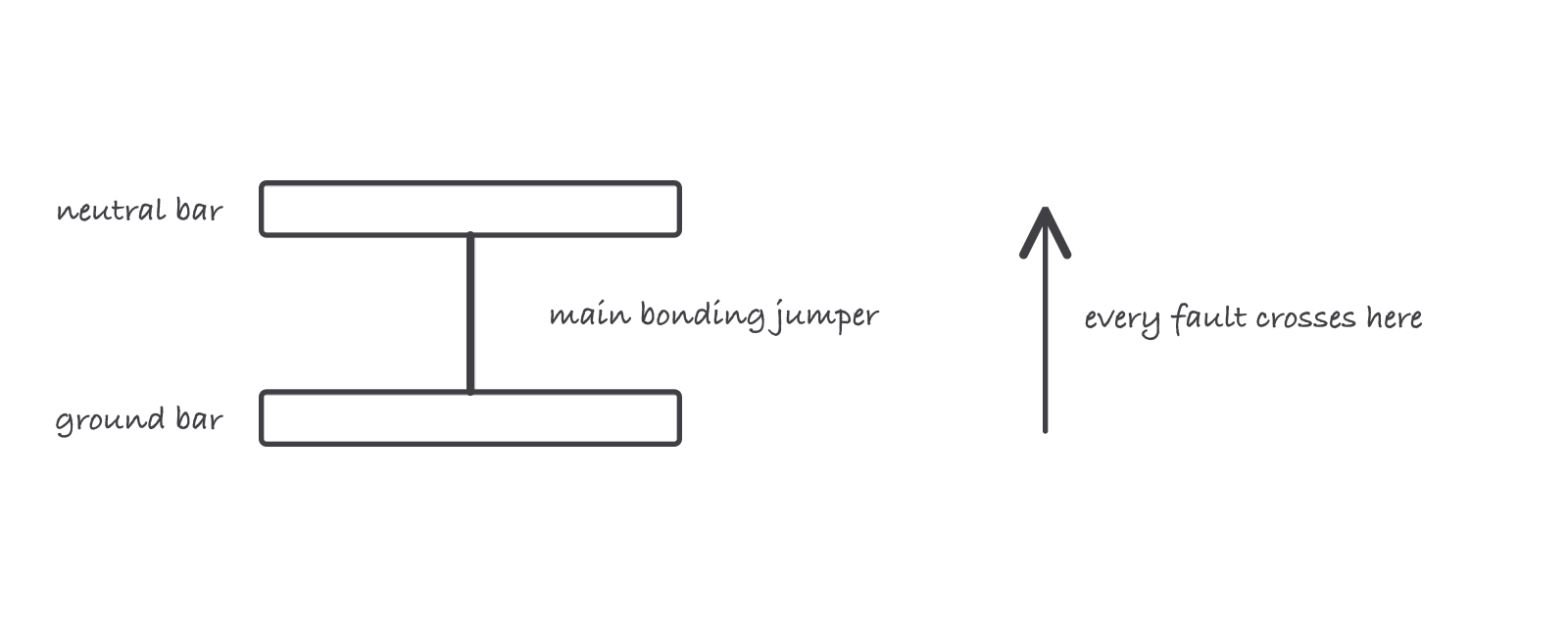
Two networks, one deliberate link: the main bonding jumper at the service is the only place neutral and ground meet, and every fault in the building crosses it
Where it bites
- The unscrewed green screw is a real and common defect. A panel works perfectly without its main bonding jumper, lights on, loads running, until the first fault. Test for neutral-to-ground continuity at the service; never assume the factory or the last electrician did it.
- Bonded neutrals in subpanels are the mirror-image mistake. The strap that is mandatory at the service is a violation downstream. Moving a service panel to subpanel duty, common in generator and solar upgrades, means removing the bond.
- The jumper must handle the building’s full fault current, which is why it is sized from the service-entrance conductors like the GEC, not from any breaker. A factory screw or strap is listed for the panel; a field-built jumper must be sized, not guessed.
- Separately derived systems repeat this whole story with a system bonding jumper at the transformer or generator: same one-point rule, new source.
Exam relevance
Exams test the location rule, neutral-to-ground bond at the service disconnect only, with scenario questions about subpanels, detached buildings, and generator transfer switches. Expect items on what the main bonding jumper may be (wire, bus, screw, strap), how it is sized, and fault-path tracing questions where the correct sequence includes the jumper by name. The missing-jumper failure mode, everything works until a fault, is a favorite master-level scenario.
Verified requirements
| Where | Expires | Renewal | Continuing education |
|---|---|---|---|
| Texas | Yes | 1 year | 4 hours per annual renewal cycle |
Information comes from issuing-authority sources. Confirm current rules, fees and eligibility with the authority before acting.