Learn · Electrical
Safe Work Practices
Assumes you know: Shock Hazards and the Body
The first safe work practice contains all the others: do not work on energized equipment. Everything else in electrical safety, boundaries, PPE, permits, procedures, exists for the shrinking set of situations where that rule genuinely cannot be applied, and for protecting the process of making equipment safe in the first place. A lesson can teach you the shape of the system; it cannot qualify you. Qualification comes from your employer’s training, and these practices only work inside such a program.
Why it matters on the job
Shock and arc flash injuries cluster around a familiar story: a routine task, a live panel, a reason that felt good at the time. Schedule pressure, a lift that would take an hour to shut down, a circuit that was “probably” the right one. Safe work practices are the discipline that interrupts that story before it starts, and they work by making the safe path the normal, expected, boring default.
The electrically safe work condition
The heart of the system is a defined state, the electrically safe work condition: the equipment is disconnected from every energy source, secured against reconnection with locks and tags, and proven de-energized by test. Reaching that state is itself electrical work done with full protection, because until the final verification, the circuit is treated as live.
The sequence that establishes it runs in a fixed order: identify all sources using up-to-date drawings and labels, interrupt the load, open the disconnecting means, verify visually where the design allows it, apply lockout/tagout, test for absence of voltage on every conductor, and ground where required. Lockout/tagout and voltage verification each get their own lesson; here the point is the destination. Work begins after the condition is established, not while it is being established.
When equipment stays energized
The honest version of the rule is not “never.” Diagnostics require live measurement; some processes create greater hazards when shut down. NFPA 70E and OSHA treat energized work as the exception that must be justified: infeasibility or increased hazard, documented, planned, and authorized through an energized electrical work permit in most cases, performed only by qualified persons with the required protection.
What that means for you is simple and sharp. If a task in front of you seems to need energized work, that is a decision your employer’s program makes through its permit process, with names on paper. It is never a decision made alone at the panel with a deadline breathing on you. Nothing on this page authorizes energized work; treat any instruction to “just do it hot” as a stop-work moment.
The daily practices
Around the central rule sits a set of habits that show up on every job:
- Plan before touching. A job briefing covering hazards, energy sources, boundaries, and who does what. Short for simple jobs, thorough for complex ones, skipped for none.
- Right tools, rated tools. Insulated tools for the task, meters and leads with the right category rating for the system, inspected before use. Damaged leads and cracked cases retire equipment on the spot.
- Respect the boundaries. Signs, barricades, and attendants are controls, not decoration. Unqualified persons stay outside the limited approach boundary, full stop.
- Housekeeping is electrical safety. Conductive clutter, water, and blocked egress around electrical equipment convert small mistakes into large ones. Working space rules exist so a person can retreat.
- Condition of equipment counts. Damaged, wet, or poorly maintained equipment changes every assumption, including arc flash numbers that depend on breakers actually operating on time.
Worked example: one decision walked through
A lighting contactor in a 480 V panel needs replacement. The store manager asks for it live so the sales floor stays lit.
- The task is repair, not diagnostics: no infeasibility argument exists. Convenience and cost are explicitly not justifications for energized work.
- The decision path: schedule the outage, establish the electrically safe work condition, and do the swap with the panel dead.
- What the manager’s request actually triggered was not negotiation at the panel but a call to the supervisor and a scheduled shutdown window that night.
The example is deliberately undramatic. That is the point: the system worked when the story stayed boring.
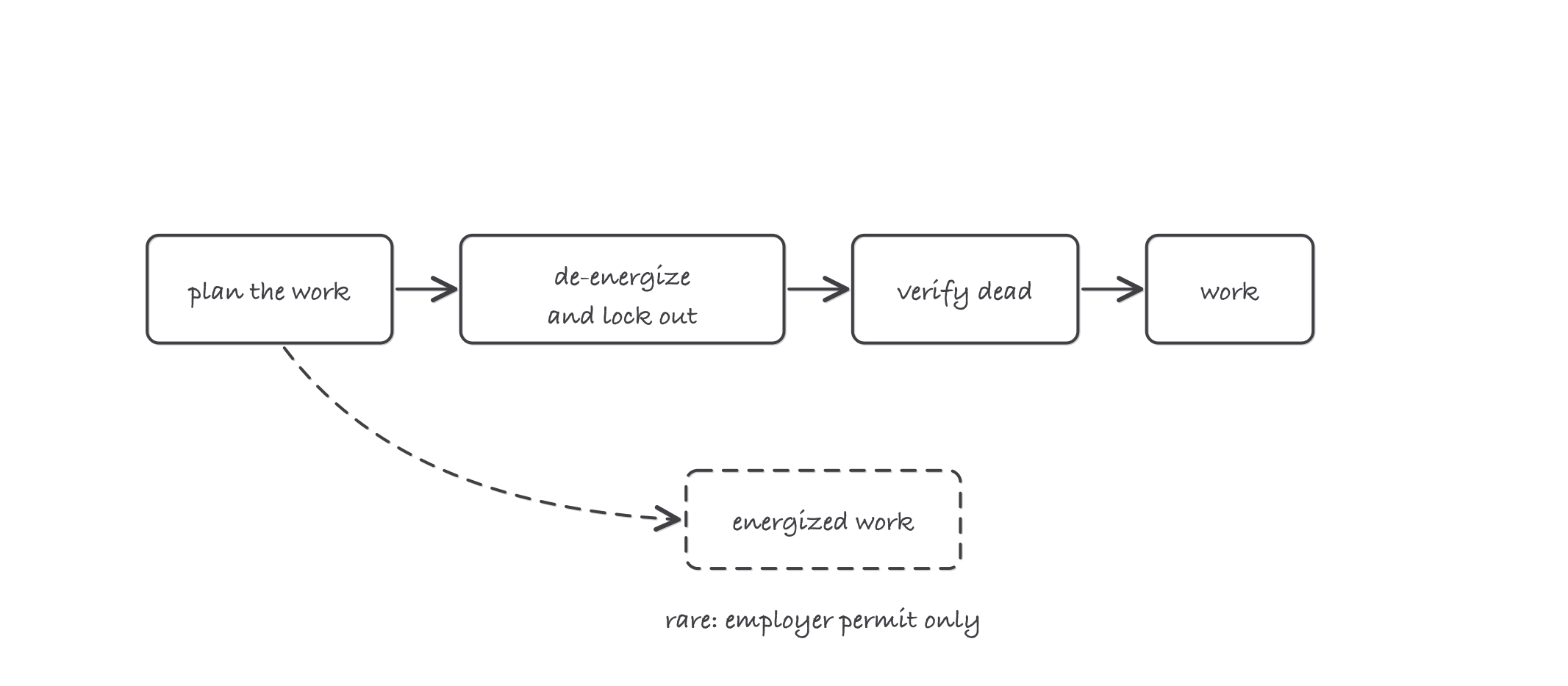
The main road is the whole method: the side gate opens only through the employer’s permit process, never through schedule pressure
Where it bites
- “Qualified” is task-specific and employer-granted. A journeyman card does not make you qualified on unfamiliar gear. Qualification means trained and knowledgeable for this equipment and this task, and it is documented, not assumed.
- Diagnostics are the seductive exception. Live troubleshooting is permitted work under defined conditions, and it quietly becomes live repair one wire nut at a time. When measurement ends and modification begins, the circuit comes down.
- The person who normally flips that switch is a hazard control. Notify affected people before de-energizing. Surprise outages produce improvised re-energizations.
- Pressure is the real hazard. Every energized-work fatality report contains a schedule. Stop-work authority belongs to everyone on a healthy crew, apprentices included.