Learn · Electrical
Ampacity
Part of Journeyman Electrician Exam Prep · step 19 of 73 · next: Conductor Sizing
In learning paths: Journeyman Electrician Exam Prep
Assumes you know: Current
Ampacity is the maximum current a conductor can carry continuously without exceeding its temperature rating. It is not a property of the copper alone: the same #8 wire has three different ampacities depending on the insulation wrapped around it, because the insulation is what cooks. Every conductor decision you make starts from this number.
Why it matters on the job
Current makes heat. The power burned in a wire is I²R, so doubling the current quadruples the heat, and the heat has nowhere to go but through the insulation. Run a conductor past its ampacity and the insulation ages, hardens, cracks, and eventually fails to a fault. The ampacity tables in your code book are heat budgets: how much current a given conductor can carry, in given conditions, forever, without crossing its insulation’s temperature limit.
Reading the table
The conductor ampacity table in your code book is organized by size and by insulation temperature rating: 60 °C, 75 °C, and 90 °C columns. Higher-rated insulation tolerates more heat, so the same wire earns a higher number in a hotter column. Three values worth knowing cold, from the 75 °C copper column: #12 = 25 A, #10 = 35 A, #8 = 50 A.
Two rules control which column you may actually use:
The termination rule. A conductor system is only as good as its coolest-rated connection. Most breakers and lugs on circuits 100 A and under are rated 75 °C, many devices only 60 °C. So even though THHN insulation is 90 °C, you select ampacity from the 75 °C column (or 60 °C where terminations require it). The 90 °C column exists mainly as the starting point for derating, which the next lessons cover.
The small-conductor rule. Regardless of what the table says, the overcurrent device is capped for the small sizes: #14 at 15 A, #12 at 20 A, #10 at 30 A for copper. The table may say #12 is good for 25 A; the breaker protecting it still cannot exceed 20 A except for specific equipment the code book lists, motors being the big one.
Worked example
You are pulling #8 THHN copper to a 50 A load, ordinary conditions, breaker terminations rated 75 °C.
- #8 THHN appears in the 90 °C column at 55 A.
- The terminations are 75 °C, so the usable ampacity is the 75 °C value: 50 A.
- 50 A ampacity ≥ 50 A load, and a 50 A breaker protects it. The wire works.
Now try to cheat with #10 THHN. The 90 °C column says 40 A, which looks tempting for that 50 A load if you squint. But the 75 °C value is 35 A, and the small-conductor rule caps #10 at a 30 A device anyway. #10 fails twice. Size #8 it is.
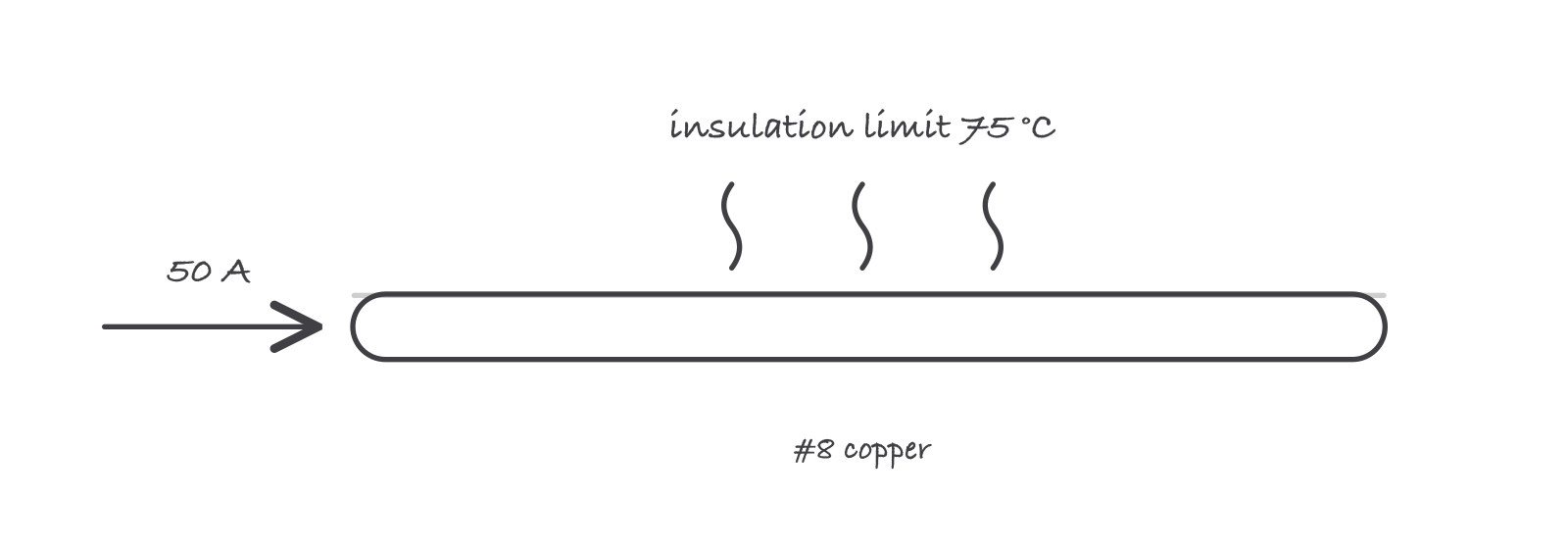
Ampacity is a heat budget: the most current the insulation can live with, forever
Where it bites
- THHN’s 90 °C rating is almost never usable directly. The terminations govern. Pick from the 75 °C column unless you have verified every termination in the circuit is rated 90 °C, which on ordinary gear you will not.
- Ampacity is continuous by definition. There is no “it’s only for a few hours” allowance in the table. Time-limited overloads are handled by the overcurrent device’s trip curve, not by the wire.
- The small-conductor rule trumps the table. #12 at 25 A in the 75 °C column does not mean a 25 A breaker. This is one of the most reliable trick questions in existence.
- Conditions change the number. The table values assume no more than 3 current-carrying conductors and 30 °C (86 °F) ambient. Stray from either and you must derate, which is its own lesson.
Exam relevance
Ampacity lookups are free marks if you respect the two overriding rules. Examiners love #12 and #10 questions precisely because the table value and the permitted breaker differ, and they love THHN questions because the 90 °C column is bait. Read the question for termination ratings, answer from the 75 °C column by default, and apply the small-conductor caps before you commit.
Verified requirements
| Where | Expires | Renewal | Continuing education |
|---|---|---|---|
| Texas | Yes | 1 year | 4 hours per annual renewal cycle |
Information comes from issuing-authority sources. Confirm current rules, fees and eligibility with the authority before acting.