Learn · Electrical
EMT
Part of Journeyman Electrician Exam Prep · step 32 of 73 · next: Rigid Metal Conduit and IMC
In learning paths: Journeyman Electrician Exam Prep
EMT, electrical metallic tubing, is thin-wall steel raceway: light enough to bend by hand in a one-shot bender, too thin to thread, joined instead by set-screw or compression fittings. It is the default raceway of commercial work, and the skill of an electrician is often judged by what their EMT looks like on a wall.
Why it matters on the job
Walk any office, school, or warehouse and the wiring above the ceiling and down the walls is EMT. It is cheap, fast, reworkable, and, made up properly, serves as its own equipment grounding conductor. The two disciplines that make an EMT run pullable and legal, the bend budget and the fitting choice, are also two of the most reliable exam themes in the wiring-methods block.
Fittings, not threads
EMT walls are too thin to cut threads into, so every joint is a fitting:
- Set-screw couplings and connectors: dry locations, the everyday choice.
- Compression fittings: required where listed rain-tight for wet locations, and the usual pick where concrete-tight matters.
The fitting is part of the circuit. Steel EMT with fittings made up wrench-tight is a listed equipment grounding conductor, so a loose set screw is not a cosmetic defect: it is a break in the fault-current path that the grounding subject taught you to protect. Where the run is a ground path, every joint is a splice in that path.
The bend budget: 360° between pull points
Between any two pull points, boxes, conduit bodies, or fittings you can open, the run may contain no more than 360° of total bend: the classic four quarter bends. Every bend counts against the budget, not just the obvious 90s. An offset made of two 30° bends spends 60°. A three-bend saddle over a pipe spends its full figure. Kicks count. The budget exists because pulling friction multiplies through every degree of bend; past 360°, pulls damage insulation or simply stall.
The fix when a run needs more geometry is never to cheat the budget: it is to add a pull point and reset it to zero.
Supports, briefly
The classic pattern, with your code’s table governing: secured within 3 ft of every box or termination and at intervals not over 10 ft. The supports lesson later in this subject assembles the whole family of these numbers side by side.
Worked example
A run leaves a panel, turns up the wall, crosses a beam, and drops to a disconnect. Budget the bends:
- Stub up out of the panel: 90°. Running total 90°.
- Offset to clear the beam, two 30° bends: 60°. Total 150°.
- Quarter bend across to the drop: 90°. Total 240°.
- Offset into the disconnect, two 30° bends: 60°. Total 300°.
- The layout now wants one more 90° to line up on the disconnect hub: that would make 390°. Over budget.
- Solution: replace the third offset with a conduit body, or set a 4-in square box at the top of the drop. Either one is a pull point; the budget restarts at zero on its far side.
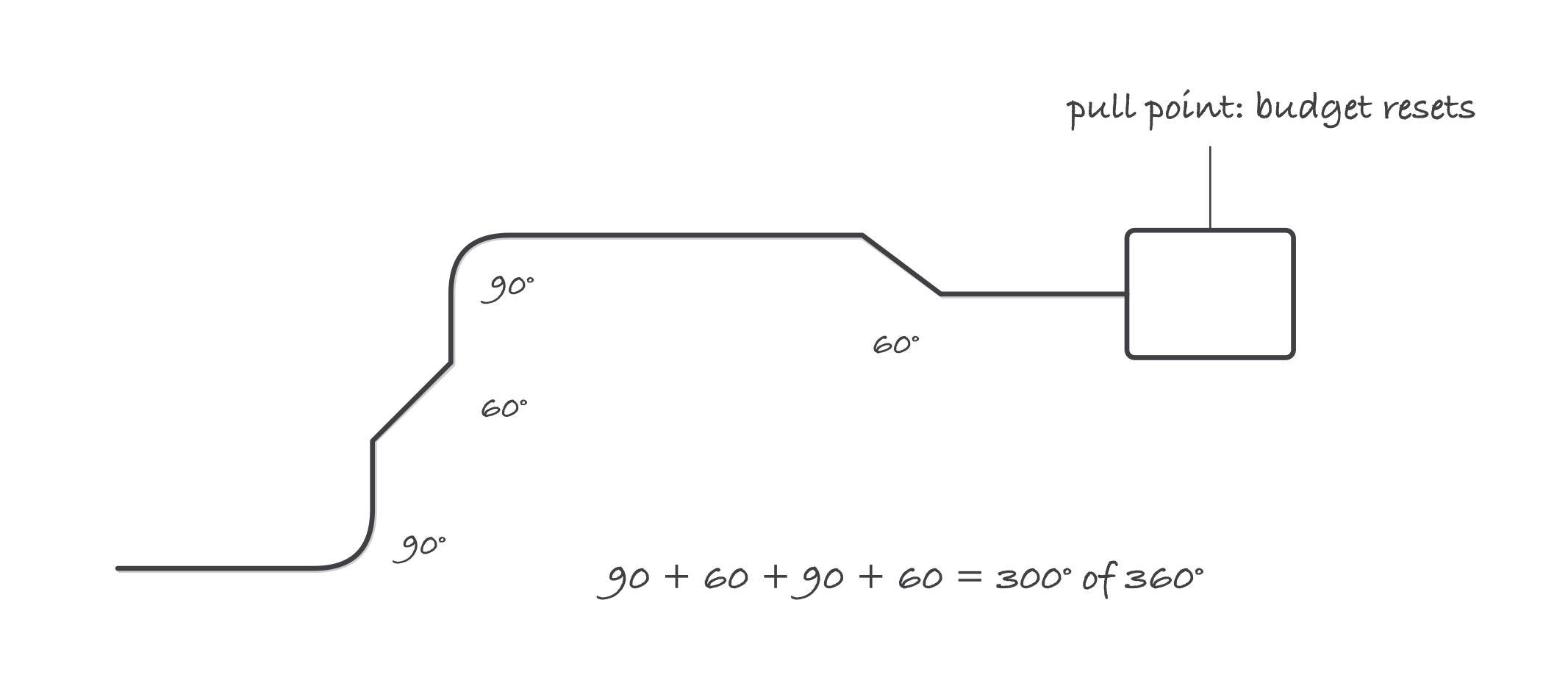
Every degree spends the same budget: 300° used here, so one more 90° needs a pull point first
Where it bites
- Offsets are the silent budget-killers. Crews count 90s and forget that every offset and saddle spends degrees. The exam question lists a stub, two offsets, and a saddle precisely to catch the 90-counters.
- Rain-tight is a listing on the fitting, not a property of compression. Indoor compression fittings and rain-tight compression fittings are different listed parts. Outdoors, the marking decides.
- A loose set screw breaks the ground, not just the joint. When EMT is the EGC, unmade fittings are open splices in the fault path. Torque them like terminations, because that is what they are.
- Deformed tubing ruins the pull. A kinked bend or a dented section grabs conductors at exactly the spot you cannot see. Cut out damage; never pull through it.
- Support numbers drift between methods. EMT’s 3 ft and 10 ft pattern is not NM’s 12 in and 4.5 ft. Keep the families straight; the supports lesson gives the full table.
Verified requirements
| Where | Expires | Renewal | Continuing education |
|---|---|---|---|
| Texas | Yes | 1 year | 4 hours per annual renewal cycle |
Information comes from issuing-authority sources. Confirm current rules, fees and eligibility with the authority before acting.