Learn · Electrical
Receptacles
Part of Journeyman Electrician Exam Prep · step 39 of 73 · next: Switches and Switching Circuits
In learning paths: Journeyman Electrician Exam Prep
Assumes you know: Boxes and Enclosures
A receptacle’s terminals are color-coded to the circuit: brass screws take the hot, silver screws take the neutral, and the green screw takes the equipment ground. Everything else about receptacle work, polarity, ratings, wiring technique, builds on landing those three conductors on the right metal.
Why it matters on the job
Receptacles are the most-installed device in the trade, and the mistakes are invisible: a receptacle wired backwards powers a lamp perfectly. The failure appears later, as a shell that bites, a downstream outlet that dies, or a backstabbed connection that arcs behind a bed. Exam writers test terminal identification, the 15 A versus 20 A pairing rules, and the listing categories, TR and WR, that modern codes require by location.
Polarity is a safety feature
The hot and neutral are not interchangeable, even though a light works either way. Appliance switches and lamp sockets are built assuming the hot arrives on the narrow blade: the switch breaks the hot, and the lamp’s center tab, the hard-to-touch part, is the hot side, while the threaded shell, the easy-to-touch part, stays at neutral. Reverse the polarity and every downstream product has its protection inverted: switched-off appliances remain live inside, and lamp shells go hot. Brass to hot, silver to white, is that entire safety scheme.
The slots encode it: the narrow slot is hot, the wide slot is neutral, the round hole is ground. A 20 A receptacle adds the sideways T to the neutral slot.
Ratings, and the pairing rule
The code-typical pattern for matching receptacles to branch circuits: a 15 A circuit takes 15 A receptacles; a 20 A circuit may take either 20 A receptacles or, where there are two or more receptacles on the circuit, 15 A receptacles. The ordinary duplex counts as two receptacles, which is why houses full of 20 A small-appliance circuits legally wear 15 A duplexes. What never works is the reverse: a 20 A receptacle on a 15 A circuit invites a 20 A plug onto a 15 A wire.
Two listing letters carry location rules: TR, tamper-resistant, with internal shutters, required in the dwelling locations your code lists, which is most of them; WR, weather-resistant, required outdoors and in damp locations, under an in-use cover where the location demands it.
Terminations: three ways, two good ones
- Side-wire screws: conductor hooked clockwise around the screw, so tightening closes the loop. Solid and universal.
- Back-wire clamp (screw-and-clamp): the conductor enters a plate clamped by the side screw. Equally sound, faster, and the standard on spec-grade devices.
- Backstab (push-in spring): a spring edge gripping the wire, 14 AWG only on most listings. Legal, and the trade’s most common source of arcing failures years later. Treat backstabs as a thing you can identify and replace, not a thing you install.
Where the circuit continues downstream, splice through with pigtails to the device rather than feeding through the device’s terminals: then a failed or removed receptacle does not open every outlet after it.
Worked example
Wire a duplex mid-circuit on a 20 A small-appliance run of 12/2:
- Two cables in the box: feed and onward. Splice hots together with a pigtail, neutrals together with a pigtail, grounds together with a pigtail.
- Pigtails land: black to a brass screw, white to a silver screw, bare to the green screw, hooks clockwise, screws torqued snug.
- Device: 15 A TR duplex, legal on the 20 A circuit because the duplex is two receptacles, TR because it is a dwelling location.
- Test after energizing: hot on the narrow slot, neutral on the wide, ground reads to the round.
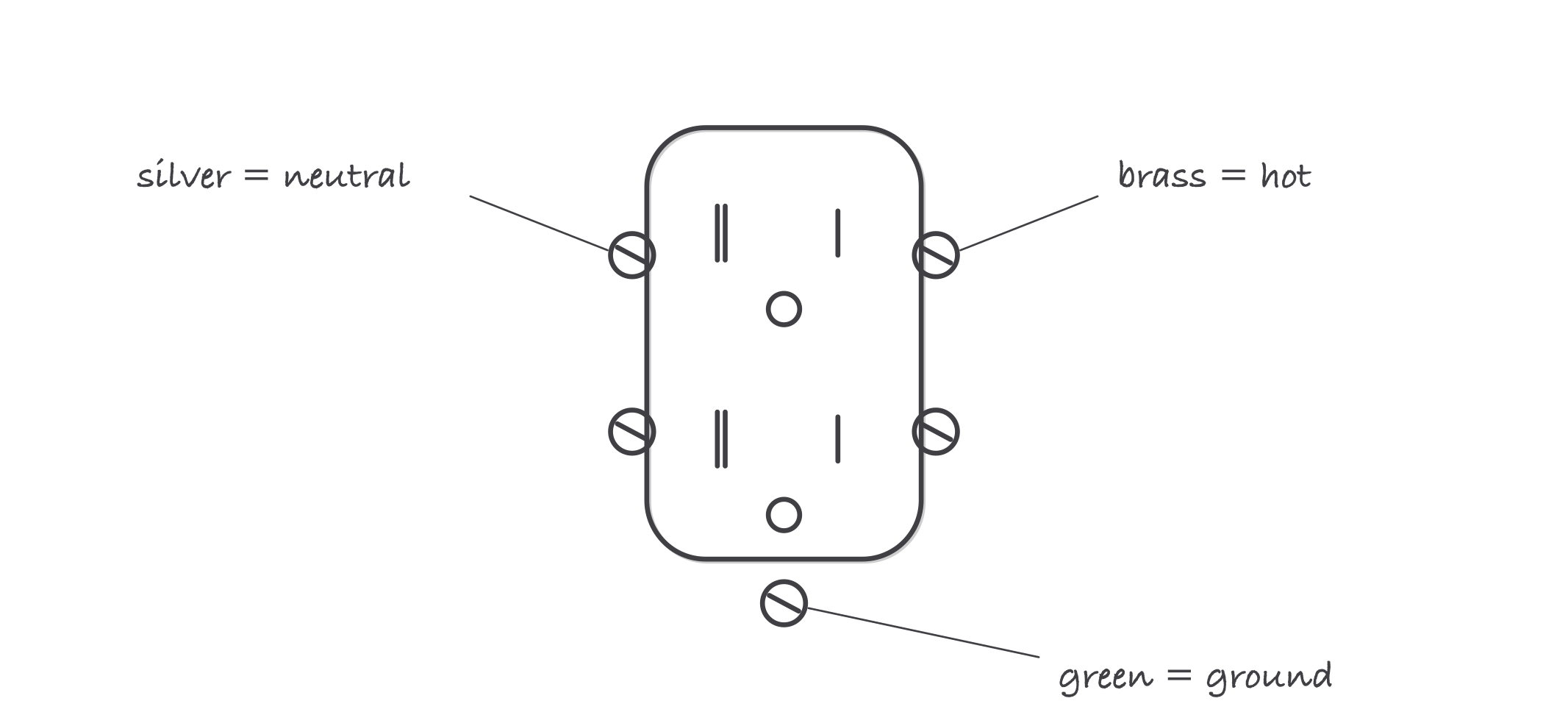
The whole polarity system in three screws: hot on brass, neutral on silver, ground on green, and the slot widths repeat the story on the face
Where it bites
- Reversed polarity passes the “it works” test. Only a tester or an inspection catches it, and the danger lands on whoever touches a lamp shell later. Verify polarity as a habit, not a suspicion.
- Backstabbed springs loosen with heat cycles. The mysterious dead-outlets-half-the-room call is usually one failed backstab feeding everything downstream. Pigtails plus screw terminals end the genre.
- 20 A receptacle, 15 A circuit. The pairing table only bends one direction. The T-slot is a promise about the wire behind it.
- Feed-through as a splice. Using device terminals to continue the circuit makes every receptacle a series link in the run.
- Missing WR outdoors. The weather rating is on the device, not the cover; both the WR letters and the right cover are required.
Verified requirements
| Where | Expires | Renewal | Continuing education |
|---|---|---|---|
| Texas | Yes | 1 year | 4 hours per annual renewal cycle |
Information comes from issuing-authority sources. Confirm current rules, fees and eligibility with the authority before acting.