Learn · Electrical
Raceway Supports and Securing
Part of Journeyman Electrician Exam Prep · step 36 of 73 · next: Pull and Junction Box Sizing
In learning paths: Journeyman Electrician Exam Prep
Assumes you know: EMT
Every raceway and cable method carries the same two-number support rule: a maximum distance from each box or termination, and a maximum interval along the run. The numbers change by method; the grammar never does. Learn the grammar and the family of numbers, and let your code’s tables state the exact values you certify to.
Why it matters on the job
Support violations are the easiest thing on a job for an inspector to find, because they are visible from the floor with a tape measure. They are also a favorite exam format: four methods, four interval choices, pick the row that matches. And mechanically the rules matter: an unsupported raceway works its fittings loose, and on metal raceways the fitting is the ground path, so a sagging run is slowly disconnecting its own fault protection.
The two-number grammar
Every rule has the same shape: secure near every termination (so the box connection never carries the run’s weight or movement) and support at intervals (so the span never sags). The code-typical family, the pattern published tables follow:
| Method | Near each box | Max interval |
|---|---|---|
| NM cable | 12 in | 4.5 ft |
| AC cable | 12 in | 4.5 ft |
| MC cable | 12 in | 6 ft |
| FMC / LFMC | 12 in | 4.5 ft |
| EMT | 3 ft | 10 ft |
| RMC / IMC | 3 ft | 10 ft |
| PVC | 3 ft | 3 ft for small sizes, longer as size grows |
Two patterns worth noticing. Cables secure within 12 in; rigid raceways secure within 3 ft, because a tube is stiff enough to bridge to its first strap. And PVC breaks the raceway pattern: it is floppy and it creeps with temperature, so its intervals start at 3 ft for the small trade sizes and lengthen with diameter, per its own table. Threaded conduit runs get a further allowance: larger vertical risers with threaded couplings may go longer between supports, which is how switchboard risers stay legal.
The hardware
- One-hole straps for a single tube on a wall, two-hole straps where the spec wants two fasteners.
- Conduit hangers (minerallac style) to drop a single run off structure.
- Trapeze: strut hung on two threaded rods, carrying many runs on strut straps. The strut is supported; each raceway is secured to the strut.
- Cables in accessible attics and basements ride bored holes through framing, which count as support, or staples per their own rules.
Independent support is the quiet requirement: raceways are supported from structure, not from ceiling grid wires, other pipes, or each other, except where a listed grid-support method is specifically permitted.
Worked example
A 40 ft EMT run crosses a ceiling between a panel and a junction box, no bends. Place the straps:
- End rule: one strap within 3 ft of each box. Set them at 3 ft from each end.
- Between those straps lies 40 − 6 = 34 ft. Maximum interval 10 ft: 34 ÷ 10 = 3.4, round up to 4 spans, so 3 intermediate straps.
- Total: 2 + 3 = 5 straps, spacing 34 ÷ 4 = 8.5 ft. Under 10 ft everywhere: legal, and evenly walked off.
- Same run in 3/4-in PVC at a 3 ft interval: 40 ÷ 3 = 13.3, round up to 14 spans: 13 intermediate plus the ends. PVC’s floppiness is priced in straps.
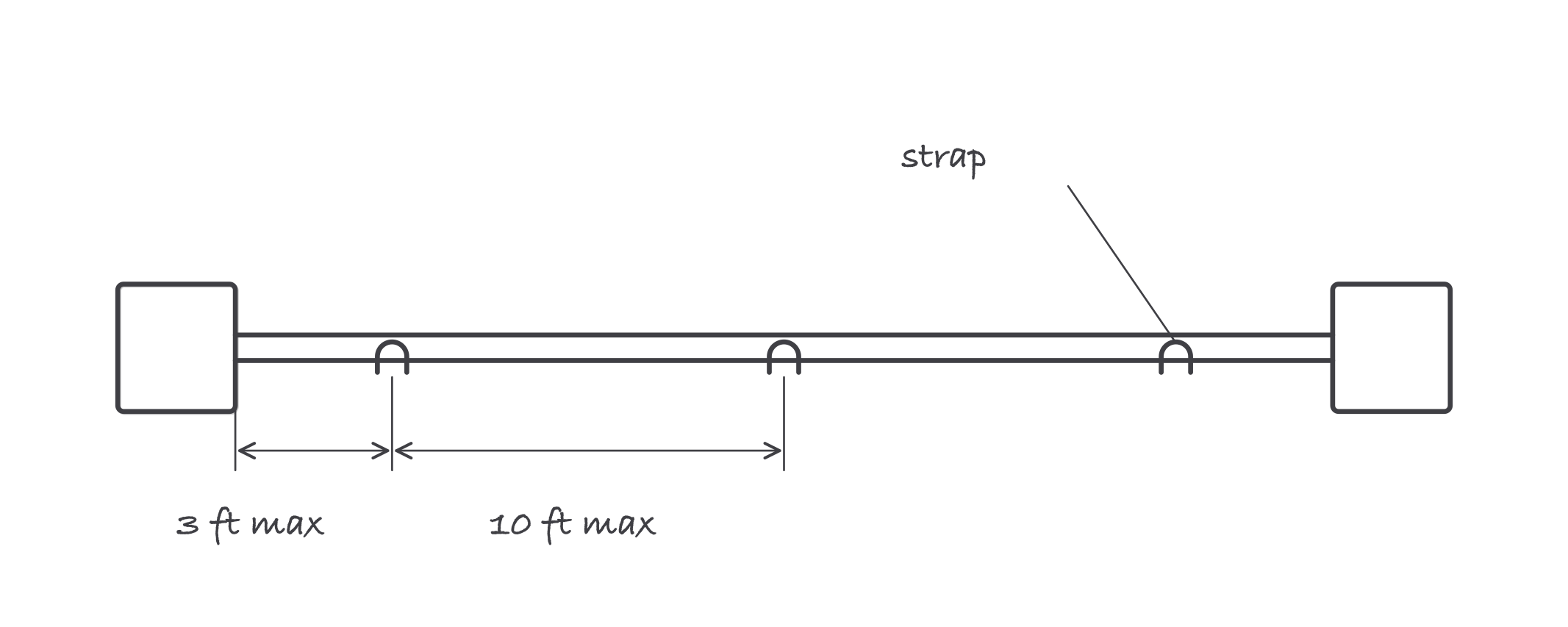
The two-number grammar drawn once: a strap close to every box, then a ceiling on the span, here EMT’s 3 ft and 10 ft pattern
Where it bites
- Cross-method contamination. NM’s 4.5 ft applied to MC, EMT’s 10 ft applied to PVC: the grammar transfers, the numbers do not. Exams build entire questions out of swapped rows.
- The forgotten first strap. Runs strapped beautifully at intervals but starting 6 ft from the box fail the near-termination half of the rule, and that half exists to protect the fitting.
- Ceiling-wire hitchhiking. Tie-wiring conduit to grid hanger wires is the classic shortcut; support must be independent of the grid except with listed methods installed for the purpose.
- PVC supported like steel. A PVC run strapped every 10 ft passes the eye test in April and hangs in festoons by August. Its short intervals are a thermal-movement rule wearing a support rule’s clothes.
- Vertical runs. Risers need support too, and cable in vertical raceways has its own rules; do not assume gravity only acts horizontally on the table.
Verified requirements
| Where | Expires | Renewal | Continuing education |
|---|---|---|---|
| Texas | Yes | 1 year | 4 hours per annual renewal cycle |
Information comes from issuing-authority sources. Confirm current rules, fees and eligibility with the authority before acting.