Learn · Electrical
Bonding at Service Equipment
Part of Journeyman Electrician Exam Prep · step 17 of 73 · next: Separately Derived Systems
In learning paths: Journeyman Electrician Exam Prep
Assumes you know: Main Bonding Jumper
Bonding at service equipment follows stricter rules than bonding anywhere else in the building, because a fault at the service has no breaker ahead of it worth mentioning. Metal raceways, meter enclosures, and service equipment on the line side of the main disconnect must be bonded with methods the code specifically lists, and the everyday shortcuts, a standard locknut, a plain bushing, are explicitly not enough here.
Why it matters on the job
Downstream of the main breaker, a fault is limited by a 15, 20, or 100 A device. On the line side of that breaker, the only protection is the utility’s primary fuse, which may tolerate thousands of amps of secondary fault current for seconds. A service raceway fault can dump the transformer’s full available fault current, often 10,000 A or more, through whatever bonding you provided, for far longer than any branch-circuit fault would last. The code’s answer is a short list of methods that stay tight and conductive under exactly that abuse, and inspectors check service bonding harder than almost anything else on the job.
What the service rules require
Listed methods only. At service equipment, bonding is done with bonded (grounded) threaded hubs, threadless fittings made up tight on rigid or IMC, bonding-type locknuts, bonding bushings with jumpers, or other listed means. A standard locknut biting paint through a knockout is fine on a branch-circuit panel; at the service it is named as insufficient.
Concentric and eccentric knockouts are the enemy. Those punched rings in enclosure walls leave thin webs of steel between raceway and cabinet. On a 20 A circuit, adequate. At service fault levels, they can arc and blow clear. Where a service raceway lands in a ring knockout, you install a bonding bushing and jumper around the rings, sized like a supply-side bonding jumper from the service conductors.
The neutral does double duty ahead of the main. On the line side, the grounded conductor itself is permitted as the bonding means, which is why a meter can’s neutral lug bonds the can: fault current from the meter enclosure rides the bonded neutral straight back to the transformer. It is the one region of the installation where neutral and enclosure are deliberately married.
Supply-side bonding jumpers are sized from the service-entrance conductors, on the same table as the GEC and main bonding jumper, because the current they may carry comes from the same unlimited place.
Worked example
A 200 A service: metal riser to a meter can, then a nipple through concentric knockouts into the service disconnect. Bond it:
- Riser to meter can: threaded hub, listed and bonded. Done by construction.
- Meter can itself: bonded through the grounded neutral terminating on its lug.
- The nipple lands in concentric knockouts at both ends: bonding bushing and jumper at each end, wrapped around the rings.
- Jumper size comes from the service conductors: 2/0 copper service entrance conductors call for 4 AWG copper jumpers, the same table row as the GEC. A fault here could see the full 10,000 A available; 4 AWG copper survives that long enough for the utility’s protection to act, a 12 AWG “ground wire” would not.
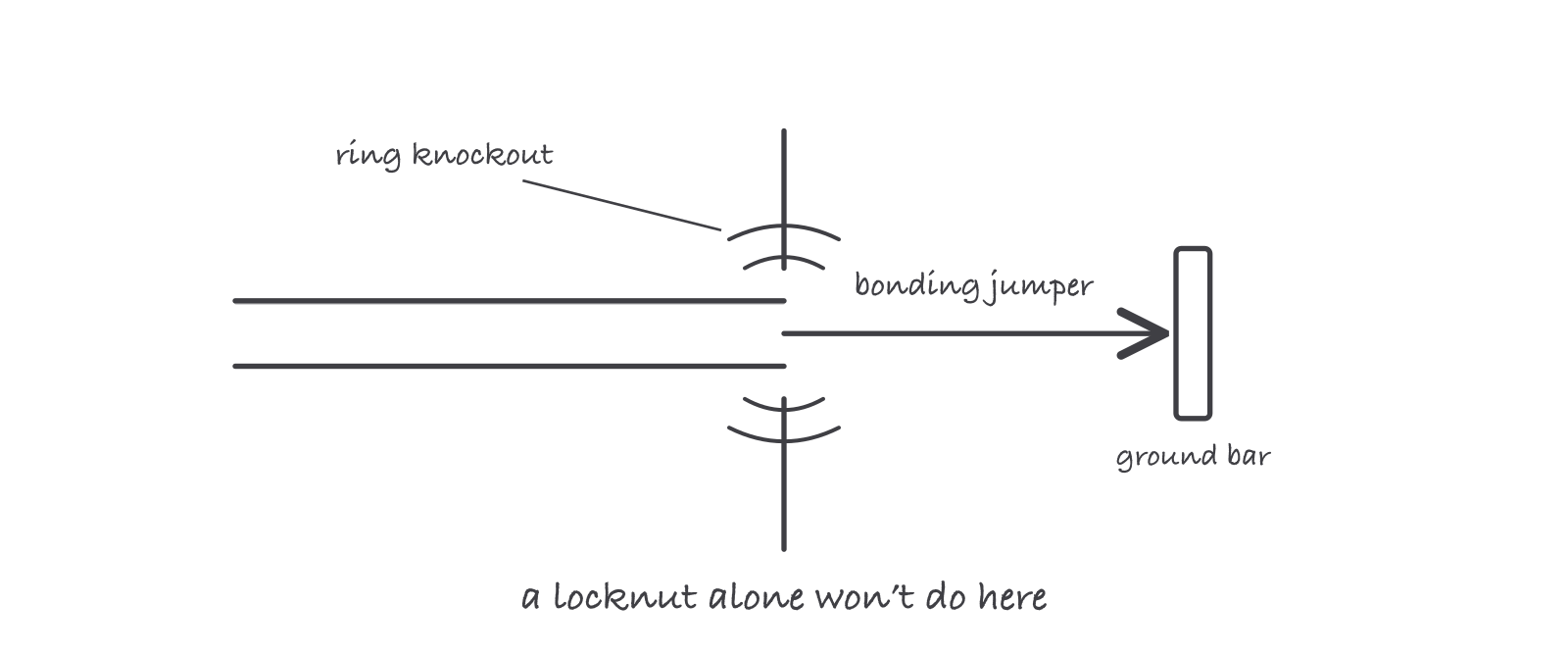
Ahead of the main breaker the fault current is the transformer’s to give, so ring knockouts get jumpered with a bonding bushing, not trusted to a locknut
Where it bites
- “It’s metal to metal, it’s bonded” fails inspection at the service even when it would pass anywhere else. The line side has its own list of methods; learn it as a separate rule set.
- Ring knockouts hide in plain sight. The habit of glancing past knockouts is exactly how unjumpered concentric rings end up carrying service fault duty.
- Neutral-as-bond is line-side only. The same meter-can logic applied downstream, bonding a subpanel can through its neutral, creates the parallel-path violation from the main bonding jumper lesson. The boundary is the service disconnect.
- Supply-side jumpers sized like EGCs is the sizing error to watch for: these jumpers key on service conductors, not on any overcurrent device, because no overcurrent device protects them.
Exam relevance
Service bonding is a dependable exam cluster: which methods are permitted at services, why standard locknuts and ring knockouts are called out, and where the grounded conductor may serve as the bonding means. Sizing questions ask for supply-side bonding jumper sizes from service-entrance conductor size, deliberately mixing in EGC-table distractors. Master exams add available-fault-current reasoning: explaining why line-side rules are stricter than load-side rules at all.
Verified requirements
| Where | Expires | Renewal | Continuing education |
|---|---|---|---|
| Texas | Yes | 1 year | 4 hours per annual renewal cycle |
Information comes from issuing-authority sources. Confirm current rules, fees and eligibility with the authority before acting.