Learn · Electrical
System Grounding
Part of Journeyman Electrician Exam Prep · step 12 of 73 · next: Equipment Grounding Conductors
In learning paths: Journeyman Electrician Exam Prep
Assumes you know: The Effective Fault-Current Path
System grounding is the intentional connection of one current-carrying conductor of an electrical system, almost always the neutral, to the earth. It answers a question most electricians never think to ask: what holds your system’s voltage steady relative to the ground you are standing on? Equipment grounding protects the metal you can touch; system grounding disciplines the system itself.
Why it matters on the job
You inherit a grounded system on nearly every job, so it is easy to treat it as wallpaper. But the choice of which conductor is grounded, and where, decides which wire is the neutral, why the neutral is white, why a fault to metal produces a predictable 120 V drive, and why the main bonding jumper has a job at all. When you move up to transformers and generators, you become the person who creates a grounded system, and getting it wrong builds installations that either cannot clear faults or carry current on paths that were never meant to see it.
What grounding the system does
Take a standard 120/240 V single-phase transformer secondary. The winding gives you two hots and a center tap. Until something is grounded, that is just a 240 V winding floating in space: its voltage to earth is undefined, set by stray capacitance, and free to drift to hundreds of volts above ground if a primary fault or surge leans on it.
Ground the center tap and everything snaps into place. The center tap becomes the neutral, held at earth potential. Each hot is now a fixed 120 V to earth, and the worst case anywhere on the system is 240 V. Insulation stress is capped and known. Lightning and line surges have a reference and a drain. And a fault from a hot to anything at earth potential now has a defined voltage behind it, which is what makes fault current predictable and clearable.
The grounded conductor is still a normal current-carrying conductor. Grounding it does not make it safe to handle; it makes the rest of the system predictable.
Worked example
Compare the same fault on a floating system and a grounded one.
- Floating 240 V system. A hot touches a bonded metal enclosure. No conductor is grounded, so no circuit exists between the hot and earth. Fault current is essentially zero, nothing trips, and the system keeps running with one conductor now earthed by accident. The first fault is silent. The second fault, on the other conductor, is a dead short across 240 V through the building’s metal.
- Grounded 120/240 V system. The same hot-to-enclosure fault immediately has a 120 V drive across the bonded path back to the grounded center tap. With 0.1 Ω of path impedance, current is 120 ÷ 0.1 = 1,200 A, and the breaker clears it at once.
Grounding the system is what puts a firm voltage behind every fault so the fault-clearing path has something to work with.
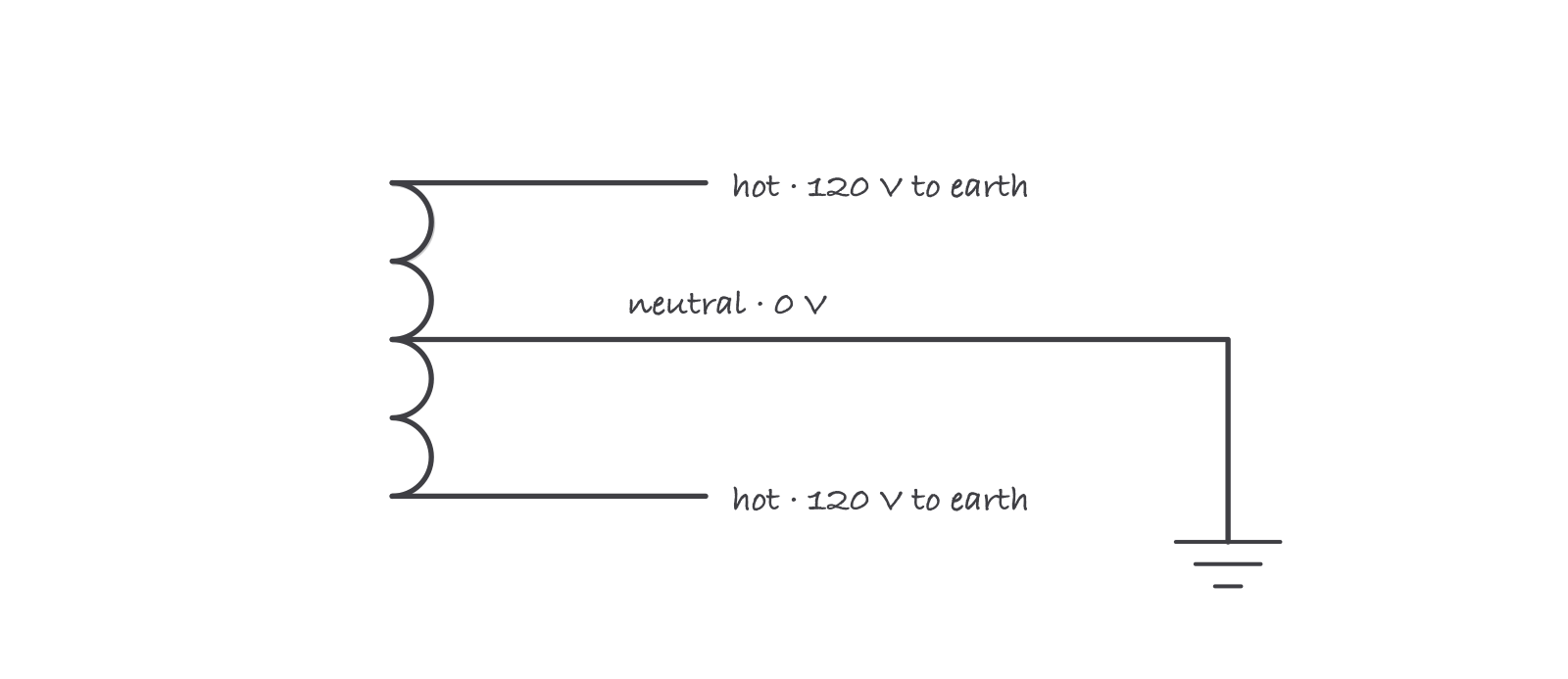
Ground the center tap and the whole system takes a fixed posture: neutral at earth potential, each hot a known 120 V from everything around it
Where it bites
- Grounding the system and grounding equipment are separate acts. A perfectly grounded neutral does nothing for a metal enclosure that has no bonded path. You need both, joined at exactly one point.
- The neutral is grounded, not harmless. It carries load current all day at earth potential. Break it under load and the open end can rise to full line voltage through the connected loads.
- Ungrounded systems are legal in specific industrial settings precisely because the first fault does not trip anything, which keeps critical processes running. They demand ground detectors and disciplined maintenance; do not import their habits into ordinary work.
- Regrounding the neutral downstream of the service creates parallel paths that put load current on metal. System grounding happens at the source and service, once.
Exam relevance
Exams test the stated NEC purposes of system grounding, stabilizing voltage to earth during normal operation and limiting voltage rise from lightning, line surges, and accidental contact with higher-voltage lines, and they test which conductor gets grounded on common systems: the center tap of a 120/240 V single-phase secondary, the neutral of a wye. Master-level items add ungrounded and high-impedance grounded systems and ask what happens on the first fault versus the second.
Verified requirements
| Where | Expires | Renewal | Continuing education |
|---|---|---|---|
| Texas | Yes | 1 year | 4 hours per annual renewal cycle |
Information comes from issuing-authority sources. Confirm current rules, fees and eligibility with the authority before acting.