Learn · Electrical
Meters and Measurement
Part of Electrical Foundations · step 11 of 19 · next: Alternating Current
In learning paths: Electrical Foundations
Assumes you know: Series-Parallel Circuits
A meter is theory made visible: every reading is voltage, current, or resistance measured the way those quantities actually exist in a circuit. Voltage between two points, current through one path, resistance of a dead component. Use the meter the way the quantity works and it tells the truth; use it any other way and it lies, or dies.
Why it matters on the job
The meter is the only honest witness on the job. Your eyes cannot see whether a conductor is live, loaded, or open; the meter can, but only if the measurement matches the quantity. Most destroyed meters, blown fuses, and wrong diagnoses trace to one of three mismatches: ohms on a live circuit, an ammeter across a source, or a clamp around the wrong bundle. Learn the three measurements as three different physical acts and none of those mistakes survive.
The three measurements
Voltage: across, always. Voltage is a difference between two points, so the voltmeter’s two leads go to two points with the circuit live. The meter’s own resistance is very high, so it sips almost no current and disturbs nothing.
Current: through, always. Current exists in a path, so it must be measured in the path: either break the circuit and put the meter in series, or clamp the magnetic field around one conductor. Clamp around a whole cable, hot and neutral together, and the two opposing fields cancel: the meter reads zero with the load running fine.
Resistance: dead and isolated, always. An ohmmeter works by pushing its own small test current through the component and watching the result. It assumes it is the only source present. Never put an ohmmeter on a live circuit: outside voltage makes the reading garbage at best and destroys the meter at worst. Kill the power, verify dead, and disconnect at least one lead of the component so parallel paths cannot fake a low reading.
And the ritual that wraps every dead check: prove the tester on a known live source, test the circuit, prove the tester again. A dead battery must never get to impersonate a dead circuit.
Worked example
A 1,500 W, 120 V space heater stopped heating. Theory predicts what every reading should be before you take it.
- Expected element resistance: R = E² / P = (120 × 120) / 1500 = 14400 / 1500 = 9.6 Ω
- Expected running current: I = P / E = 1500 / 120 = 12.5 A
Unplug the heater, then ohm across its plug with the switch on. A healthy element reads near 9.6 Ω. This one reads OL, an open: the element or its internal thermal cutout has failed, and no current can flow. Had it read 9.6 Ω instead, you would clamp one conductor of the cord with it running and expect 12.5 A, and the fault hunt would move upstream to the receptacle and circuit. Every step is a prediction first, a reading second.
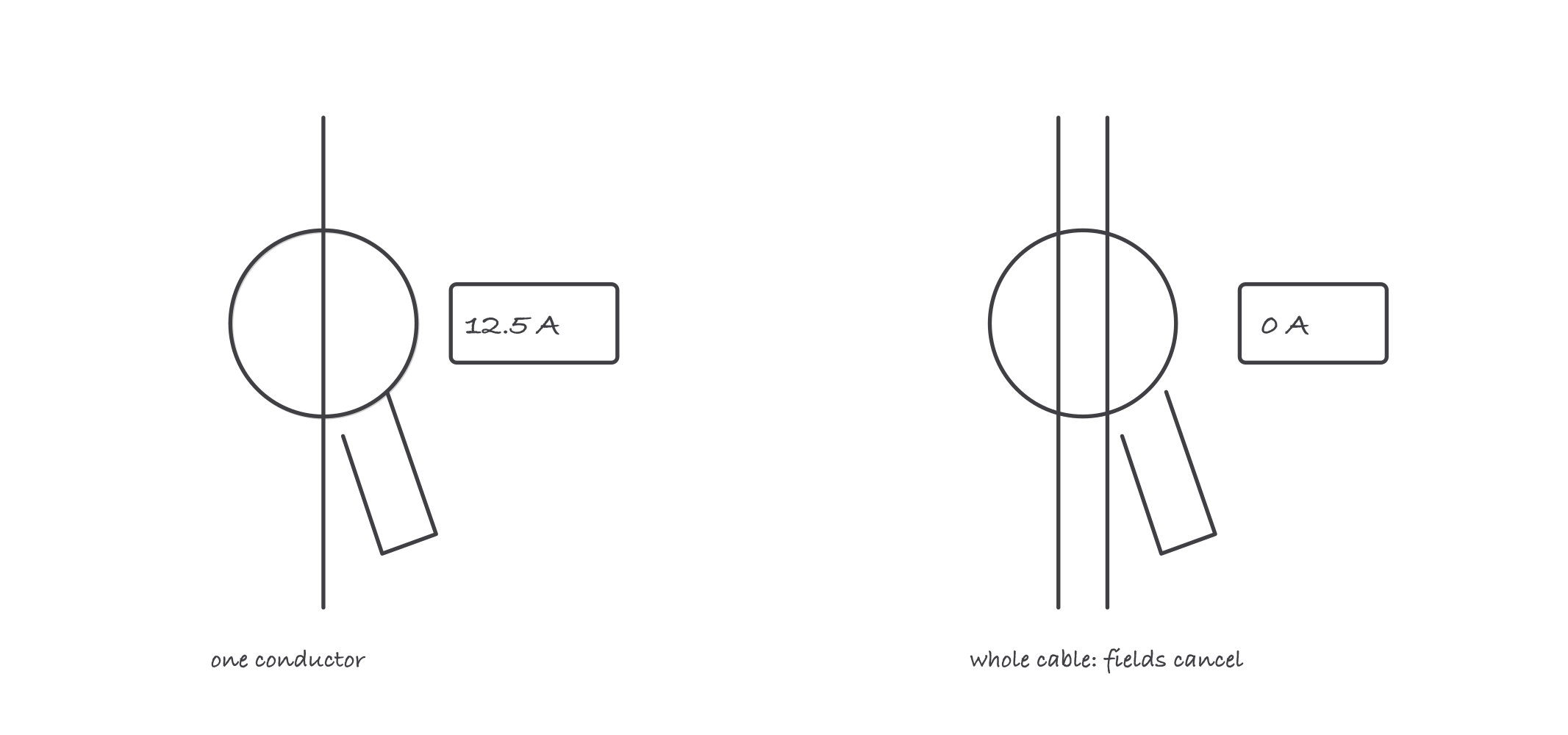
One conductor in the jaw reads the load; the whole cable reads the fields cancelling
Where it bites
- Ohms on a live circuit is the classic meter killer. Resistance is a dead measurement, no exceptions, and “I thought it was off” is how it happens. Verify dead first.
- The clamp around the whole cable reads zero on a running load. One conductor only; that cancellation trick in reverse is also how leakage testing works later in your career.
- Ghost voltage. A high-impedance meter can show tens of volts induced on a disconnected conductor that could not light a lamp. A low-impedance setting or a solenoid tester loads the phantom away.
- An ammeter across a source is a short circuit. In-series ammeters have almost no resistance; connected like a voltmeter they draw everything the source can give. This is what the meter’s fuse is for, once.
Exam relevance
Exams test the connections more than the numbers: voltmeter in parallel, ammeter in series, ohmmeter on de-energized equipment only. Expect a scenario where a described hookup is wrong and you name the consequence. The predictions-first habit from the worked example is also the fastest route through exam troubleshooting questions.