Learn · Electrical
How a Three-Phase Motor Works
Part of Journeyman Electrician Exam Prep · step 57 of 73 · next: Motor Starting Methods
In learning paths: Journeyman Electrician Exam Prep
Assumes you know: How Motors Work
Give a motor all three phases and the rotating field appears on its own: three stator windings, spaced 120 degrees apart around the frame and fed currents that peak 120 degrees apart in time, hand the magnetic peak around the stator in a smooth circle. No start winding, no capacitor, no centrifugal switch. This is why the three-phase induction motor is the workhorse of every plant and commercial building.
Why it matters on the job
Three-phase induction motors drive the pumps, fans, conveyors, and compressors that commercial and industrial work revolves around. They are also the simplest motors you will ever service, precisely because the starting hardware that fails on single-phase machines does not exist here. What you must understand instead is the field, because the field explains starting current, speed, and the famous two-lead reversal.
How the field rotates by itself
Recall from Three-Phase Power that the three phase currents reach their peaks in a fixed sequence, evenly spaced in time. Wind three coil groups evenly spaced around the stator and connect one phase to each. As each phase peaks in turn, the strongest magnetism steps from one coil group to the next, around and around, at synchronous speed, 120 × f / P, exactly as How Motors Work defined it.
The squirrel-cage rotor inside behaves as before: the sweeping field induces bar currents, the bar currents build a rotor field, and the rotor is dragged around at synchronous speed minus slip. Because the three-phase field is strong and truly rotating from the first instant, the motor develops solid torque from a standstill.
Reversing: swap any two leads
The direction of the field follows the phase sequence. Interchange any two of the three line leads and the sequence the stator sees reverses, so the field, and the shaft, rotate the other way. This is routine on installation day, and it is also a hazard: an upstream repair that swaps two conductors reverses every motor downstream, and a pump running backward can look almost normal while moving very little water.
Worked example
A 6-pole, 60 Hz motor: Ns = 120 × 60 / 6 = 1,200 RPM. Nameplate speed is 1,160 RPM, so full-load slip is 1200 − 1160 = 40 RPM, or 40 / 1200 = 3.3%.
Check the family: 2-pole gives 3,600, 4-pole gives 1,800, 6-pole gives 1,200, 8-pole gives 900. When a nameplate reads 1,760 or 3,450 or 1,160, you can name the pole count on sight: it is the standard speed just above, minus slip.
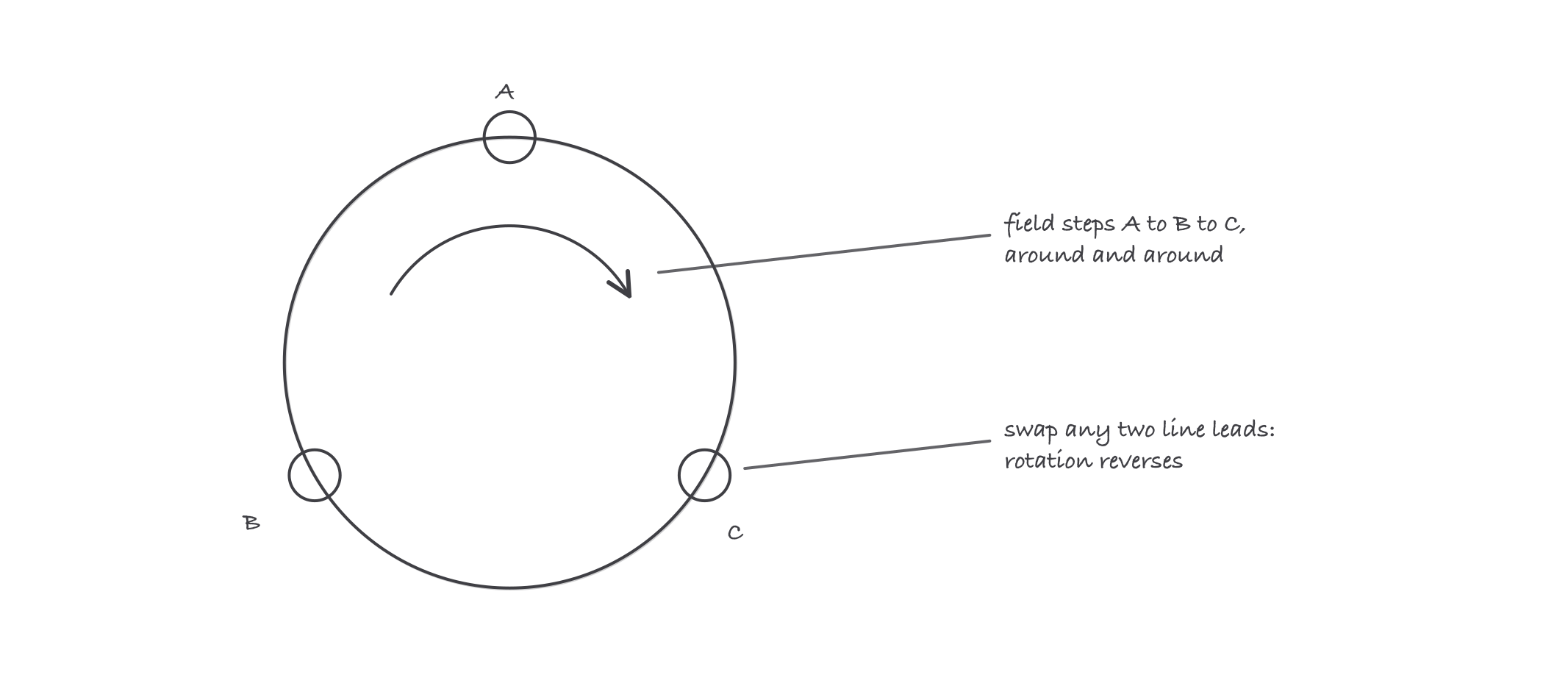
Three phases peaking in sequence walk the field around the stator; reverse the sequence and the walk reverses
Where it bites
- Rotation is never assumed, it is verified. Check rotation before coupling the load, by bumping the motor or using a phase-rotation meter. Backward rotation destroys some driven equipment, screw compressors especially, in seconds.
- A three-phase motor that hums and will not start may be single-phasing. With one line open, a three-phase motor becomes a single-phase motor with no starting scheme: it hums at a standstill and cooks. A running motor that loses a phase keeps limping while overheating. The Motor Protection lesson picks this up.
- Nameplate speed identifies poles, but only for 60 Hz. On a VFD or a 50 Hz supply the arithmetic changes with the frequency, same formula, different input.