Learn · Electrical
How Motors Work
Part of Journeyman Electrician Exam Prep · step 55 of 73 · next: Single-Phase Motors
In learning paths: Journeyman Electrician Exam Prep
Assumes you know: Three-Phase Power
An electric motor turns electrical energy into rotation using two magnetic fields: one that spins, and one that chases it. The spinning field lives in the stationary outer winding, the stator. The chasing field lives in the rotating center piece, the rotor. Everything else in motor work, starting, protection, speed control, is built on this one interaction.
Why it matters on the job
Motors are the biggest loads you will ever wire. They pull huge current at start, run for decades when treated well, and burn up in minutes when mistreated. Reading a nameplate, predicting a speed, or explaining why a motor hums but will not turn all come straight from the fundamentals in this lesson.
Two parts, two fields
The stator is the stationary frame winding. Feed it AC and its magnetic field does not just pulse, it can be made to rotate around the frame, the AC lesson Three-Phase Power showed you the timing that makes this possible.
The rotor in the most common design is a squirrel cage: aluminum or copper bars shorted together at both ends. Nothing connects to it. The rotating stator field sweeps past the bars, induces current in them (this is why the machine is called an induction motor), and that current builds the rotor’s own field. The two fields lock in a magnetic tug, and the rotor is dragged around after the stator field.
Synchronous speed and slip
The stator field rotates at synchronous speed, set only by supply frequency and the number of magnetic poles the winding creates. In words: 120 times the frequency, divided by the number of poles.
Ns = 120 × f / P
The rotor can never quite catch the field. If it did, the bars would stop cutting field lines, induction would stop, and the driving force would vanish. The rotor always runs a little behind; that lag is called slip, and it grows as the mechanical load grows. Nameplate speed is synchronous speed minus slip at rated load.
Worked example
A 60 Hz, 4-pole motor: Ns = 120 × 60 / 4 = 1,800 RPM. Its nameplate reads 1,750 RPM, so slip at full load is 1800 − 1750 = 50 RPM, or 50 / 1800 = 2.8%.
A 2-pole motor on the same 60 Hz supply: Ns = 120 × 60 / 2 = 3,600 RPM. Fewer poles, faster field. Frequency and pole count are the only levers on speed, which is exactly the lever a variable frequency drive pulls later in this subject.
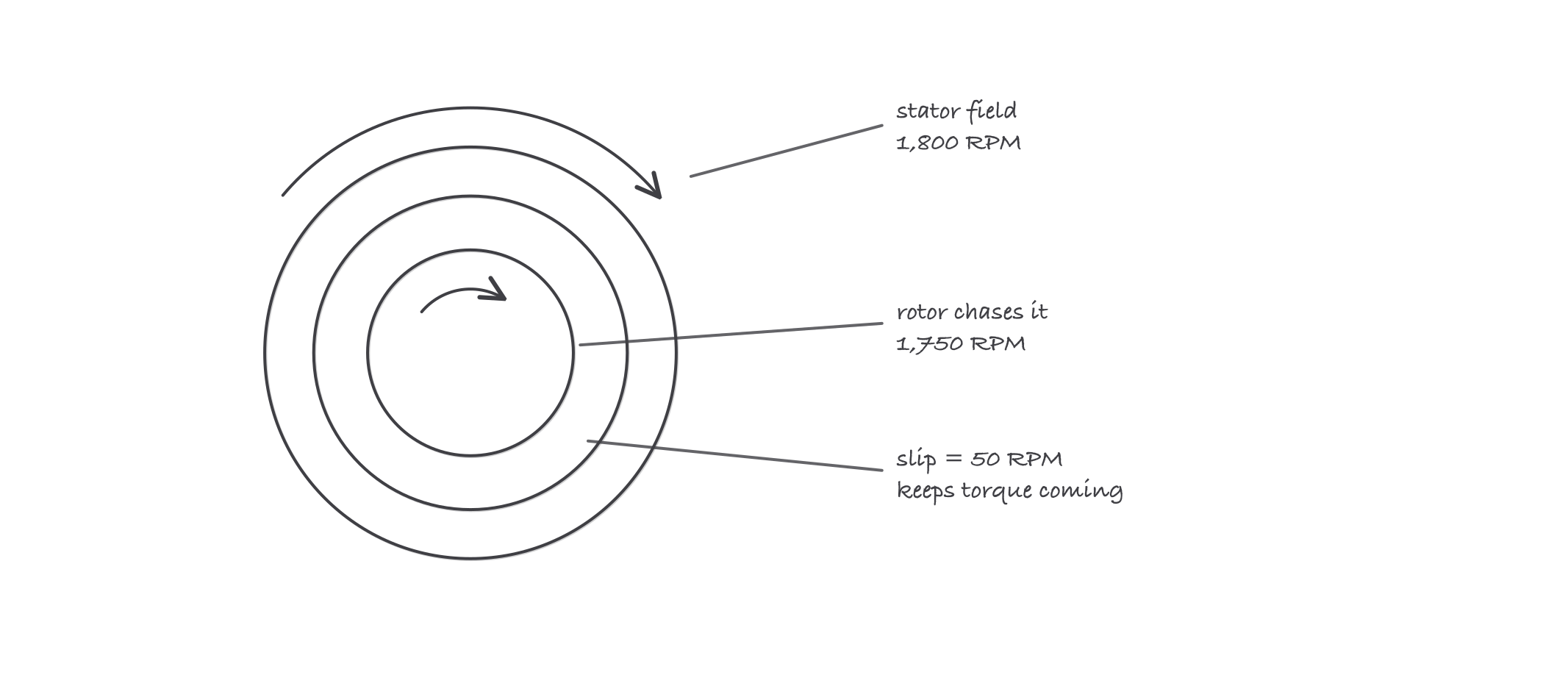
The field turns at 1,800 RPM; the rotor chases it at 1,750, and that 50 RPM of slip is what keeps the torque coming
Where it bites
- Slip is a feature, not a fault. A 4-pole motor reading 1,750 RPM is healthy. Expecting to measure 1,800 on a loaded induction motor sends people hunting for problems that do not exist.
- The rotor has no electrical connection. Techs new to motors look for brushes or rotor wiring on a squirrel-cage machine. Induction does the whole job across the air gap.
- More load does not slow a motor much, it raises current. Speed sags only a few percent from no load to full load; the current can double or more. Watch amps, not RPM, to judge loading.