Learn · Electrical
What Earth Ground Actually Does
Part of Journeyman Electrician Exam Prep · step 9 of 73 · next: The Effective Fault-Current Path
In learning paths: Journeyman Electrician Exam Prep
Assumes you know: Grounding vs Bonding
The earth connection does two real jobs: it holds the electrical system near earth potential, and it gives lightning and utility surges somewhere to go. What it does not do, and cannot do, is clear a ground fault. The dirt is a terrible conductor, and the numbers prove it in one line of arithmetic.
Why it matters on the job
Half the bad grounding decisions in the field come from crediting the electrode with powers it does not have. Electricians drive extra rods to “fix” tripping breakers, isolate equipment on its own rod to get a “clean ground,” or assume a well-grounded machine cannot shock anyone. All three moves come from the same wrong mental model. Knowing what earth ground actually does, and the small size of that job, keeps you from betting a life on 25 ohms of soil.
The two real jobs
Voltage stabilization. Connecting one point of the system to earth pins the whole system to a known reference. On a grounded 120/240 V service, the neutral sits at earth potential, so each hot conductor is a predictable 120 V from the ground you are standing on, from the plumbing, from the building steel. Without that reference, the system floats, and its voltage to earth can wander wherever capacitance and leakage push it.
Surge and lightning dissipation. Lightning and utility switching events shove thousands of volts onto the system for microseconds. The grounding electrode gives that energy a short path into the earth instead of letting it flash through insulation, appliances, and people. For these events, even a mediocre earth connection is far better than none, because the voltages involved are enormous and brief.
Both jobs are about voltage reference and transient energy. Neither job involves carrying fault current long enough or large enough to open a breaker.
Worked example
A hot conductor at 120 V contacts a metal fence post that is grounded through its own rod, with no bonded path back to the panel. Assume a good driven rod at 25 ohms to soil, a widely used benchmark for a single electrode.
- Fault current = 120 V ÷ 25 Ω = 4.8 A.
- The circuit’s 15 A breaker needs at least 15 A, and in practice far more for a fast trip. It sees 4.8 A: less than a hair dryer. It holds indefinitely.
- The post now sits at nearly 120 V to the surrounding soil, energized around the clock.
Anyone bridging post and earth becomes a parallel path. The electrode did its two jobs perfectly and still left the post lethal, because clearing faults was never its job.
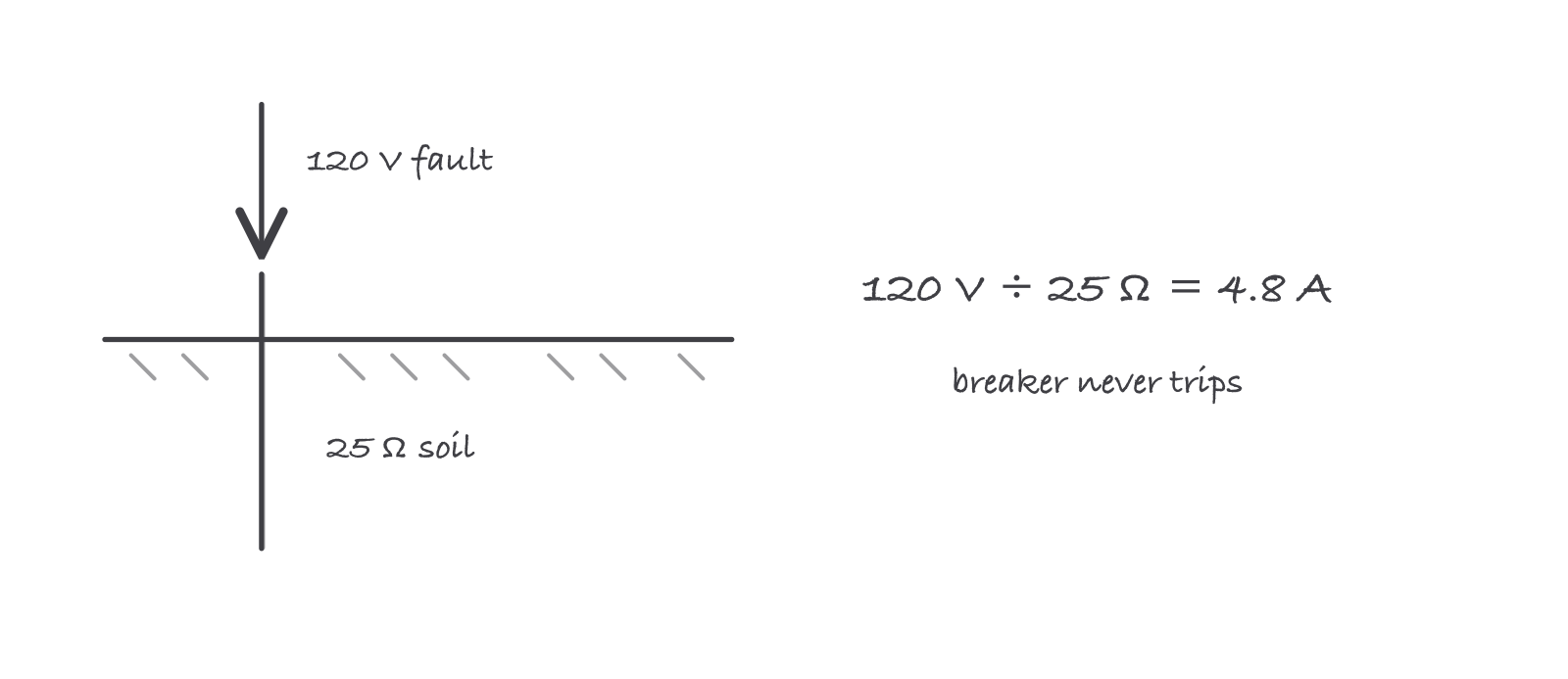
The arithmetic that kills the myth: a good rod at 25 ohms passes 4.8 A from a 120 V fault, and no breaker anywhere trips on 4.8 A
Where it bites
- “Add another rod” does not fix trips or shocks. Two rods in parallel might halve the soil resistance. Halving 25 Ω to 12.5 Ω raises the example’s fault current to 9.6 A. The breaker still never trips.
- An isolated electrode is worse than none when it replaces the bonded path, because it makes equipment look grounded while leaving it unable to clear a fault. Auxiliary electrodes are permitted only alongside the equipment grounding conductor, never instead of it.
- Soil resistance is not a constant. Moisture, temperature, and season swing it widely. A rod that measured well in spring can triple in a dry August. Nothing that varies that much can be a protective system.
- Lightning work still deserves respect. The electrode’s surge job is real, which is why grounding electrode conductors are kept short and straight where practical: surge current hates sharp bends and long runs.
Exam relevance
Journeyman and master exams test whether you can state the purposes of system grounding in NEC terms: stabilizing voltage to earth and limiting surges from lightning and line events. Distractor answers credit the electrode with clearing faults, and the earth-path current calculation in the worked example is a recurring question format. Be ready to compute fault current through a stated electrode resistance and conclude, on paper, that the overcurrent device does not open.
Verified requirements
| Where | Expires | Renewal | Continuing education |
|---|---|---|---|
| Texas | Yes | 1 year | 4 hours per annual renewal cycle |
Information comes from issuing-authority sources. Confirm current rules, fees and eligibility with the authority before acting.