Learn · Electrical
The Grounding Electrode System
Part of Journeyman Electrician Exam Prep · step 14 of 73 · next: Grounding Electrode Conductor Sizing
In learning paths: Journeyman Electrician Exam Prep
Assumes you know: System Grounding
The grounding electrode system is the NEC’s answer to a simple problem: a building does not get to choose one connection to earth, it must use all the ones it has, bonded together into a single system. Every qualifying electrode present at a building, metal water pipe, concrete-encased rebar, ground rods, plates, building steel that qualifies, gets tied together so the structure has one earth reference, not several competing ones.
Why it matters on the job
You will build or extend this system on every service you install. The concept the code enforces is unity: multiple electrodes at different potentials turn a building into a network of voltage differences, exactly what grounding exists to prevent. During a lightning strike or a utility surge, thousands of amps hunt for earth. If the water pipe, the footing steel, and a rod are separate, that current equalizes between them through whatever is in the way: your panels, your piping, sometimes your customers. Bonded into one system, they rise and fall together, and the differences that do the damage never develop.
What counts, and what it must do
The common electrodes, in the order you usually meet them:
Metal underground water pipe. Often the best electrode in the building, thanks to long soil contact. Because plumbing gets repaired with plastic, the code treats it as unreliable on its own: it must be supplemented by another electrode.
Concrete-encased electrode (the Ufer). Rebar or bare copper encased in a footing in contact with earth. Concrete stays moist and presents a large soil contact area, which makes this a consistently excellent electrode. On new construction, coordinating a stub-up before the pour is your job.
Rod and pipe electrodes. The familiar driven rod: cheap, always available, and the weakest performer of the group. The code’s working benchmark is 25 ohms: a single rod that cannot show 25 ohms or less must be supplemented by a second electrode. In practice, almost nobody measures; they drive two rods a rod-length apart and move on, which the code accepts.
Ground ring, plates, structural steel connected to earth fill out the family.
If none of these exist, you must create one, typically rods, a plate, or a ring.
Worked example
A new house has a metal underground water service, footing rebar, and nothing else yet. Build the system:
- The water pipe qualifies and must be used, but cannot stand alone. The Ufer qualifies and serves as its supplement.
- Bond both together to the service: water pipe and Ufer connected into one system, with the connection to the water pipe made within the first few feet of its entry, ahead of meters and unions that could later interrupt it.
- No rods are required at all: the code demands all electrodes present, not any particular one, and pipe plus Ufer already forms a complete, compliant system.
Two electrodes, one system, one potential.
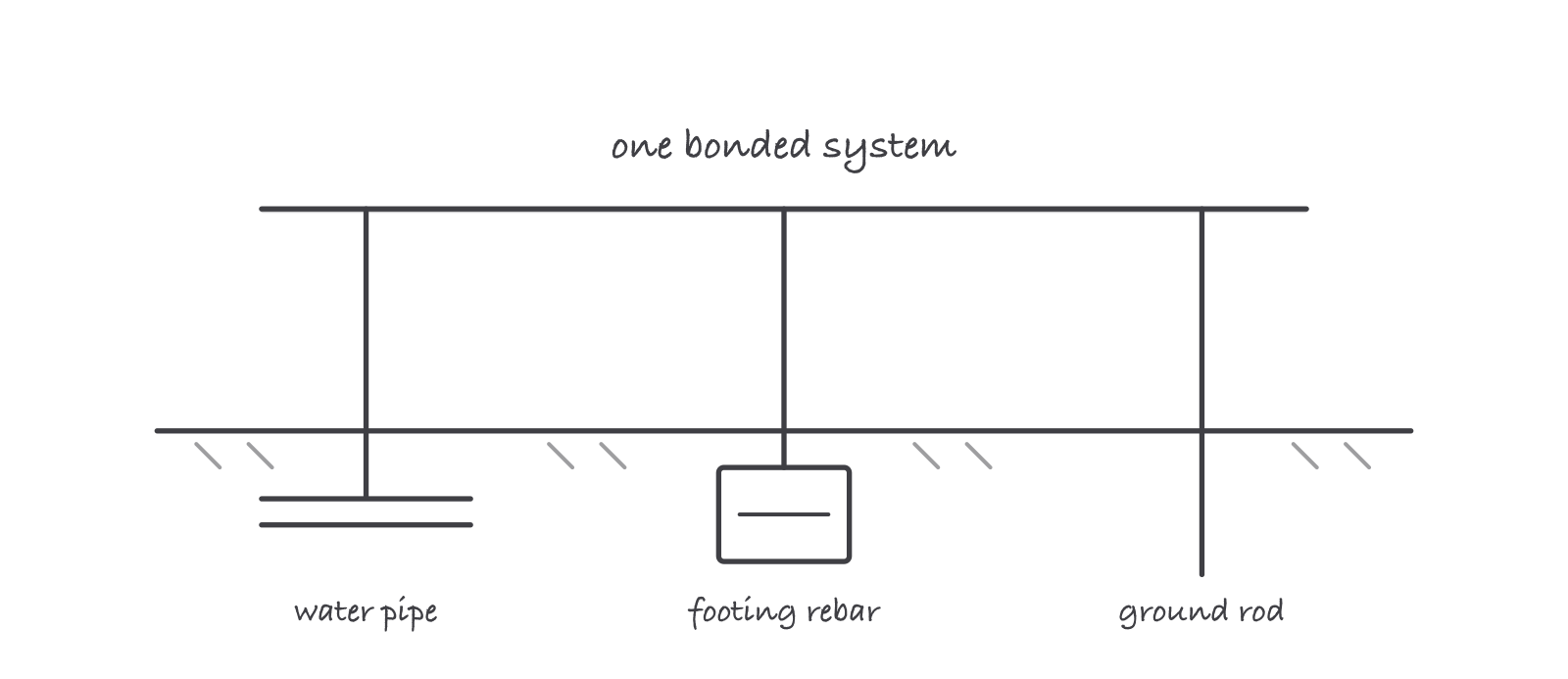
Whatever earth connections the building has, water pipe, footing steel, rod, they are bonded into one electrode system with one potential
Where it bites
- This system does not clear faults. Even a spectacular electrode system is still tens of ohms of soil in series with any fault. Its jobs are surge dissipation and holding one reference potential; the bonded metal path back to the source still does all the fault clearing.
- The water pipe connection point matters. Land it too far downstream and a future water heater swap or plastic repair coupling silently disconnects your best electrode.
- Interior metal piping is bonded, not an electrode. Pipe that leaves the ground stops being an earth connection and becomes just metal likely to be energized: it gets bonded for that reason, on that basis.
- The Ufer only exists if someone remembers before the pour. Retrofitting a concrete-encased electrode means jackhammers. Coordinate with the concrete crew or lose the best electrode on site.
Exam relevance
Electrode identification is a reliable exam section: which items qualify as grounding electrodes, which must be supplemented, and what the 25-ohm benchmark applies to. Scenario questions hand you a building inventory, water pipe, footing steel, well casing, rods, and ask what the grounding electrode system must include. Master exams add the connection rules: where the water pipe connection lands and why interior piping is bonded rather than counted as an electrode.
Verified requirements
| Where | Expires | Renewal | Continuing education |
|---|---|---|---|
| Texas | Yes | 1 year | 4 hours per annual renewal cycle |
Information comes from issuing-authority sources. Confirm current rules, fees and eligibility with the authority before acting.