Learn · Electrical
Impedance
Part of Electrical Foundations · step 16 of 19 · next: Power Factor
In learning paths: Electrical Foundations
Assumes you know: Inductance, Capacitance
Impedance is the total opposition an AC circuit offers: resistance and reactance combined into one number, Z, in ohms. It is the number Ohm’s law actually wants on AC, I = E / Z, and the reason the combination is not a simple sum is the phase shifts from the last two lessons: resistance and reactance push back out of step with each other, so they add like the sides of a right triangle, not like beads on a string.
Why it matters on the job
Every real AC load is a mixture. A motor is winding resistance plus a lot of inductance; a heater is nearly pure resistance; a drive input is resistance plus capacitance. When you ask the practical question, how much current will this draw at this voltage, impedance is the quantity answering. It is also the bridge into power factor: the geometry you learn here is exactly the geometry of watts and volt-amperes in the next lesson.
The concept
Resistance R opposes current and wastes energy as heat, in step with the voltage. Reactance X opposes current but wastes nothing, a quarter cycle out of step. Because their oppositions peak at different moments, they combine at right angles:
Z = √(R² + X²)
Draw it: R along the bottom, X vertical, Z the hypotenuse. The impedance triangle is not a metaphor; the arithmetic really is Pythagorean, and it appears again as the power triangle next lesson.
Two refinements complete the picture:
- Inductive and capacitive reactance oppose each other. One drags current late, the other pulls it early, so in one circuit they partially cancel: X = XL − XC. A circuit can contain large XL and large XC and behave almost purely resistive; tuned to exact cancellation, that is resonance, useful in electronics, occasionally troublesome in power systems.
- Ohm’s law survives intact. I = E / Z, E = I × Z, Z = E / I. Everything from the DC lessons carries over once Z replaces R.
Worked example
A coil has 40 Ω of resistance and 30 Ω of inductive reactance at 60 Hz, on a 120 V supply.
- Z = √(R² + X²) = √(40² + 30²) = √(1600 + 900) = √2500 = 50 Ω
- Current: I = E / Z = 120 / 50 = 2.4 A
Note what the naive sum would have promised: 40 + 30 = 70 Ω and 1.7 A, wrong on both counts. The right-angle addition always yields less than the straight sum and never less than the larger side.
Now add 30 Ω of capacitive reactance in series with the same circuit: X = XL − XC = 30 − 30 = 0, so Z = √(40² + 0²) = 40 Ω and I = 120 / 40 = 3 A. Adding a component raised the current, because it cancelled reactance instead of adding opposition. That result surprises everyone once, on paper, where it is cheap.
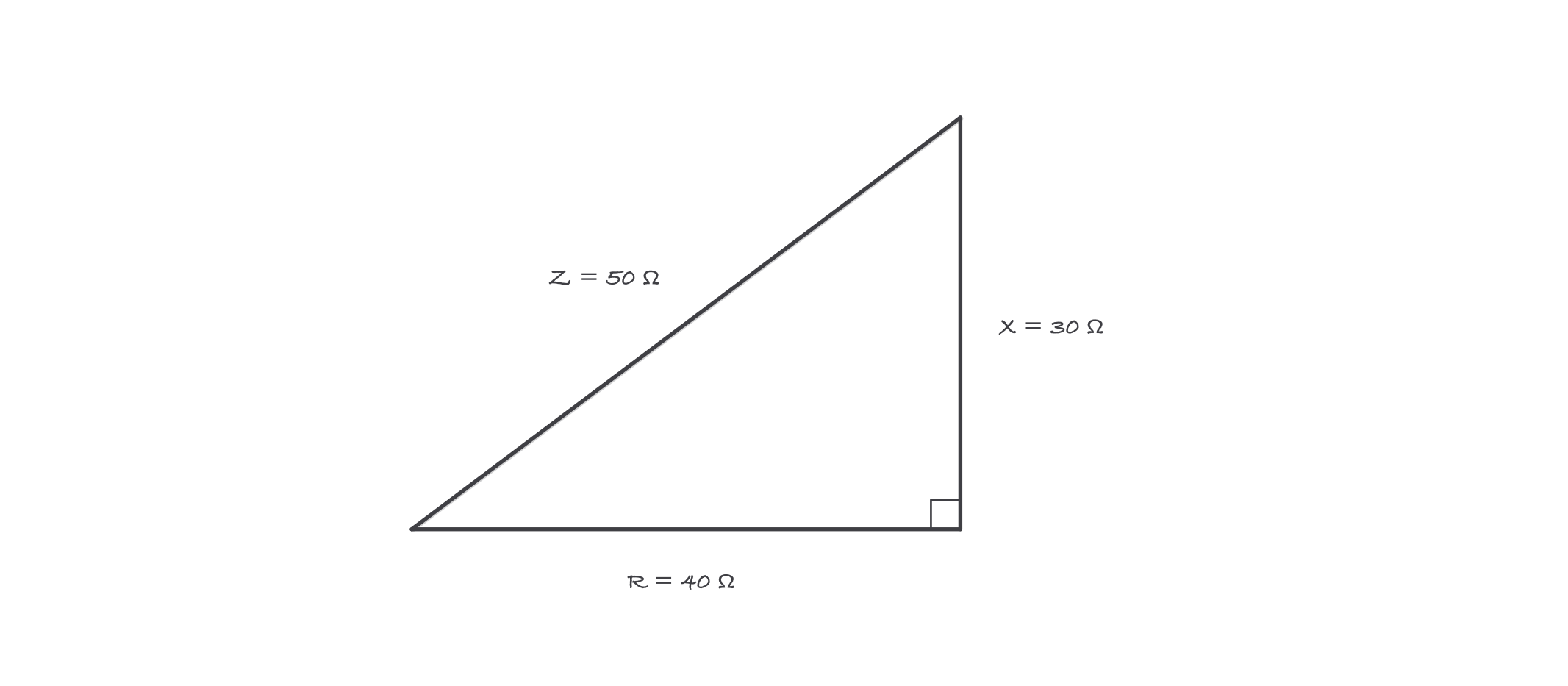
Resistance and reactance add at right angles: 40 and 30 make 50, not 70
Where it bites
- Adding R and X arithmetically is the signature error of this topic. 40 and 30 make 50 here. If your Z came from simple addition, it is wrong.
- The ohmmeter measures R and only R. A dead circuit has no frequency, so no reactance exists to be read. Winding resistance is one leg of the triangle, never the hypotenuse; running current will always be less than the DC reading predicts.
- Impedance moves with frequency. XL climbs and XC falls as frequency rises, so the same hardware presents a different Z at a different frequency. On drive-fed and harmonic-rich systems, the 60 Hz picture is not the whole picture.
- Nearly cancelled reactance is not gone. Large XL and XC in balance still store and exchange real energy, and voltages across the individual parts can exceed the supply. Resonance rewards respect.
Exam relevance
Impedance questions are dependable: given R and X, find Z; given E and Z, find I; both straight from the worked example. The wrong answers on the sheet are always the straight sum and the reversed subtraction of XL and XC. Sketch the triangle in the margin; the geometry checks the arithmetic for free, and the same sketch returns one lesson later as the power triangle.