Learn · Electrical
How Ohm's Law Works
Part of Journeyman Electrician Exam Prep · step 4 of 73 · next: Electrical Power
Part of Electrical Foundations · step 5 of 19 · next: Electrical Power
In learning paths: Journeyman Electrician Exam Prep · Electrical Foundations
Assumes you know: Voltage, Current, Resistance
Ohm’s law is the relationship every electrical calculation stands on: current equals voltage divided by resistance. Three quantities, one equation, and if you know any two you can find the third. Everything from sizing a circuit to diagnosing a dead heater comes back to this.
Why it matters on the job
You will use Ohm’s law before you notice you are using it. Why does a 1,500 W heater pull more current than a lamp? Why does a corroded connection get hot? Why does the breaker hold on one circuit and trip on another? Each answer is Ohm’s law with different numbers in it. It is also the foundation the next topics assume: power calculations, series and parallel circuits, and later, voltage drop.
The relationship
Current is how much charge flows. Voltage is the pressure pushing it. Resistance is how hard the path fights back. Ohm’s law ties them together:
I = E / R
- I, current in amperes
- E, voltage in volts (you will also see V used)
- R, resistance in ohms (Ω)
Rearranged, the same fact answers two other questions:
- E = I × R, the voltage needed to push a current through a resistance
- R = E / I, the resistance of a load, from what you can measure
The classic memory aid is the triangle: E on top, I and R on the bottom. Cover the one you want; what remains is the formula.
Worked example
A 240 V water heater element has a resistance of 12 Ω. How much current does it draw?
- I = E / R
- I = 240 / 12
- I = 20 A
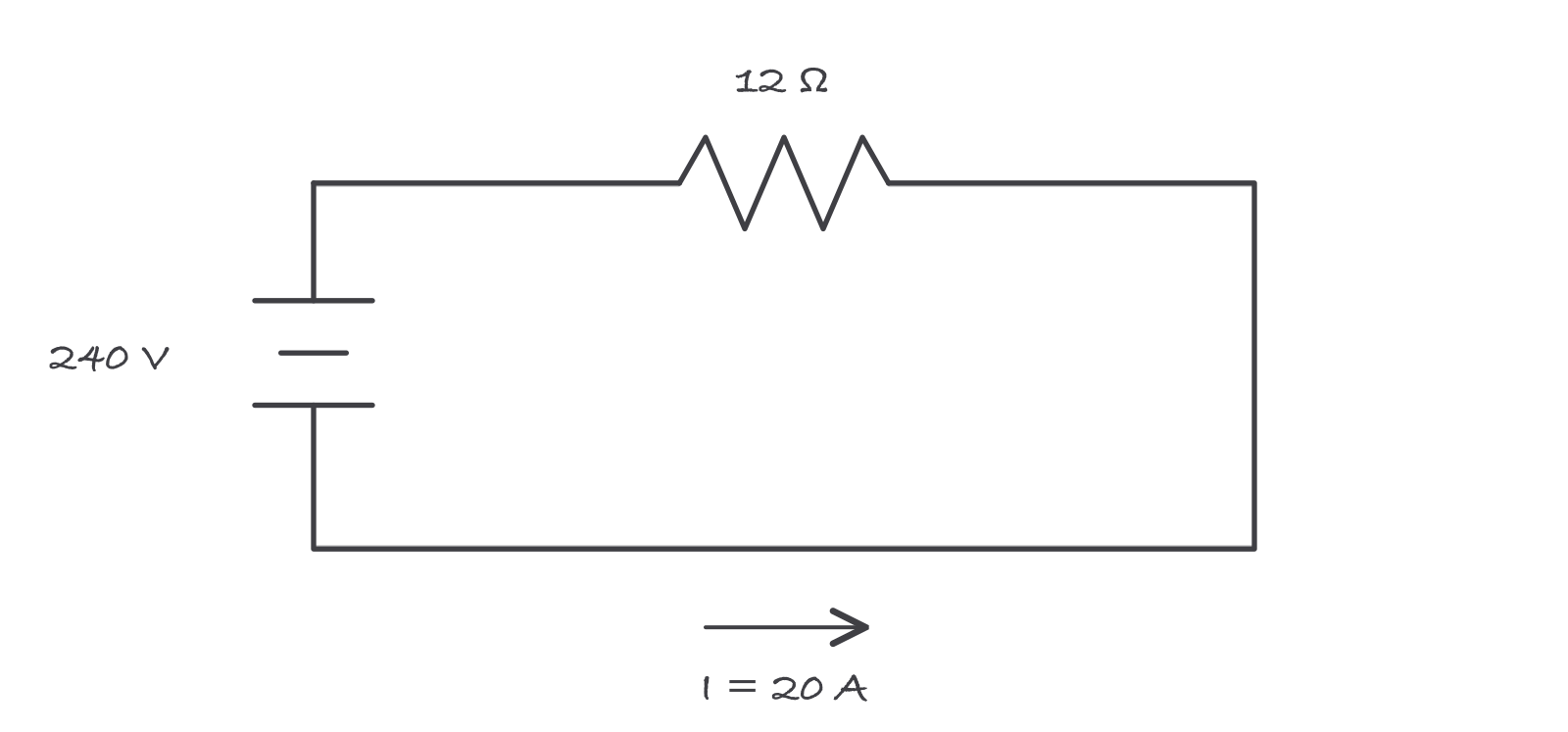
The whole worked example in one sketch: one source, one element, one loop, so the current is the same everywhere in it
Now flip it around the way you would in the field. You measure 8 A on a 120 V circuit feeding a heater. What is the element’s resistance?
- R = E / I
- R = 120 / 8
- R = 15 Ω
If that same element reads 30 Ω on your meter, half of it has likely burned open, and the current will confirm it: 120 / 30 = 4 A, half the expected draw.
Where it bites
- Ohm’s law works on resistance, not on nameplates. A motor’s running current is set by its load and its impedance, not by the winding resistance you measure with the power off. Applying I = E / R to a motor’s DC winding resistance gives a huge, wrong number. Motors come later; for now, apply Ohm’s law to resistive loads: heaters, elements, lamps.
- E is the voltage across the thing, not the supply. In a series circuit, each resistance sees only its share of the source voltage. Using supply voltage across one component of several is the most common Ohm’s law error, and the series circuits topic deals with it head on.
- Cold resistance is not hot resistance. Filaments and elements read low resistance cold; resistance rises with temperature. Your meter reading on a cold lamp will not predict its running current exactly.
Exam relevance
Journeyman and master exams use Ohm’s law constantly, rarely as a standalone question and constantly inside bigger ones: voltage drop, power calculations, motor circuits. If the algebra is not automatic, timed calculation questions become the bottleneck. Drill it until rearranging the triangle takes no thought.