Learn · Electrical
AFCI Protection
Part of Journeyman Electrician Exam Prep · step 43 of 73 · next: Service Entrances
In learning paths: Journeyman Electrician Exam Prep
Assumes you know: GFCI Protection
An AFCI listens to the shape of the current for the electrical signature of an arc: the ragged, chaotic waveform of current jumping a gap. When it hears a sustained arc rather than the brief, orderly arcs of normal life, it opens the circuit. It is a fire protector: the hazard it interrupts is not a person in the circuit but a glowing fault slowly igniting the building.
Why it matters on the job
Arcing faults are how wiring starts fires: the overdriven staple from the NM lesson, the loose backstab from the receptacles lesson, the undertorqued termination from the last lesson. Each one arcs at currents far too small to trip a breaker, for months, inside walls. The AFCI is the device built for exactly that failure family, and distinguishing it from the GFCI is a required piece of understanding: the two devices monitor the same wire for different hazards, and one never substitutes for the other.
Two arcs, one listener
Series arcs happen in line with the load: a broken strand, a loose screw, a corroded splice. Current across the gap is limited by the load itself, maybe 5 A through a lamp circuit, so no overcurrent device will ever see it. It just sits there at 6,000 °F.
Parallel arcs jump between conductors, hot to neutral or hot to ground, through damaged insulation: the nail through the cable, the cracked cord pinched under a couch leg. Current is higher but often still below or barely at the breaker’s trip curve, and an arcing fault is intermittent, resetting the breaker’s thermal element between bursts.
The modern combination-type AFCI detects both. Its electronics sample the current waveform continuously and match it against arc signatures: the high-frequency chaos, the shoulder-to-shoulder asymmetry of current striking and extinguishing every half cycle. Normal arcs, a switch opening, a motor’s brushes, a plug pulled under load, are brief or rhythmic; the AFCI is listening for arcs that persist.
GFCI and AFCI answer different questions
The cleanest way to hold the pair:
- GFCI asks: is current leaving the circuit? Threshold about 5 mA. Hazard: shock. Protects people.
- AFCI asks: does the current’s shape say arcing? Hazard: ignition. Protects the structure.
A person in the circuit produces an imbalance, GFCI territory; a loose joint arcing in a wall produces a signature with no imbalance at all, AFCI territory. Because dwellings now demand both in many rooms, dual-function breakers and receptacles package the two detections in one device, and the code-typical requirement pattern puts AFCI protection on most dwelling habitable-room branch circuits, with your code’s list governing the exact rooms and the permitted device forms: breaker, or first-outlet receptacle under specified wiring conditions.
Worked example
An AFCI breaker on a bedroom circuit trips every few evenings. Diagnose by hypothesis, using this subject’s catalog of arc sources:
- Unload the circuit completely. Reset. Holds: the arc is in something plugged in, or load-dependent.
- Return loads one at a time. Trips with the old floor lamp: flex the cord, find the crack near the plug: a parallel arc source. Retire the lamp.
- Had it tripped unloaded: suspect the fixed wiring. Prime suspects in order: backstabbed receptacles, the staple driven too hard during rough-in, a loose neutral sharing a box with another circuit.
- What is never the fix: swapping the AFCI for a standard breaker. That does not repair the arc; it just stops the only device that can hear it.
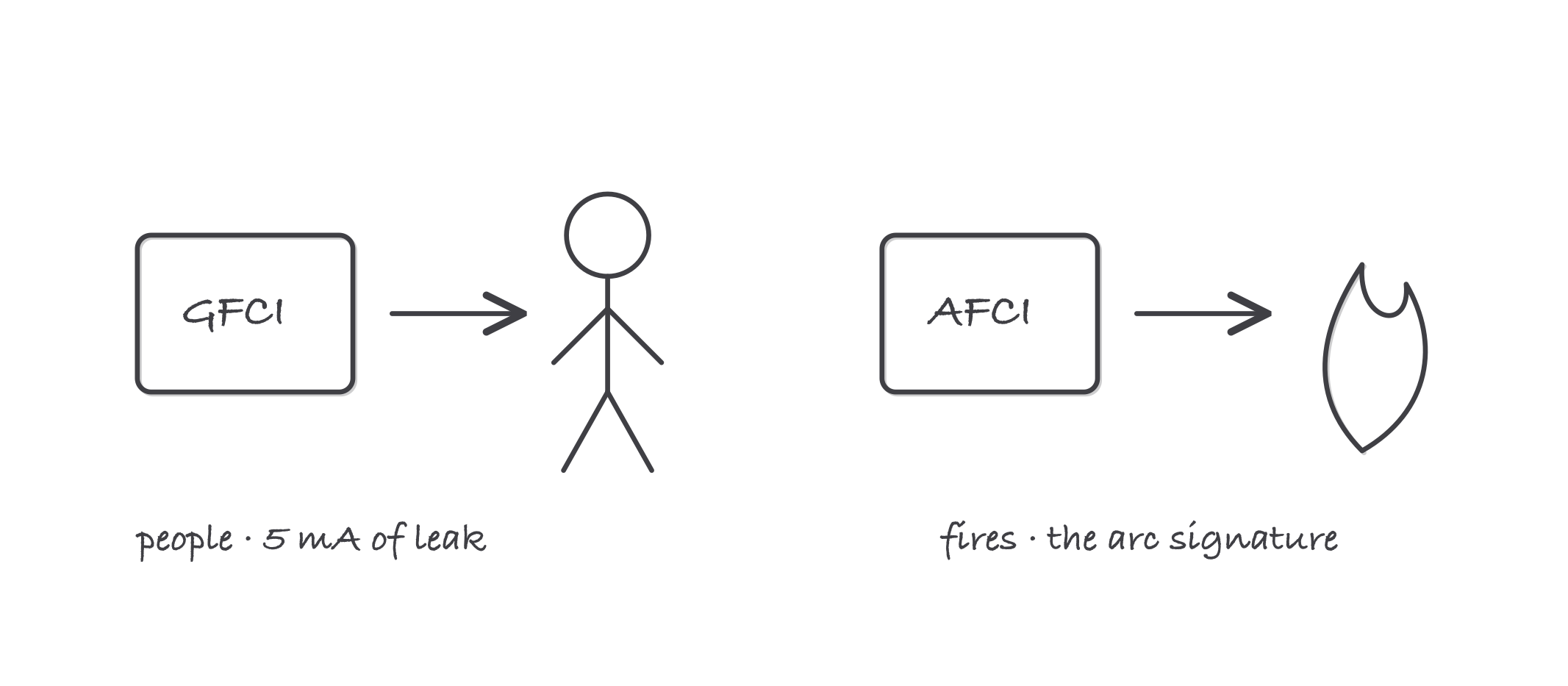
Same wire, different hazards: the GFCI watches for current escaping through a person, the AFCI listens for the arc that starts a fire
Where it bites
- “The AFCI is faulty” is usually wrong. Persistent trips mean the electronics keep hearing something. Early-generation nuisance-trip stories age poorly as an excuse; modern combination devices trip on arcs that exist.
- Swapping in a standard breaker to end trips. It ends the trips the way removing a smoke alarm ends beeping. It also removes required protection, and inspectors treat it exactly that way.
- Assuming AFCI covers shock. It does not watch for imbalance; only a GFCI or dual-function device protects the person. The exam tests this boundary explicitly, in both directions.
- Shared neutrals confuse single-pole AFCIs. A multiwire branch circuit’s crossed or shared neutral reads as leakage and signature noise. Multiwire circuits need two-pole AFCI solutions, and old crossed neutrals must actually be fixed.
- Forgetting the arc sources are your own work. Overdriven staples, backstabs, and undertorqued screws are the AFCI’s steady customers. The device is downstream quality control on every habit this subject teaches.
Verified requirements
| Where | Expires | Renewal | Continuing education |
|---|---|---|---|
| Texas | Yes | 1 year | 4 hours per annual renewal cycle |
Information comes from issuing-authority sources. Confirm current rules, fees and eligibility with the authority before acting.