Learn · Electrical
Motor Starters
Assumes you know: Relays and Contactors
A motor starter is a contactor and an overload relay packaged as one device: the contactor switches the motor, the overload relay watches its current and breaks the control circuit if the motor runs too hot for too long. Everything you learned in Relays and Contactors and in Motor Protection bolts together here into the standard piece of hardware on every motor circuit.
Why it matters on the job
Starters are what you actually install, wire, set, and reset in the field. The choices are practical ones: manual or magnetic, NEMA or IEC, which trip class, what the dial gets set to. And when a motor stops, the starter is where the story is written, which device opened tells you which kind of problem occurred.
The assembly
Manual starters are a switch and overload elements in one housing, operated by hand. No coil, no remote control, no low-voltage protection unless specifically built in. Small machinery only.
Magnetic starters are the standard: the contactor’s coil sits in a control circuit, so the motor can be commanded from anywhere, buttons, float switches, a PLC, and the three-wire seal-in scheme gives low-voltage protection. The overload relay’s trip contact is an NC contact wired in series in that control circuit: when the relay trips, the coil drops out and the contactor opens. The overload contact does not interrupt the motor current itself; it tells the contactor to.
A combination starter adds the disconnecting means and short-circuit protection (breaker or fusible switch) in the same enclosure, the whole Article 430 branch circuit in one box.
NEMA starters come in standardized sizes selected simply by motor horsepower and voltage, big, conservative, interchangeable across manufacturers. IEC starters are compact devices selected more precisely from manufacturer tables for the specific application and duty; smaller and cheaper, and less forgiving of casual selection. Both are everywhere; select each the way its own standard intends.
The overload relay is set to the motor’s nameplate full-load current, either by installing the heater elements the manufacturer’s table matches to that current, or by turning an electronic relay’s dial to it, with the adjustment rules of NEC Article 430 governing, as covered in Motor Protection.
Worked example: one starter, three shutdowns
A pump motor, nameplate FLA 14 A, locked-rotor current 84 A, on a combination starter: breaker, contactor, Class 20 electronic overload relay dialed to 14 A, three-wire start/stop control.
- Normal stop. The operator presses stop: the coil drops, the contactor opens, current ceases. Nothing tripped; the starter resets nothing because nothing operated.
- Pump jams. Current climbs to 84 A, 600% of the 14 A setting. The Class 20 relay times out within 20 seconds and its NC contact opens the control circuit; the contactor drops out. The reset button on the overload relay must be pressed, after the jam is found, before the motor can restart.
- Cable fault. A phase-to-phase fault drives current to hundreds of amps; the breaker clears it in cycles. The handle sits between OFF and ON, the signature of a trip, and the overload relay never got warm.
Three shutdowns, three different devices, three different next moves. The starter is not just switching the motor, it is telling you what happened.
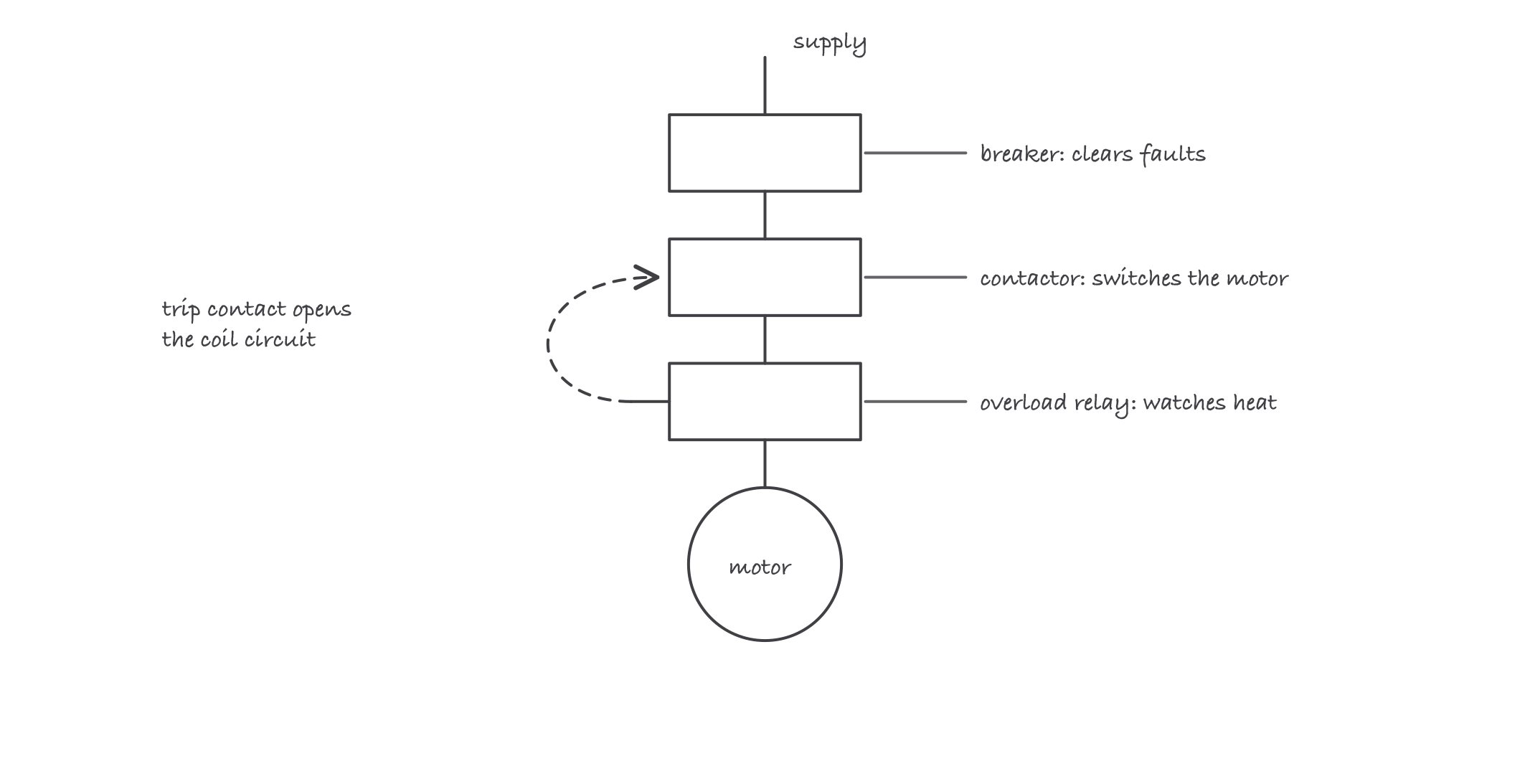
The contactor switches the motor; the overload relay trips the contactor; the breaker handles what neither can
Where it bites
- The overload relay does not open the power circuit. It opens the coil circuit. On a starter whose contacts have welded, an overload trip drops the coil and the motor keeps running, which is why welded contacts are a serious failure, not a curiosity.
- NEMA and IEC sizing philosophies do not mix. Selecting an IEC starter the loose NEMA way, by horsepower alone, undersizes it for hard duty. Use the manufacturer’s selection tables for IEC gear, every time.
- Heater elements are chosen from tables, not matched to breaker sizes. The heater table maps nameplate FLA to a catalog number. Copying the previous, possibly wrong, heater forward reproduces the previous mistake.
- A starter that trips immediately on reset is answering your question. The fault is still there. Repeated resets against a jam or a lost phase finish the motor; find the cause between resets.