Learn · Electrical
Overcurrent Protection Fundamentals
Part of Journeyman Electrician Exam Prep · step 49 of 73 · next: Fuses
In learning paths: Journeyman Electrician Exam Prep
Assumes you know: Current
Overcurrent protection exists to disconnect a circuit before current makes enough heat to start a fire: fuses and circuit breakers are heat-limiting devices first, everything else second. The NEC’s overcurrent rules live in Article 240, and the organizing idea is simple: a conductor gets an overcurrent device rated to open before the conductor’s insulation cooks.
Why it matters on the job
Every circuit you build ends at an overcurrent device, and every sizing decision you make, conductor, breaker, fuse, terminates in this logic. Troubleshooting also starts here: a tripping breaker is a message, and knowing the three kinds of overcurrent tells you which of three very different problems you are hunting.
Three kinds of overcurrent
Overload: more current than the circuit is rated for, flowing through the intended path. Two space heaters on one 15 A circuit. Moderate excess, damage comes slowly, as accumulated heat.
Short circuit: current leaving the intended path, hot to neutral or hot to hot, through nearly zero impedance. Current is limited only by the impedance of the wiring and source, so it can be hundreds or thousands of amps, instantly.
Ground fault: current from a hot conductor to ground, an enclosure, a person. Magnitude varies from massive (bolted fault to a well-grounded enclosure) to tiny but lethal (through a body), which is why ground-fault protection for people, the GFCI, works at milliamps while the ordinary breaker never sees it.
Remember what current does: heat in a conductor is I²R, so heating grows with the square of current, the fact you carry from Current. Double the amps, four times the heat. That square is why devices respond on an inverse-time principle: the bigger the overcurrent, the faster the device must open. A mild overload can be tolerated for minutes; a short circuit must be cleared in a fraction of a second.
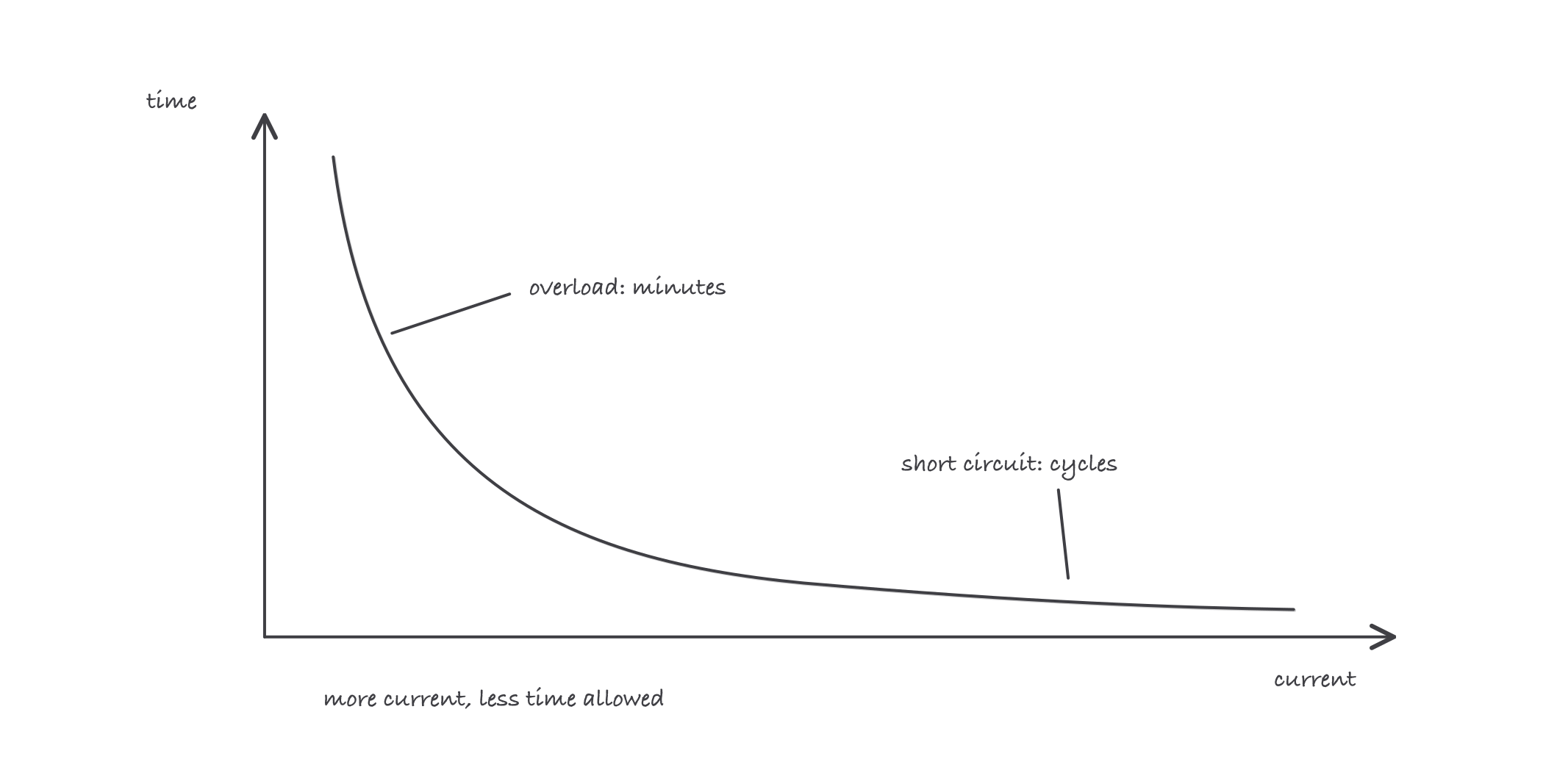
One curve, one idea: more current, less time allowed
Worked example
A 20 A circuit wired in 12 AWG copper.
Overload: a 25 A load is 25 ÷ 20 = 125% of rating. Heat in the conductor versus full load: (25 ÷ 20)² = 1.56, about 56% more heat than the circuit was designed to shed. Survivable briefly, destructive over hours, so the device opens in minutes, not milliseconds.
Short circuit: a fault drawing 800 A is 800 ÷ 20 = 40 times rating, making (40)² = 1,600 times the design heat. Nothing about that is survivable for minutes; the device must open within cycles, and it does, because inverse-time puts 40× current deep into the instantaneous end of the curve.
Same 20 A device, two responses, both correct.
Where it bites
- The OCPD protects the conductor, not the appliance. A 20 A breaker happily feeds a failing 3 A lamp forever. Equipment protection, where needed, is its own layer.
- Nuisance trip is a diagnosis of last resort. Breakers that trip are usually doing their job. Measure the load before blaming the device.
- Bigger breaker is never the fix for a tripping circuit. The conductor was sized to the old rating. Upsizing the device without upsizing the conductor removes the protection, it does not solve the problem.
- Ground faults are not always big. The faults that kill people are the small ones. Do not equate “no trip” with “no fault”.