Learn · Electrical
NEC Definitions That Decide Answers
Part of Journeyman Electrician Exam Prep · step 64 of 73 · next: Reading NEC Tables
In learning paths: Journeyman Electrician Exam Prep
Assumes you know: How the NEC Is Organized
Article 100 of the NEC defines the words the rest of the book is written in, and those definitions are not background reading: they are frequently the entire answer. Code questions that look like judgment calls are usually vocabulary tests, because when the NEC defines a term, that definition overrides whatever the word means in everyday English.
Why it matters on the job
Arguments with inspectors, exam traps, and design mistakes share one root: two people using the same word to mean different things. The Code ended that by legislating its vocabulary. The habit that separates code-fluent electricians is checking Article 100 first when a rule turns on a word, because “accessible”, “readily accessible”, “grounded”, and “within sight” are all terms of art with exact boundaries.
Definitions that decide answers
Accessible vs readily accessible. Accessible (as applied to equipment) means you can get to it, possibly with effort like removing a panel. Readily accessible means quickly reachable without climbing over obstacles, using tools to remove obstacles, or fetching a ladder. Whole categories of rules, like where the service disconnect may live, turn entirely on the word “readily”.
Grounded conductor vs equipment grounding conductor. The grounded conductor is the current-carrying conductor intentionally connected to ground, in most systems the neutral, white or gray. The equipment grounding conductor is the normally current-free fault path, bare or green. Two conductors, one syllable apart, with completely different jobs; mixing them up is the classic subpanel and appliance-wiring defect, and a staple exam distractor.
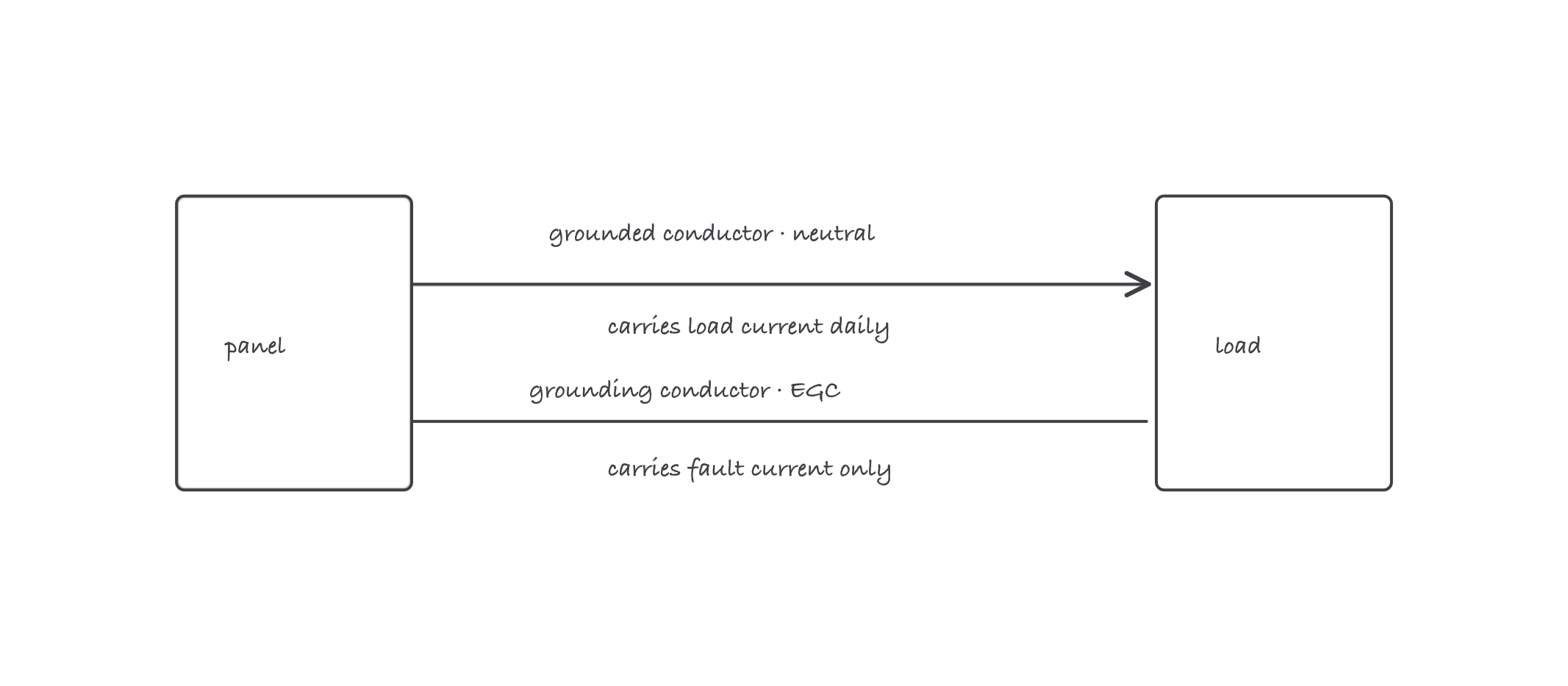
One letter apart, different jobs: the grounded conductor works every day, the grounding conductor works only during a fault
Branch circuit vs feeder. The branch circuit runs from the final overcurrent device to the outlets; a feeder is everything between the service equipment and that final OCPD. The definition decides whether Article 210 or 215 governs your conductors.
Within sight. Defined as visible and not more than 50 ft away. A motor disconnect “within sight” of the motor is a measurable claim, not a judgment call.
Qualified person. Someone with skills and knowledge of the construction and operation of the equipment and the safety training to recognize and avoid the hazards. Rules that relax requirements for qualified persons are relaxing them for that defined person, not for anyone holding a license.
Location: damp, dry, wet. Wet locations include underground, in concrete slabs in contact with earth, and areas subject to saturation, and, notably, the inside of raceways in wet locations is itself a wet location, which drives conductor insulation choices.
Worked example
Question: a service disconnect is mounted in a basement, behind a stack of stored boxes, 6 ft up a wall above a workbench. Compliant location?
Plain English says yes: you can get to it. The Code asks a different question: the disconnect must be readily accessible. Walk the definition’s tests one by one. Reachable quickly? Climbing over a workbench fails “without climbing over obstacles”. Boxes stacked in front? Stored material blocking it fails the same clause. The bench and the boxes each independently break “readily”, so the location fails, not because of a rule about benches or boxes, which does not exist, but because of a definition about access. Every step of that answer came out of Article 100.
Where it bites
- Defined terms are italicized in recent editions, flagging that Article 100 has jurisdiction. Treat the italics as a hyperlink: if a rule hinges on that word, go read the definition before answering.
- “Grounding” and “grounded” are one letter apart and refer to different conductors. Slow down on every question containing either word; this is the most farmed trap in exam writing.
- Some definitions live outside Article 100. Article-specific definitions appear within their own articles (recent editions have been consolidating them into Article 100, another edition-migration to watch). If a term reads strangely, check whether the governing article defines it locally.
- Everyday intuition is the enemy. “Within sight” has a distance limit. “Wet location” includes the inside of a dry-looking conduit outdoors. When a definition exists, intuition has no vote.
Exam relevance
Definition questions are the fastest points on journeyman and master exams and among the most missed. Expect direct lookups (“readily accessible means…”) and, more dangerous, ordinary-looking questions whose trap is a defined term used precisely: grounded vs grounding, feeder vs branch circuit, accessible vs readily accessible. In the timed code portion, tab Article 100 and make it the first stop whenever a question turns on what a word means.
Verified requirements
| Where | Expires | Renewal | Continuing education |
|---|---|---|---|
| Texas | Yes | 1 year | 4 hours per annual renewal cycle |
Information comes from issuing-authority sources. Confirm current rules, fees and eligibility with the authority before acting.