Learn · Electrical
Motor Starting Methods
Part of Journeyman Electrician Exam Prep · step 58 of 73 · next: Motor Current Calculations
In learning paths: Journeyman Electrician Exam Prep
Assumes you know: How a Three-Phase Motor Works
A three-phase induction motor started across the line pulls locked-rotor current, typically 6 to 8 times its full-load amps, until the rotor comes up to speed. Every starting method in this lesson exists to manage that inrush, or to accept it deliberately because the motor and system can take it.
Why it matters on the job
Inrush is not a defect; it is physics you plan around. On a small motor nobody notices. On a large one, across-the-line starting dips the voltage for everything on the feeder, lights blink, sensitive equipment resets, and the utility may limit you. Mechanically, slamming full torque into a belt or coupling shortens its life. Choosing and wiring the starting method is journeyman-level work you will meet on almost every industrial job.
Across the line
Full-voltage, or direct-on-line, starting connects the motor straight to the supply through a starter. Maximum inrush, maximum starting torque, fastest acceleration, simplest and cheapest hardware. It is the default for small and medium motors on stiff supplies.
Reduced-voltage methods
All reduced-voltage methods trade starting torque for lower current, and torque falls faster than current: torque varies with the square of the applied voltage. The motor must still develop enough torque to accelerate its load, or it will sit at high current until protection trips.
- Wye-delta: the starter connects the motor’s windings in wye for starting, so each winding sees line voltage divided by the square root of 3, then reconnects them in delta to run. Line current and torque both start at one third of their across-the-line values. Requires a motor with all six leads brought out.
- Autotransformer: taps (commonly 50%, 65%, 80%) feed the motor reduced voltage. Line current falls with the square of the tap ratio, the transformer action working in your favor.
- Solid-state soft starter: power electronics ramp the voltage smoothly; current limit is adjustable.
- A variable frequency drive starts at low frequency and low voltage together, holding current near full-load amps. It is the gentlest start available and gets its own lesson, Variable Frequency Drives.
Worked example
A motor with nameplate full-load current of 52 A and locked-rotor current of 6.5 × FLA.
Across the line: inrush = 52 × 6.5 = 338 A.
Wye-delta start: line current = 338 / 3 = 113 A. Starting torque is also cut to one third, fine for a fan that loads up with speed, marginal for a loaded conveyor.
Autotransformer on the 65% tap: line current = 338 × 0.65² = 338 × 0.42 = 143 A, with torque at 42% of full-voltage torque.
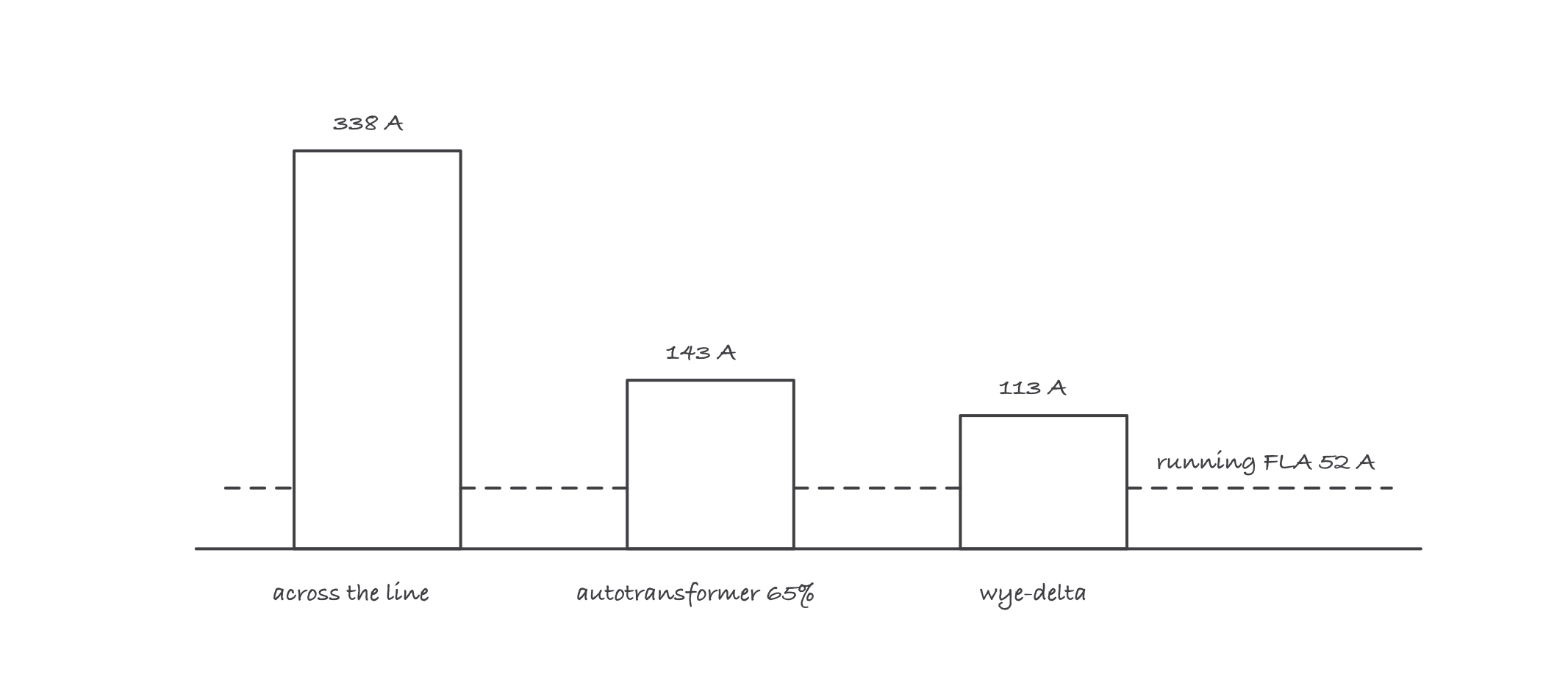
Same 52 A motor, three ways to start it: the method sets how hard the first second hits the system
Where it bites
- Torque falls with voltage squared, and loads do not care about your current problem. A reduced-voltage start that cannot break the load away leaves the motor stalled at high current, worse than the inrush you were avoiding. Match the method to the load’s torque demand, not just to the electrical limit.
- Wye-delta has a transition. Open-transition starters disconnect the motor for an instant while switching from wye to delta, and the reclosing surge can rival across-the-line inrush. Closed-transition versions exist precisely to fix this.
- Locked-rotor current flows for as long as the start takes. A high-inertia load that accelerates slowly holds the system at inrush current for many seconds, which is a protection-coordination problem, the next lesson’s territory.