Learn · Electrical
Motor OCPD and Conductor Sizing
Part of Journeyman Electrician Exam Prep · step 60 of 73 · next: Motor Protection
In learning paths: Journeyman Electrician Exam Prep
Assumes you know: Motor Current Calculations, Overcurrent Protection Fundamentals
Motor circuits split protection into two jobs that ordinary circuits combine: the branch-circuit device protects against short circuits and ground faults only, while separate overload protection guards the motor from overwork. That split is why a motor circuit legally pairs a 125 A breaker with a 62.5 A conductor, an arrangement that looks like a violation everywhere else in the trade.
Why it matters on the job
A motor draws about 6 times its full-load current every time it starts. A breaker sized like a normal circuit would trip on every start, so the code book lets the breaker be huge, big enough to ignore inrush, and assigns the actual overcurrent worry to overload devices that track heat over time. Wire this split wrong in either direction and you get nuisance trips or a motor that cooks quietly under a breaker that will never notice.
The method
Everything keys off the table FLC from the previous lesson, except overloads, which use the nameplate.
Conductors: 125 % of FLC. The motor branch-circuit conductors must have ampacity of at least 1.25 × the table FLC. Motors run hard for hours, so they are treated like a continuous load.
Branch-circuit short-circuit device: a percentage of FLC by device type. From your code book’s table: inverse-time (ordinary) circuit breaker up to 250 %, dual-element time-delay fuse up to 175 %, nontime-delay fuse up to 300 %. When the arithmetic misses a standard rating, you are permitted the next standard size up.
Overloads: from the nameplate. For motors with a service factor of 1.15 or more, overloads are sized at 125 % of nameplate FLA.
Worked example
A 10 hp, 230 V single-phase motor, table FLC 50 A, nameplate FLA 46 A, service factor 1.15, protected by an inverse-time breaker.
- Conductors: 50 × 1.25 = 62.5 A → from the 75 °C copper column, #6 AWG at 65 A.
- Breaker: 50 × 2.50 = 125 A, itself a standard rating, so a 125 A inverse-time breaker.
- Overloads: 46 × 1.25 = 57.5 A overload element.
- The finished circuit: 125 A breaker, #6 copper, overloads at 57.5 A. The breaker rides through the roughly 300 A start; the overloads catch anything sustained above 57.5 A.
With a dual-element fuse instead: 50 × 1.75 = 87.5 A, not a standard size, so the next standard up, a 90 A fuse.
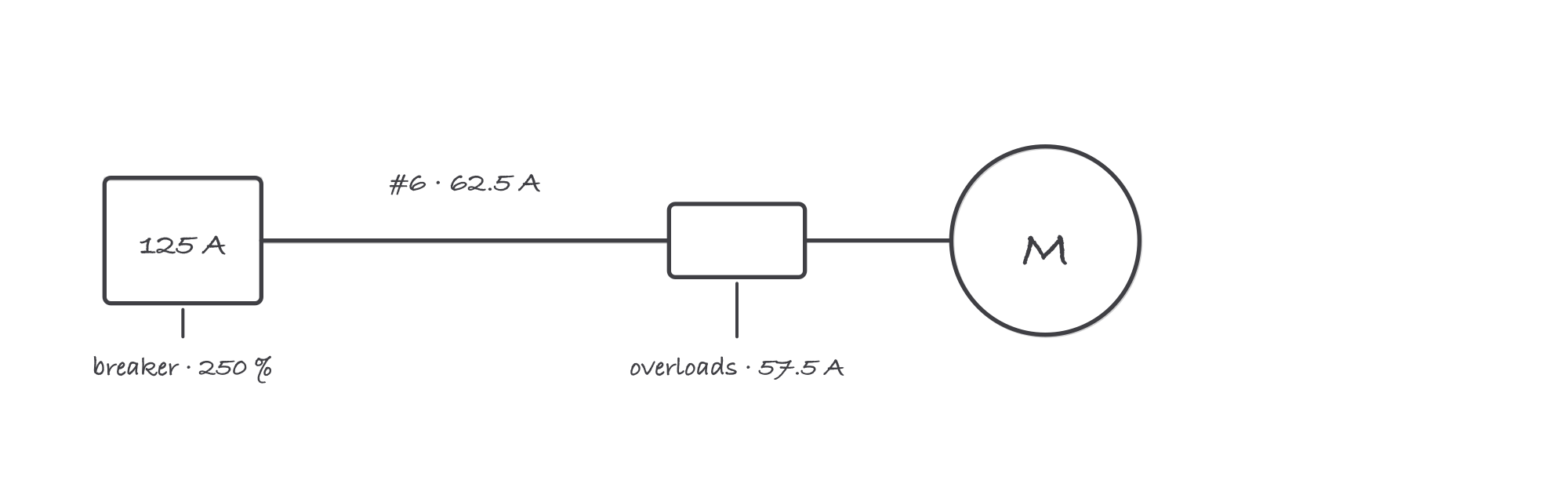
The breaker only stops faults; the little overload element is what actually protects the motor
Where it bites
- The oversized breaker is not protecting the conductor from overload, the overloads are. This is the concept the whole scheme rests on, and the one that makes the 125 A breaker on #6 wire legal. Without functioning overloads the circuit loses its logic.
- Percentages are maximums, not targets. 250 % is the ceiling for an inverse-time breaker; where a smaller device holds the start, a smaller device is better practice. Exams ask for the maximum; jobs often want less.
- Round-up is a one-step privilege. 87.5 A permits 90 A, the next standard size, not 100 A because the truck has one. The exception lifts you exactly one rung.
- Mixing the sources scrambles everything. Conductors and breaker from the table FLC; overloads from nameplate FLA. Cross them and both answers are wrong, plausibly enough to pass a casual glance.
Exam relevance
The full motor-circuit problem, conductor, branch device, overload, from one motor is a fixture of journeyman and master exams, and it tests table navigation more than arithmetic: FLC table, percentage table, standard-ratings list, ampacity table, four lookups in a chain. The 250 %/175 %/300 % percentages and the next-size-up rule carry most of the marks. Slow down at the device type; the percentage changes with it.
Verified requirements
| Where | Expires | Renewal | Continuing education |
|---|---|---|---|
| Texas | Yes | 1 year | 4 hours per annual renewal cycle |
Information comes from issuing-authority sources. Confirm current rules, fees and eligibility with the authority before acting.