Learn · Electrical
NFPA 70E Overview
Assumes you know: Arc Flash PPE and Boundaries
The NEC keeps the installation from hurting people; NFPA 70E keeps the work from hurting the worker. Both come from the same publisher, and they divide the world cleanly: NFPA 70, the National Electrical Code, governs how electrical systems are designed and built, while NFPA 70E, the Standard for Electrical Safety in the Workplace, governs how people stay alive around them, especially while installing, maintaining, and troubleshooting. An electrician who knows only the NEC knows how to build a safe system and nothing about surviving the act of working on it. Reading about 70E is not 70E training: your employer’s program is where the standard becomes your qualification.
Why it matters on the job
70E is where the vocabulary of modern electrical safety lives: electrically safe work condition, qualified person, arc flash boundary, energized electrical work permit. Job briefings, PPE tables, panel labels, and site rules all speak its language. Whether or not you ever open the book, you work inside its framework, and knowing the framework’s logic makes the rules make sense instead of feeling like decoration.
Where 70E sits in the legal landscape
OSHA writes the law: federal regulations require employers to protect workers from electrical hazards and to have practices like lockout/tagout and PPE programs. But OSHA regulations are deliberately broad and slow to change. 70E is the consensus standard, revised on a regular cycle by industry, that spells out in current detail how to meet those obligations.
The relationship in one line: OSHA says you must; 70E shows how. OSHA does not adopt 70E word for word, but conforming to it is the widely accepted way employers demonstrate they are doing what the law demands. That is why “per NFPA 70E” appears in company safety manuals that never mention most other standards.
The shape of the standard
70E’s logic runs in a hierarchy you already know from its other lessons:
First, eliminate the hazard. The centerpiece of the standard is the electrically safe work condition: de-energized, locked out, verified dead. 70E treats energized work as the justified exception, gated by the energized electrical work permit, never the convenient default.
Then, assess what remains. For work near hazards, 70E requires risk assessment on two axes: shock (voltage, approach boundaries) and arc flash (incident energy or PPE categories, arc flash boundary). Each assessment produces distances and protection requirements before the task starts.
Then, control what remains. Qualified-person requirements, job safety planning, boundaries and barricades, rated tools and PPE. The standard also covers maintenance, because a breaker that has not been maintained cannot be trusted to clear a fault in the time the arc flash calculation assumed.
A qualified person, in 70E’s meaning, is trained and knowledgeable about the construction and operation of the specific equipment, and trained to recognize and avoid its hazards. It is task- and equipment-specific, employer-determined, and perishable: the standard expects retraining at intervals and when practices change.
Worked example: one task, both books
A journeyman replaces a breaker in a 480 V panelboard.
- NEC questions: is the replacement breaker’s rating right for the conductors, is series rating respected, is working clearance about the panel per Article 110 maintained? These decide whether the installation is code-compliant when finished.
- 70E questions: has an electrically safe work condition been established, what did the shock and arc flash risk assessments say, who is qualified for this task, and does the job require a permit if any part cannot be de-energized? These decide whether the person doing it goes home.
- Same panel, same hour, two standards answering two different questions: one about the equipment’s future, one about the worker’s next twenty minutes.
Inspectors enforce the first list. OSHA and your employer’s program enforce the second. A complete electrician carries both in the same head.
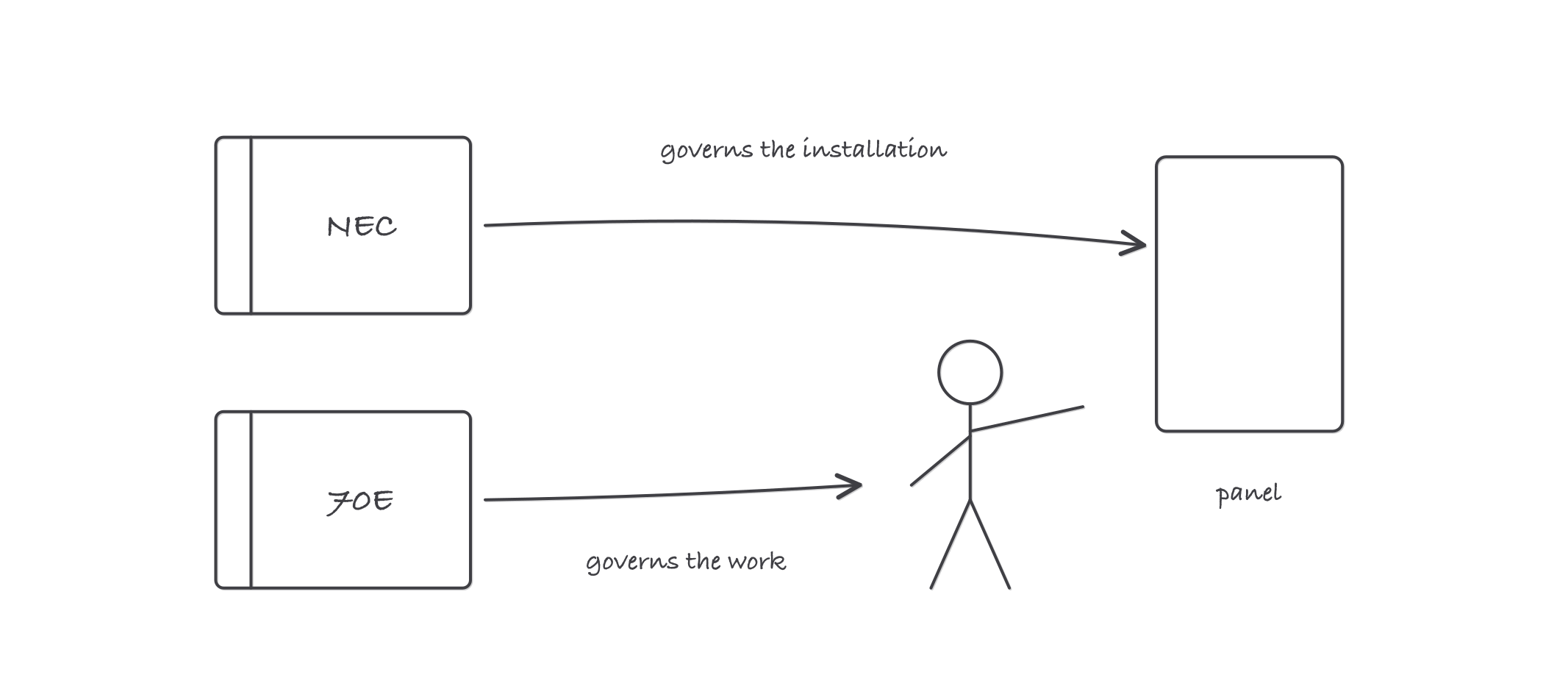
Same panel, two standards: the NEC answers for the equipment, 70E answers for the person working on it
Where it bites
- The NEC will not save you at the panel. A fully code-compliant installation can still kill the person working on it energized. Code compliance is about the system; 70E is about the task.
- 70E is a moving target on purpose. The standard revises on a multi-year cycle, and tables, categories, and definitions shift between editions. Cite the edition your employer’s program adopts, not the one you memorized as an apprentice.
- “We follow 70E” means the employer has duties too. Programs, training, audits, PPE provision, and equipment labeling belong to the employer. If those pieces are missing, the framework is not actually in place, and that is worth saying out loud.
- Qualified is not a synonym for licensed. A license is a legal credential; qualification under 70E is demonstrated knowledge of specific equipment and its hazards. Each can exist without the other, and the standard only cares about the second.