Learn · Electrical
Navigating the Ampacity Tables
Part of Journeyman Electrician Exam Prep · step 66 of 73 · next: Code Cycles and State Adoption
In learning paths: Journeyman Electrician Exam Prep
Assumes you know: Reading NEC Tables, Ampacity
Navigating the ampacity tables is a fixed sequence: start from the right table, take the base value from the conductor’s insulation-temperature column, multiply by the ambient-temperature correction and the conductor-count adjustment, then cap the result at what the terminations allow. Four steps, in order, every time. You already know what ampacity is from Ampacity; this lesson is the lookup choreography the NEC builds around Table 310.16.
Why it matters on the job
This is the single most-performed code calculation in the trade, and the most-tested. Attic runs, conduits shared by multiple circuits, rooftop raceways: real installations rarely match the laboratory conditions the base table assumes, and the correction-and-adjustment machinery is how the Code scales the numbers to reality. Doing the sequence out of order, or skipping the termination check, produces answers that are confidently wrong in both directions.
The sequence
Step 1: the base table. Table 310.16 is the default: insulated conductors, not more than three current-carrying conductors in a raceway or cable, 30 °C ambient. Its conditions are in its title, the discipline from Reading NEC Tables. Other 310-family tables cover other installation conditions; confirm you are in the right one before reading any number.
Step 2: pick the column by insulation. For the calculation, use the column matching the conductor’s insulation rating. THHN in dry locations is a 90 °C conductor, so its math starts in the 90 °C column, the biggest number in the row. This is the one legitimate use of that column.
Step 3: multiply the factors.
- Ambient correction, Table 310.15(B)(1): ambients above 30 °C shrink ampacity, below 30 °C grow it. Pick the correction from the same temperature column you started in.
- Adjustment for more than three current-carrying conductors, Table 310.15(C)(1): four to six conductors take 80%, seven to nine take 70%, and it falls from there. Neutrals carrying only imbalance and grounding conductors do not count.
Step 4: the termination cap, 110.14(C). Breakers and lugs are usually rated 75 °C (60 °C on some small or old equipment). The final ampacity may never exceed the conductor’s value in the termination-temperature column. Whichever is smaller, the corrected 90 °C math or the 75 °C column value, wins.
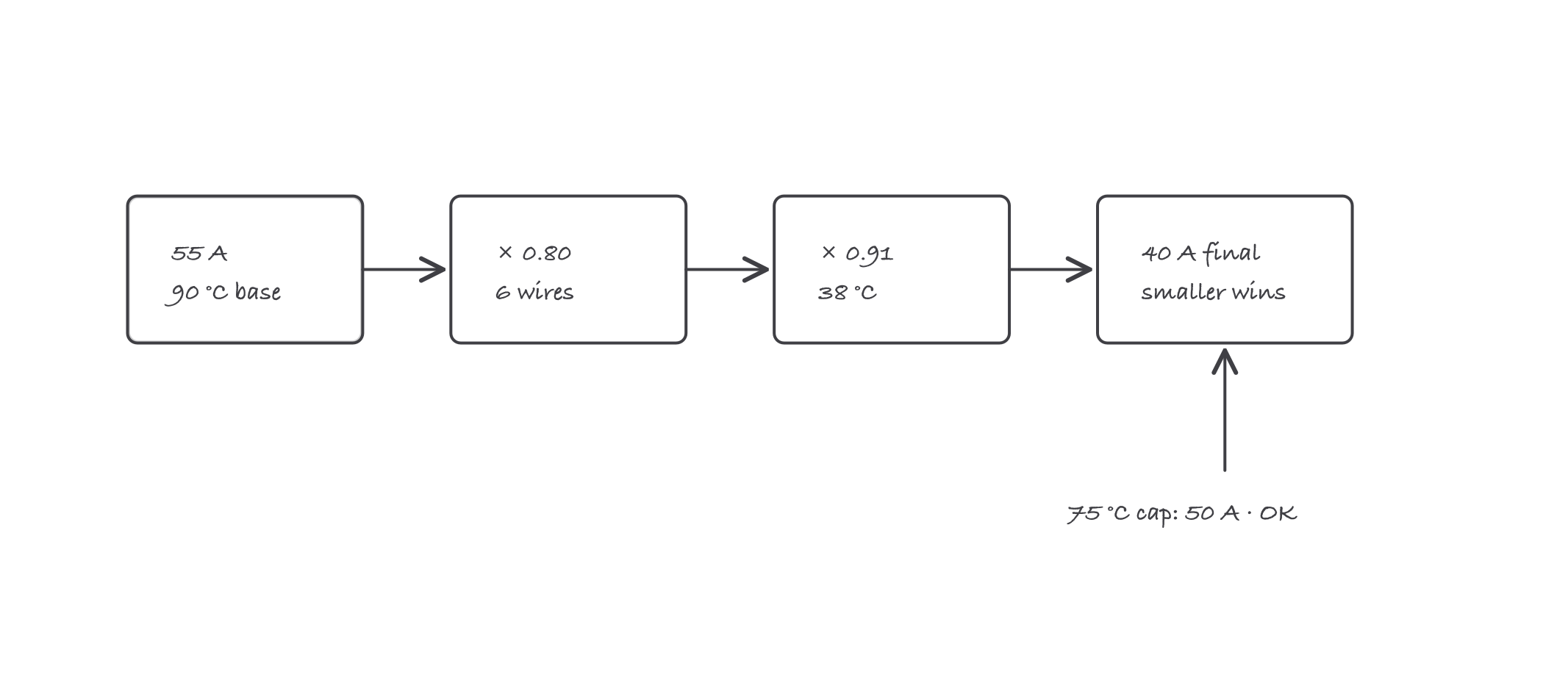
Start high, derate, then cap: the answer is the smaller of the corrected value and the termination column
Worked example
Six current-carrying 8 AWG copper THHN conductors share one conduit through a 38 °C mechanical room. Terminations are 75 °C. Final ampacity of each conductor?
- Base: Table 310.16, 8 AWG copper, 90 °C column: 55 A.
- Adjustment: six current-carrying conductors, Table 310.15(C)(1): 80%. 55 × 0.80 = 44 A.
- Correction: 38 °C ambient falls in the 36 to 40 °C band; for the 90 °C column the factor is 0.91. 44 × 0.91 = 40.0 A.
- Termination cap: 8 AWG copper in the 75 °C column is 50 A. Final ampacity is the smaller of 40.0 and 50: 40 A.
Run the same math from the 75 °C column instead, 50 × 0.80 × 0.88 = 35.2 A, and you land 5 A lower: starting from the 90 °C column exists precisely to soften derating, and it is only available because THHN insulation really is rated 90 °C.
Where it bites
- Starting the math in the 75 °C column. Legal but needlessly punishing, and on exams it produces one of the listed wrong answers. Base the calculation on insulation; cap it by termination.
- Finishing in the 90 °C column. The mirror error: 55 A as a final answer for 8 AWG THHN ignores 110.14(C) and fails hard against real equipment.
- Counting conductors wrong. The adjustment counts current-carrying conductors in the raceway, not wires. Imbalance-only neutrals and EGCs are excluded; fully loaded neutrals of certain circuits count. Miscounting shifts the whole answer one bracket.
- Correction factors follow the column. The 0.91 belongs to the 90 °C column at 36 to 40 °C; the 75 °C column has its own, smaller factor for the same band. Mixing columns between base and correction silently corrupts the result.
Exam relevance
Multi-factor ampacity problems are a fixture of journeyman and master exams, and the distractors are systematic: the uncorrected base value, the answer from the wrong starting column, the answer without the termination cap. Write the four steps as a checklist on scratch paper and run every ampacity question through it in order; the sequence, not the arithmetic, is what the question is testing.
Verified requirements
| Where | Expires | Renewal | Continuing education |
|---|---|---|---|
| Texas | Yes | 1 year | 4 hours per annual renewal cycle |
Information comes from issuing-authority sources. Confirm current rules, fees and eligibility with the authority before acting.