Learn · Electrical
Flexible Raceways
Part of Journeyman Electrician Exam Prep · step 35 of 73 · next: Raceway Supports and Securing
In learning paths: Journeyman Electrician Exam Prep
Assumes you know: EMT
Flexible raceways exist for the last few feet: the vibrating motor, the adjustable light fixture, the disconnect that is never quite where the drawing said. The family has four members, FMC, LFMC, LFNC, and ENT, and choosing among them comes down to two questions: wet or dry, and metal or not.
Why it matters on the job
Rigid methods end where equipment begins. Motors vibrate, condensers get replaced, transformers hum, and a hard-piped connection transmits all of it into the raceway system until something cracks. The flex whip is the shock absorber of the trade, and its rules, length, support, and grounding, are compact enough that exams test all three in a single question.
The family
FMC, flexible metal conduit, greenfield: a bare interlocked steel spiral. Dry locations only; the spiral is a water channel with no jacket to stop it. The standard connection from ceiling box to recessed fixture, and the indoor motor whip.
LFMC, liquidtight flexible metal conduit, sealtight: the same steel spiral under an extruded plastic jacket, with fittings listed liquidtight. Wet locations, outdoor equipment, washdown areas. The AC-condenser whip is LFMC almost by definition.
LFNC, liquidtight flexible nonmetallic conduit: the all-plastic version, for wet and corrosive spots where even the jacketed spiral is unwelcome.
ENT, electrical nonmetallic tubing, smurf tube: corrugated plastic tubing for concealed dry work, inside walls, above certain ceilings, and embedded in concrete in the patterns its listing allows. It is a routing method for protected spaces, not an exposure-rated raceway.
Grounding: the spiral is not a wire
A flexible metal spiral is a long helix, and fault current hates a helix. Neither FMC nor LFMC can be assumed to be the equipment grounding conductor. The code-typical pattern permits the flex itself to serve as the EGC only in a narrow case: short lengths, 6 ft or less in the ground-fault path, small overcurrent devices, and fittings listed for grounding. Outside that narrow gate, and always where the whip exists specifically because things vibrate, you pull a green EGC through the flex. The practical rule on real work is simpler: pull the green, every time, and the narrow exception stops mattering.
Support, and the whip allowance
The classic pattern, your code’s table governing: secured within 12 in of every box and at intervals not over 4.5 ft. Then the exception that makes whips legal: where flexibility is needed at equipment, an unsecured length is permitted, 3 ft in the classic pattern, with longer allowances for fixture whips. The flex is allowed to do its job at the connection point; it is not allowed to be the whole unsupported run.
Worked example
Hook up an outdoor heat-pump condenser from its wall-mounted disconnect:
- Location: outdoors, rain, condensation. LFMC, with fittings listed liquidtight, straight connector at the disconnect, 90° connector at the unit.
- Length: 4 ft of whip, enough slack for the unit to be pulled forward for service, inside the unsecured-length allowance at equipment.
- Conductors: wet location inside the raceway, so THWN-2 from the insulation lesson.
- Grounding: a green EGC pulled with the circuit conductors and landed at both ends. The spiral gets no grounding job.
- The whip’s gentle sweep also spends bend budget, but at 4 ft with two connectors, it is nowhere near the 360° that the EMT lesson budgets.
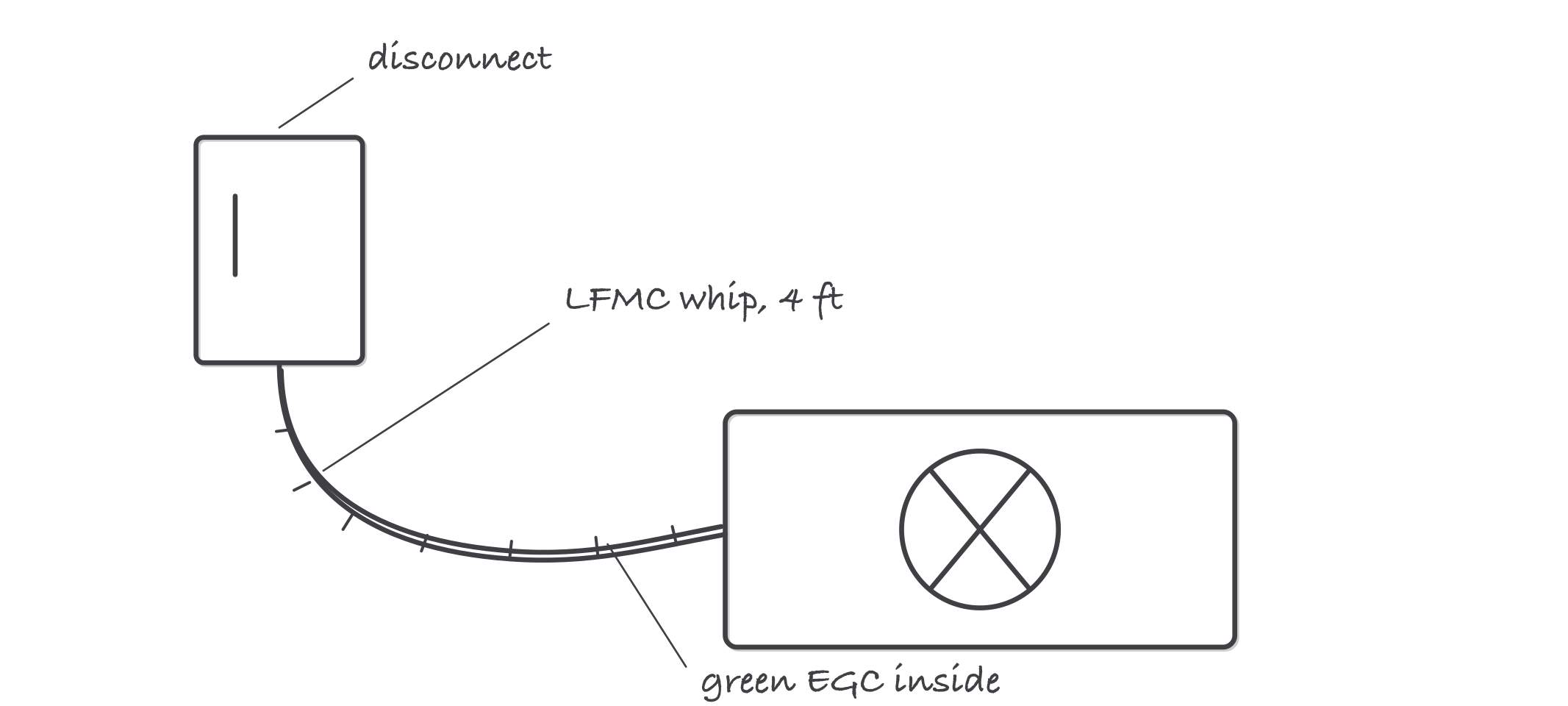
The last few feet flex so the equipment can move and be serviced: liquidtight jacket for the weather, and the ground rides inside as a wire
Where it bites
- FMC outdoors. Bare greenfield on a roof or a wall fills with water and feeds it straight into the equipment. If weather can reach it, it wears the liquidtight jacket.
- Trusting the spiral as a ground. The narrow exception becomes a habit, then a violation, the first time the whip is over 6 ft or the breaker is large. Pull the green and the question dies.
- The 20 ft whip. Unsecured flex is an allowance at connection points, not a substitute for supports. Long flappy runs fail the support table and chafe at every edge they touch.
- Wrong fitting listing. LFMC with dry-location fittings is a wet-location violation at the exact point water arrives. The jacket does not certify the joint; the fitting’s listing does.
- ENT where it can be hit. Smurf tube is for concealed, protected spaces. Exposed on a garage wall it is both a listing violation and a future break.
Verified requirements
| Where | Expires | Renewal | Continuing education |
|---|---|---|---|
| Texas | Yes | 1 year | 4 hours per annual renewal cycle |
Information comes from issuing-authority sources. Confirm current rules, fees and eligibility with the authority before acting.