Learn · Electrical
Arc Flash PPE and Boundaries
Assumes you know: Arc Flash
NFPA 70E manages arc flash with two tools: circles on the floor and layers on the body. The circles are boundaries that decide who may be where; the layers are arc-rated clothing matched to the energy an arc would deliver. Both exist to manage the risk that remains when work cannot be done on a de-energized system, and neither is a license to prefer energized work. What follows describes the 70E system so you can recognize it; your employer’s program and training, not this page, determine what you wear and where you stand.
Why it matters on the job
The difference between ordinary work clothes and arc-rated clothing is the difference between a burn injury and clothing that ignites and keeps burning after the arc is gone. Meltable synthetics make it worse still. Knowing how PPE is selected, and what the boundary signs and labels are asking of you, is baseline literacy for anyone walking an industrial floor.
The boundaries
70E draws two families of boundary around energized equipment.
Shock protection boundaries key off voltage. The limited approach boundary is the outer line for unqualified persons. The restricted approach boundary is closer, crossed only by qualified persons with the right protection and authorization; inside it, the rules treat you as at risk of contact.
The arc flash boundary keys off energy, not voltage: it is the distance at which incident energy falls to 1.2 cal/cm², the second-degree burn threshold. It can sit inside or outside the shock boundaries; a high-energy, low-voltage panel can throw its arc flash boundary far beyond its shock lines. Crossing it while a hazard exists means wearing arc-rated protection.
The practical discipline: boundaries are real lines with entry conditions, established from the tables or the facility’s analysis before the task starts, not estimated by eye during it.
How PPE gets selected
70E provides two roads, and a facility uses one or the other for a given task, never both at once.
The incident energy analysis road. Engineering calculates incident energy at working distance for each piece of equipment; the label states, for example, 8.3 cal/cm² at 18 inches. PPE is then chosen so its arc rating meets or exceeds that number.
The PPE category road. For common tasks on common equipment, 70E’s tables assign a PPE category, 1 through 4, each with a minimum arc rating and a prescribed kit, provided the equipment’s fault current and clearing time sit within the table’s stated limits. Category 1 is the lightest, single-layer arc-rated regime; category 4 is the heaviest, multi-layer flash-suit regime. The table values themselves live in the current edition of 70E and in your employer’s program; treat any copied numbers, including examples in study material, as illustrations rather than authority.
Arc rating is the clothing’s tested capability in cal/cm². The layers of the kit scale with category: arc-rated shirt and pants, face shield and balaclava or hood, gloves, hearing protection, leather footwear. Underneath everything: natural fibers or arc-rated layers, never meltable synthetics against skin.
Worked example: matching a label to a rating
The panel label from the arc flash lesson reads 8.3 cal/cm² at 18 inches, arc flash boundary 48 inches.
- The task must be performed within 18 inches, inside the boundary, so arc-rated PPE is required.
- Minimum acceptable arc rating: at least 8.3 cal/cm². A common 8 cal/cm² shirt-and-pants kit fails the comparison by 0.3; the next standard tier up, typically 12 cal/cm² gear, passes.
- A helper staying at 5 feet, outside the 48 inch boundary, is outside the arc flash boundary but must still respect the shock boundaries if conductors are exposed.
The arithmetic is one comparison. The judgment, whether the task should be happening energized at all, comes first and belongs to the safe work practices lesson.
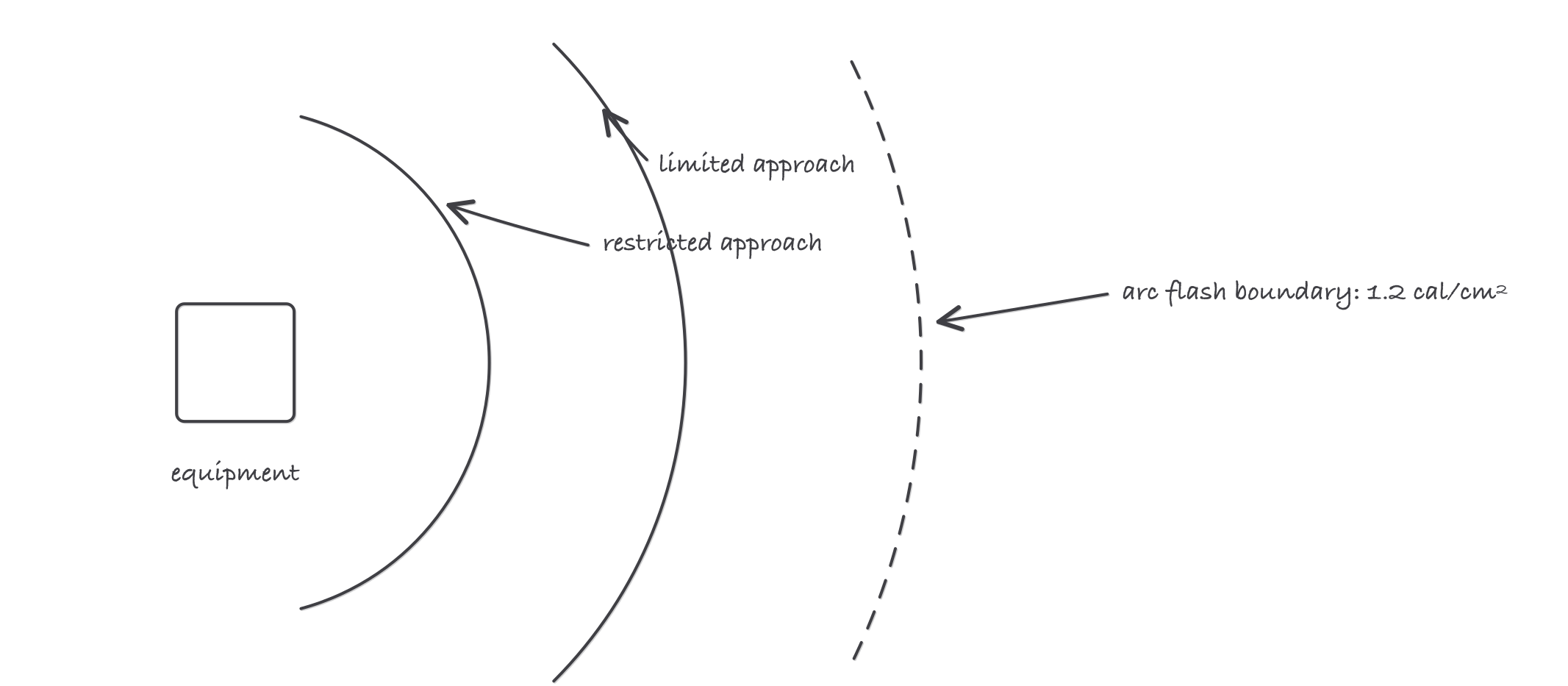
Two families of circle: shock boundaries scale with voltage, the arc flash boundary scales with energy, and each has its own entry conditions
Where it bites
- PPE is the last control, not the plan. Every ring and layer manages leftover risk. The first question on every job is whether the equipment can be made electrically safe, and the default answer is yes.
- Rated for the arc does not mean comfortable in the arc. Category 4 suits are hot, heavy, and vision-limiting, which quietly pressures workers toward shortcuts. Plan time and rest around the gear.
- The kit fails at its weakest gap. An arc-rated shirt over a polyester tee, an open collar, safety glasses instead of the required face protection: the arc finds the gap. The category prescribes a kit, not a suggestion.
- Daily-wear FR is not automatically task-appropriate. The question is always whether the arc rating meets the labeled energy or the table’s category for this task, on this equipment, today.