Learn · Electrical
Boxes and Enclosures
Part of Journeyman Electrician Exam Prep · step 38 of 73 · next: Receptacles
In learning paths: Journeyman Electrician Exam Prep
Every splice, device, and conductor termination lives inside a box, and the box is chosen twice: once for volume, so the conductors fit without cramming, and once for material and environment, so the enclosure survives where it is mounted. Box fill is the calculation; the enclosure type is the judgment.
Why it matters on the job
An overcrowded box is a heat problem and a workmanship problem at once: conductors folded hard against device screws, insulation nicked while stuffing, splices under strain forever. Box fill is also one of the wiring-methods exam’s dependable calculations, with counting rules specific enough to be right or wrong, and traps built into exactly the items people miscount.
Counting box fill
Box fill is a count of volume allowances. Each allowance is worth the volume your code’s table assigns to the conductor size: the classic values are 2.00 in³ for 14 AWG and 2.25 in³ for 12 AWG. Count like this:
- Each insulated circuit conductor entering the box: 1 allowance each. A conductor passing through unbroken also counts 1.
- All equipment grounding conductors together: 1 allowance, at the size of the largest EGC present. (Recent code editions add an extra count when more than four grounds land in one box; your edition’s exact wording governs.)
- Each device (receptacle or switch): 2 allowances, at the size of the largest conductor connected to it.
- All internal cable clamps together: 1 allowance, at the size of the largest conductor in the box.
- Each fixture stud or hickey: 1 allowance.
Short pigtails that never leave the box count nothing. The box’s own volume is stamped inside nonmetallic boxes and listed in the table for standard metal boxes; extension rings and plaster rings marked with a volume add theirs.
Metal or plastic, and what NEMA numbers mean
Metal boxes are part of the fault path: they must be grounded, they bond to metal raceways through their connectors, and they are the only choice where the wiring method is metal raceway or where the box supports heavy equipment. Nonmetallic boxes pair with NM cable in residential work: nothing to ground, but nothing to bond through either, so the EGC does all the work.
For enclosures in the weather, the NEMA type number is the environment rating, and the pattern worth memorizing: Type 1 indoor general purpose, Type 3R rain-resistant outdoor, the standard for exterior disconnects and panels, Type 4 and 4X hose-down tight, with X adding corrosion resistance for washdown and coastal service.
Worked example
A device box takes two 12/2 NM cables (feed in, feed on to the next box) and one duplex receptacle, with internal clamps. Count it:
- Insulated conductors: 2 per cable × 2 cables = 4 allowances.
- Grounds: two bare EGCs, all grounds together = 1 allowance.
- Device: the receptacle = 2 allowances.
- Clamps: all internal clamps together = 1 allowance.
- Total: 4 + 1 + 2 + 1 = 8 allowances, all at 12 AWG: 8 × 2.25 = 18.0 in³.
- A single-gang nonmetallic box stamped 20.4 in³ passes with room to work; an old 18.0 in³ box passes by exactly nothing, and the next cable ends its career.
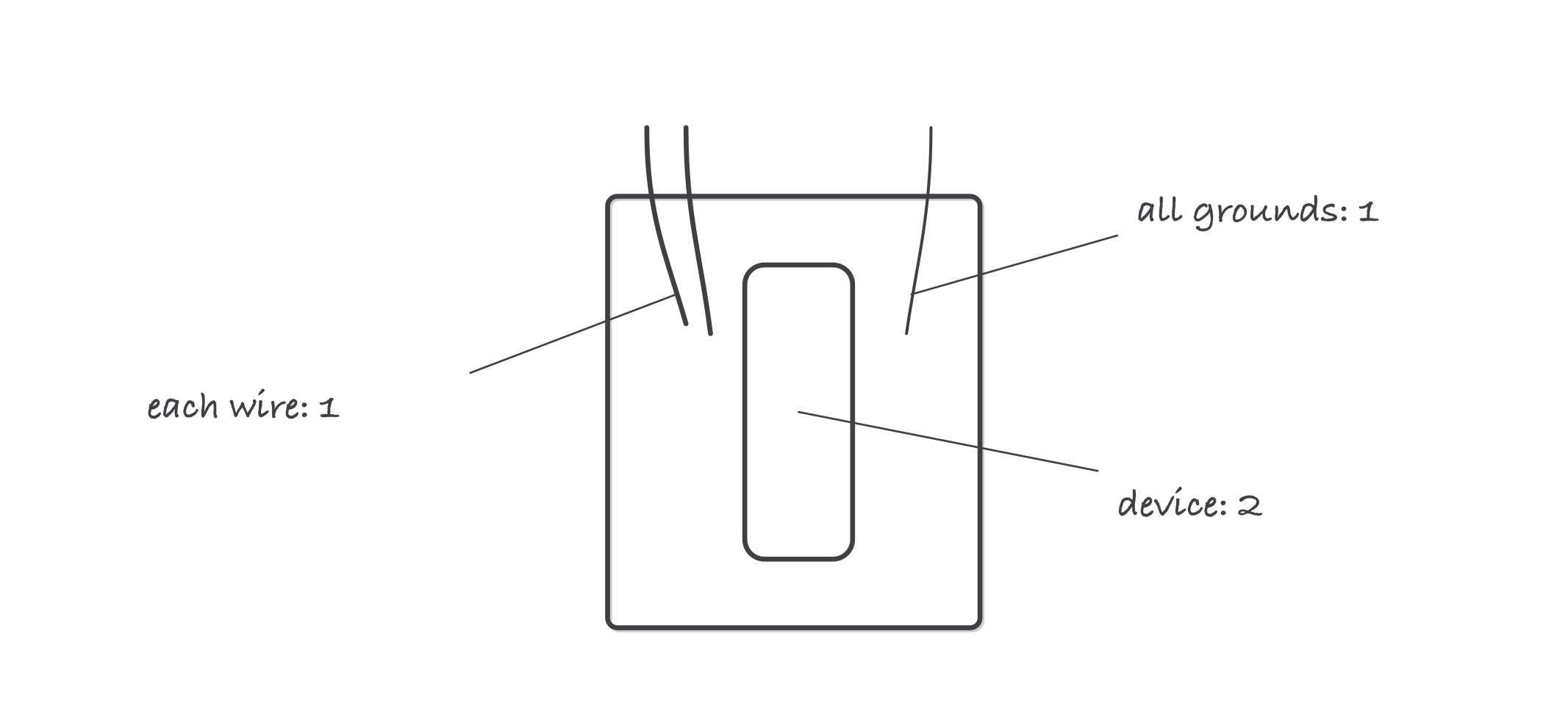
The three counts people miss, drawn once: every insulated conductor is 1, the device is 2, and the grounds share a single 1
Where it bites
- The device counts double. The single most-missed allowance, on exams and in cramped old-work boxes alike. A switch is 2, at the largest conductor size touching it.
- Grounds are one, not none, not each. Counting every bare wire separately oversizes the box; counting zero undersizes it. One allowance for the crowd, sized at the largest, plus your edition’s wrinkle past four.
- Clamps count once when they are inside. Boxes with internal NM clamps take the allowance; connectors that clamp outside the box do not.
- Mixed conductor sizes. Each conductor counts at its own size; the device and the clamp allowances take the largest size present. Sum volumes, not counts, when 14s and 12s share a box.
- 3R is rain, not washdown. An outdoor rating is not a hose-proof rating: equipment that gets cleaned with water wants Type 4, and corrosive sites want the X. The enclosure type table is a one-line exam question waiting to happen.
Verified requirements
| Where | Expires | Renewal | Continuing education |
|---|---|---|---|
| Texas | Yes | 1 year | 4 hours per annual renewal cycle |
Information comes from issuing-authority sources. Confirm current rules, fees and eligibility with the authority before acting.