Learn · Electrical
Electrical Power
Part of Journeyman Electrician Exam Prep · step 5 of 73 · next: Series Circuits
Part of Electrical Foundations · step 6 of 19 · next: Electrical Energy and kWh
In learning paths: Journeyman Electrician Exam Prep · Electrical Foundations
Assumes you know: How Ohm's Law Works
Power is the rate of doing work, in circuits, volts times amps, measured in watts. It is the number customers buy equipment by, utilities bill by, and circuits are loaded by. After Ohm’s law, the power formula is the calculation you will use most for your entire career.
Why it matters on the job
Every nameplate speaks watts or kilowatts; every circuit question eventually becomes “how many amps is that at this voltage?” Converting between power, voltage and current is the daily arithmetic of load calculations, circuit design and troubleshooting, and it is the other half of the exam-calculation toolkit alongside Ohm’s law.
The concept
P = E × I, power in watts equals voltage times current.
Combine it with Ohm’s law and you get the whole family: P = I²R and P = E²/R. The I²R form deserves special attention: heating in a conductor rises with the square of current. Double the amps through the same resistance and you make four times the heat, the physics behind ampacity tables, breaker curves, and why loose connections burn.
Energy is power over time: kilowatt-hours, what the meter on the wall actually counts. A kilowatt-hour is 1,000 watts running for one hour.
Worked example
A 1,500 W space heater on a 120 V circuit: I = P / E = 1500 / 120 = 12.5 A. On a 15 A circuit it fits alone, and explains why two such heaters on one circuit is a guaranteed trip (25 A).
Same heater redesigned for 240 V: I = 1500 / 240 = 6.25 A, half the current for identical heat. That halving is the entire argument for higher-voltage circuits for large loads: same power, less current, smaller conductors, less I²R loss.
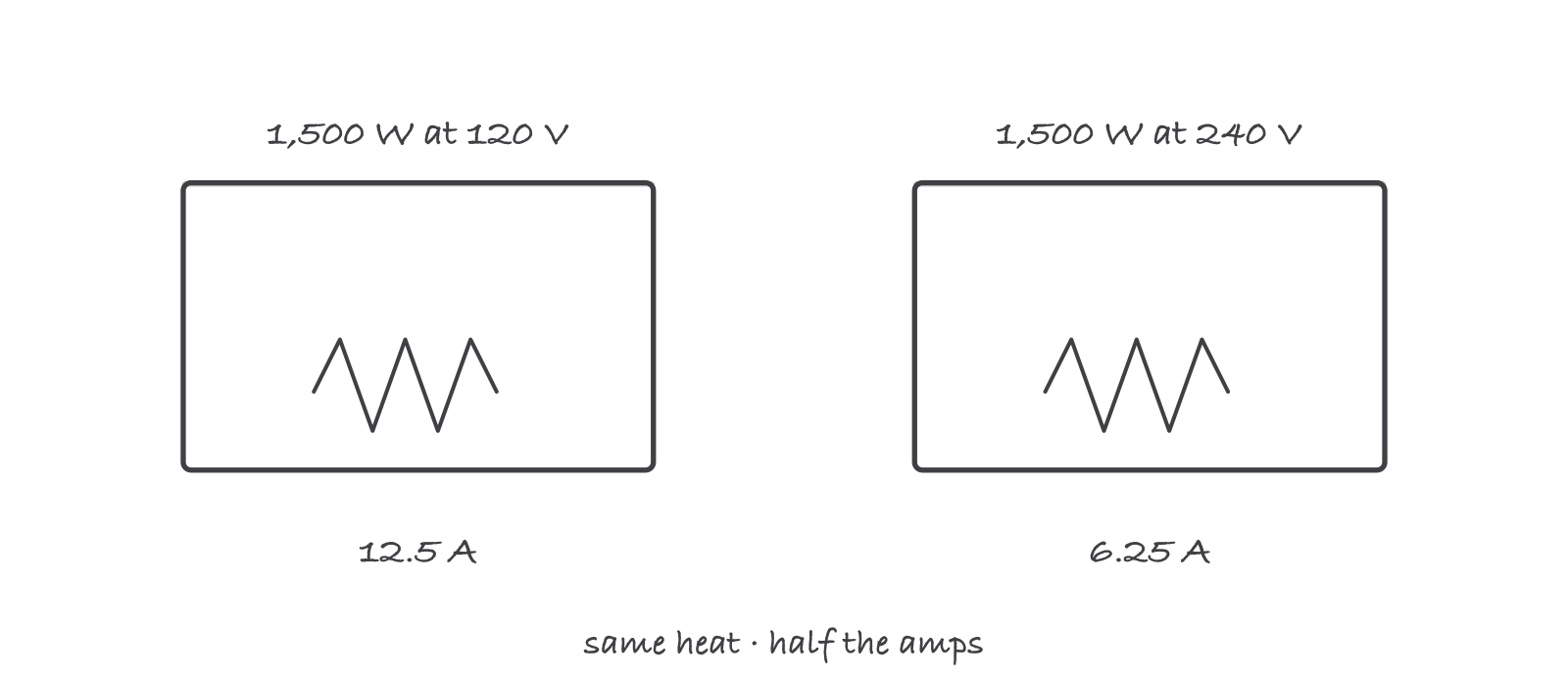
Same heat either way; the voltage decides how many amps deliver it
Running cost: 1.5 kW × 8 hours = 12 kWh per day.
Where it bites
- Watts and volt-amperes diverge on real AC equipment. Motors and electronics draw more current than P = E × I predicts because of power factor, the AC lessons cover it. For resistive loads (heaters, incandescent lamps), watts and VA agree.
- The square in I²R is not intuition, it is arithmetic, small current increases make outsized heat. Trust the formula over the gut.
- Nameplate watts are maximums or ratings, not always running draw; measure when it matters.
Exam relevance
The power wheel, the twelve combinations of P, E, I and R, is a fixture of journeyman exam prep, and power questions hide inside load-calculation, motor and conductor questions everywhere. Drill P = E × I until conversions are instant.