Learn · Electrical
Motor Protection
Part of Journeyman Electrician Exam Prep · step 61 of 73 · next: Motor Troubleshooting
In learning paths: Journeyman Electrician Exam Prep
Assumes you know: Motor OCPD and Conductor Sizing
A motor faces two different electrical threats, and no single device handles both. Short circuits and ground faults are cleared by the branch-circuit breaker or fuses; overloads, current that is too high for too long, are cleared by the overload relay. Motor protection is the art of letting these two devices each do only its own job.
Why it matters on the job
A motor circuit is the one place where the breaker is deliberately sized far above the running current, because it must ride through starting inrush without tripping. That leaves the motor unprotected against slow overcurrent unless something else watches for it. The something else is the overload relay, and misunderstanding this division of labor is behind a large share of burned motors and nuisance trips. You sized these devices in Motor OCPD and Conductor Sizing; this lesson is about what each one actually protects against and how the overload relay thinks.
Two devices, two jobs
Short-circuit and ground-fault protection (the fuses or breaker) exists for faults: a bolted phase-to-phase or phase-to-ground event where current jumps to many times even locked-rotor current. It must clear that instantly, yet sit high enough to ignore a legitimate start. The percentages that set it live in NEC Article 430, reached through the tables you used in the calculations lesson.
Overload protection exists for the motor’s thermal life. A jammed load, a lost phase, low voltage, or a seized bearing all push current above nameplate without ever looking like a fault. Heat builds in the windings over seconds and minutes; insulation cooks; the motor fails. The overload relay models that heating and opens the control circuit before the winding temperature gets there.
How the overload relay thinks
Overload elements come in three flavors: melting-alloy (a heater melts a solder pot and releases a ratchet), bimetallic (a heater bends a bimetal strip), and electronic (current transformers and a thermal algorithm). All three behave the same way from outside: the further current rises above the setpoint, the faster they trip, a shape called an inverse-time curve, because they are imitating how fast the winding itself heats.
Trip class states how long the relay holds at locked-rotor current, defined at 600% of the setting: a Class 10 relay trips within 10 seconds at 600%, Class 20 within 20 seconds, Class 30 within 30. Pick the class to match the start: a light load that spins up in 2 seconds suits Class 10; a high-inertia load that takes 12 seconds to accelerate needs Class 20, or it will trip on every normal start.
The relay is set from nameplate full-load current, not from the breaker size and not from measured current on a lightly loaded day. The nameplate service factor and temperature rating feed the adjustment rules in Article 430.
Worked example
A motor with nameplate FLA of 10 A and locked-rotor current of 60 A, protected by a Class 20 overload relay set at 10 A, behind a breaker sized per Article 430 to carry the start.
- Normal start: current sits at 60 A, which is 600% of the setting. Class 20 gives the motor up to 20 seconds at that current; the motor accelerates in 4 seconds; nothing trips.
- Jammed load: current goes to 60 A and stays. The relay times out within its 20-second window and opens the control circuit; the contactor drops out. The breaker never moves, 60 A is a number it was chosen to ignore.
- Bolted fault: current leaps to many hundreds of amps. The breaker clears in a cycle or two. The overload relay, a slow thermal device, contributes nothing here, and is not built to interrupt fault current anyway.
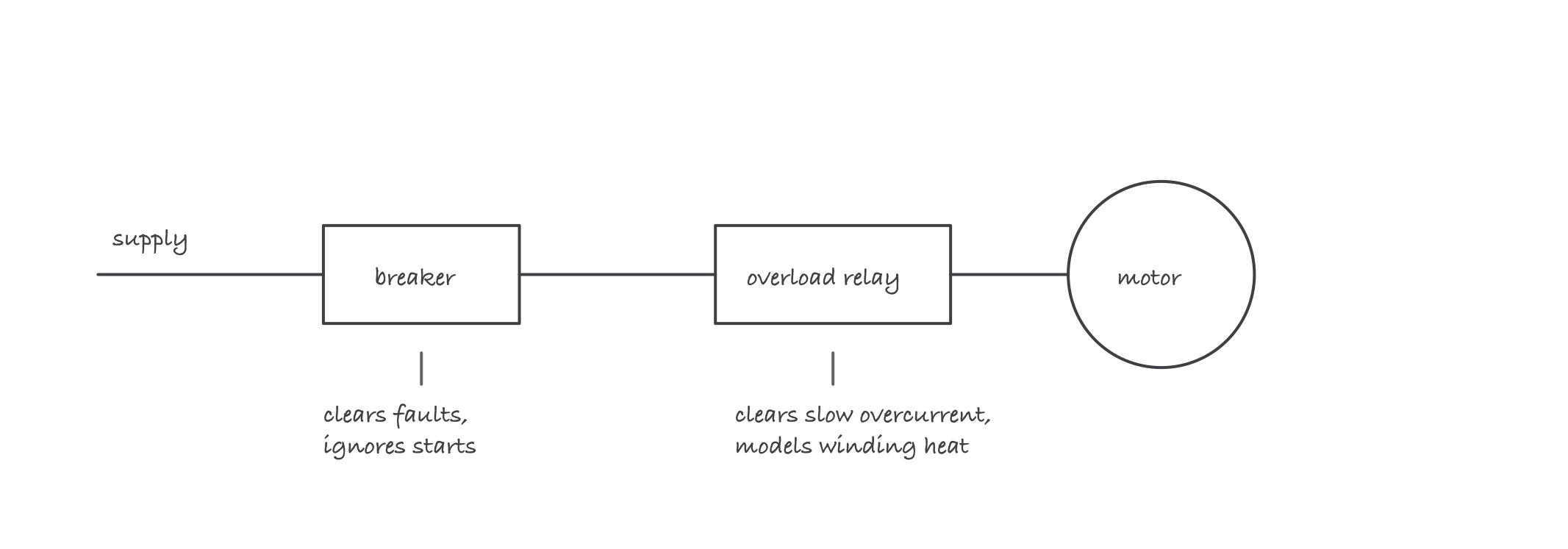
The breaker ignores anything a start could look like; the overload relay watches heat build; the motor needs both
Where it bites
- “The breaker protects the motor” is the classic wrong sentence. On a motor branch circuit the breaker protects the conductors against faults. A motor can cook to death at a current the breaker will carry all day.
- Overload trips are a symptom, not the disease. Resetting an overload relay repeatedly without finding the mechanical or supply cause finishes the motor off. Find the jam, the lost phase, or the low voltage first.
- Setting overloads from measured current instead of nameplate under-protects a motor measured on a light day and nuisance-trips one measured under peak load. The nameplate is the contract.
- Single-phasing is an overload event. Lose one phase and the remaining windings carry extra current. Modern electronic relays detect phase loss directly; melting-alloy elements catch it only through the extra heat, more slowly.