Learn · Electrical
Control Circuits
Assumes you know: Series-Parallel Circuits
A control circuit is the small circuit that decides what the big circuit does. The power circuit carries the load current, a motor’s amps, through heavy contacts. The control circuit carries a trickle of current through the buttons, switches, and relay coils that open and close those contacts. Separate the two in your head and every ladder diagram you ever read becomes a story you can follow.
Why it matters on the job
Almost every machine failure call starts in the control circuit: a stop button, an interlock, a coil, a loose terminal in the skinny wiring. The power circuit is three fat conductors doing exactly what the control circuit tells it. Troubleshooting a machine without reading its control scheme is guesswork; reading it turns the machine into a series circuit puzzle you already solved in Series-Parallel Circuits.
Reading the ladder
Control schemes are drawn as ladder diagrams: two vertical rails carrying the control voltage, with each horizontal rung a path from one rail to the other through some contacts and ending in a load, usually a coil. Current flows across a rung only when every contact in series along it is closed. Devices are drawn in their resting, de-energized state: a normally open (NO) contact is drawn open, a normally closed (NC) contact drawn closed.
Machines fed at higher voltage usually derive the control voltage from a control transformer, stepping, say, 480 V down to 120 V so operators’ buttons and the panel wiring live at a lower, more manageable voltage.
Two-wire and three-wire control
Two-wire control puts a maintained-contact device, a thermostat, float switch, or pressure switch, in series with the coil. Contact closed, machine runs; open, it stops. Simple, and it has a personality you must respect: after a power outage, if the contact is still closed, the machine restarts by itself the moment power returns. Right for unattended equipment like sump pumps, dangerous for a table saw.
Three-wire control uses momentary buttons plus a seal-in contact. The start button is NO, the stop button NC in series, and an auxiliary contact on the coil’s own device is wired in parallel with the start button. Press start, the coil energizes, and the auxiliary contact closes around the start button, sealing the circuit in. The magic is what happens on power loss: the coil drops out, the seal-in opens, and the machine stays off until a human presses start again. That behavior is called low-voltage protection, and it is why operator-attended machines use three wires.
Worked example: trace the classic rung
A 480 V machine with a 4:1 control transformer giving 120 V control. One rung: L1 rail, NC stop button, NO start button, coil M, L2 rail, with auxiliary contact M wired around the start button.
- Press start. Current flows L1, through the closed stop, through the pressed start, through coil M, to L2. M energizes: the power contacts close and the motor starts, and the auxiliary contact M closes.
- Release start. The button springs open, but current now flows through the sealed-in M contact instead. The motor keeps running: the circuit remembers.
- Press stop. The series path breaks, coil M drops out, power contacts and the seal-in both open. Releasing stop does nothing: the memory is erased.
- Power fails and returns. Same as pressing stop: the seal-in opened when the coil dropped, so the machine waits for a human.
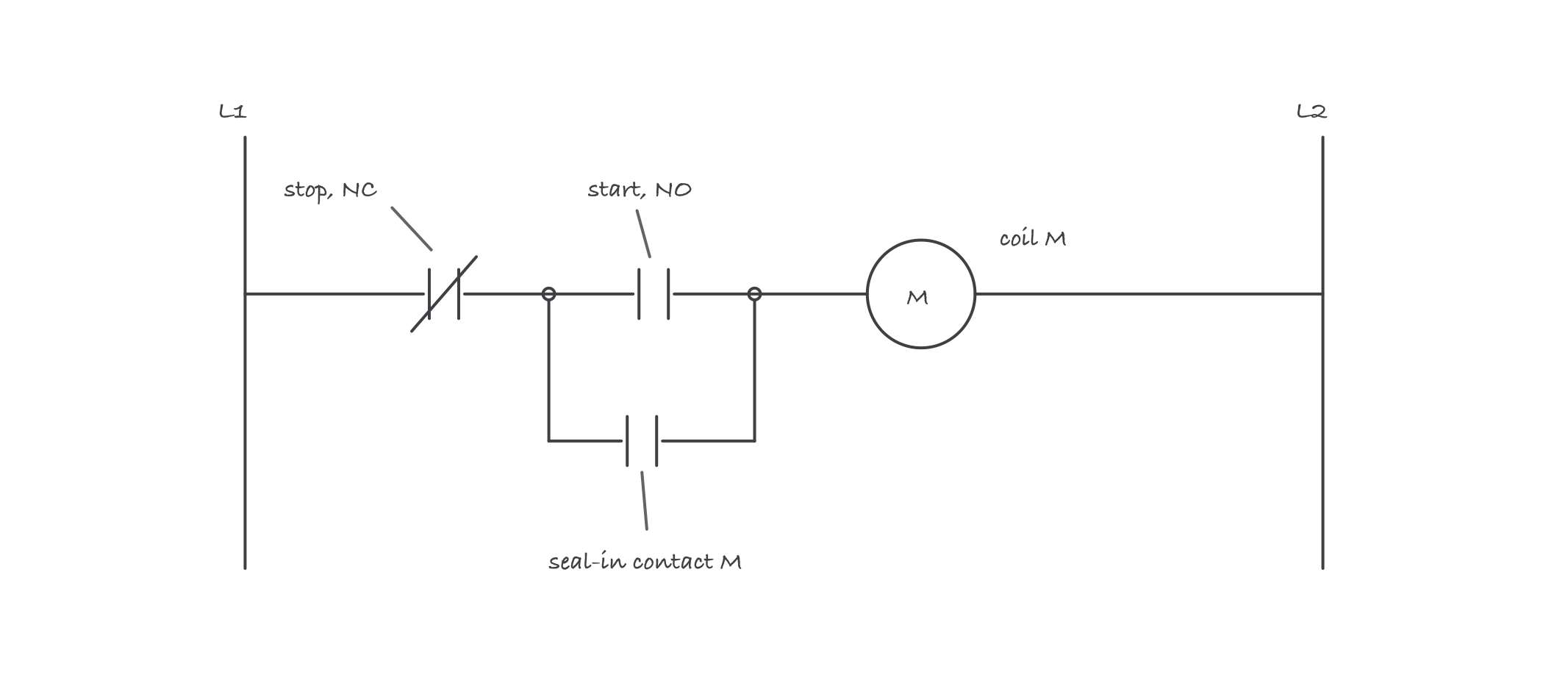
One rung of memory: the seal-in contact closes around the start button, and the NC stop breaks the whole story with one press
Where it bites
- Stops go in series, starts go in parallel. Every additional stop device (E-stops, interlocks, overload contacts) is another NC contact in the series path; every additional start station is another NO button in parallel. Reverse that and you build a machine that cannot be stopped from one station.
- Drawn state is de-energized state. A ladder shows the circuit asleep. Techs misread NC contacts as “currently closed” on a running machine and chase phantom faults.
- Two-wire control restarts by itself. After an outage, every two-wire-controlled machine on the site is a machine about to start without warning. Know which scheme you are standing next to.
- The control circuit has its own protection. A blown control-transformer fuse kills a machine as dead as a tripped main, and it is checked in seconds. Start small, then go big.