Learn · Electrical
Transformer Sizing and Protection
Part of Master Electrician Exam Prep · step 9 of 12 · next: Selective Coordination
In learning paths: Master Electrician Exam Prep
Assumes you know: Transformer Calculations
Sizing a transformer means converting the load it must carry into kVA, then choosing the next standard rating above it, with room for the future. Protecting it means respecting two of its habits: it draws a violent magnetizing inrush at energization, and it will cheerfully cook itself serving an overload it cannot feel. The arithmetic came in Transformer Calculations; this lesson is the judgment that goes around the arithmetic.
Why it matters on the job
An undersized transformer runs hot and dies early; a grossly oversized one wastes money and core losses around the clock. And a transformer is unusual among the things you protect: its primary OCPD must ignore an inrush surge many times full-load current, while its secondary side can deliver enormous fault current to conductors that leave it. Master-level work is getting all three, size, primary protection, secondary protection, right at once.
Sizing from the load
For three-phase, kVA is line-to-line voltage times line current times the square root of 3, divided by 1,000. In symbols: kVA = 1.732 × V × I / 1000. For single-phase, drop the 1.732.
Work from the realistic connected load with diversity applied per your adopted code’s load-calculation rules, then select the next standard kVA rating above the answer. Dry-type distribution transformers come in a familiar ladder of standard sizes (15, 30, 45, 75, 112.5, 150, 225, 300 kVA and up), and the step you choose should also weigh known future load: the price step between two adjacent sizes is often small compared to the cost of changing out a transformer later.
Then convert the chosen kVA back into full-load current on each side, because those two currents drive everything else: conductor sizes, OCPD ratings, and the termination hardware.
Protecting both sides
Primary protection guards the transformer and must ride through magnetizing inrush, a surge at energization that can reach many times full-load current for a few cycles. NEC Article 450 sets the maximum OCPD ratings as percentages of full-load current, with the allowances depending on voltage class and whether secondary protection exists; the tables and their percentages are the prerequisite lesson’s territory, and the code text governs.
Secondary protection guards the conductors leaving the transformer. This is the piece people miss: primary OCPD sized generously enough to ride inrush cannot see, let alone clear, a modest overload on the secondary, because the turns ratio divides the current it observes. The secondary conductors get their own protection sized to their own ampacity, per Articles 240 and 450 as adopted in your jurisdiction.
Worked example
A 208Y/120 V panel with a calculated load of 250 A, to be fed from a 480 V system.
Load kVA = 1.732 × 208 × 250 / 1000 = 90 kVA. Next standard size up: 112.5 kVA.
Secondary full-load current: 112,500 / (1.732 × 208) = 312 A. Primary full-load current: 112,500 / (1.732 × 480) = 135 A.
Those two numbers now anchor the design: the 312 A side sets the secondary conductor ampacity and its OCPD, the 135 A side sets the primary OCPD within its Article 450 ceiling, and the spare margin between 250 A of load and 312 A of capacity is the growth headroom the next tenant will thank you for.
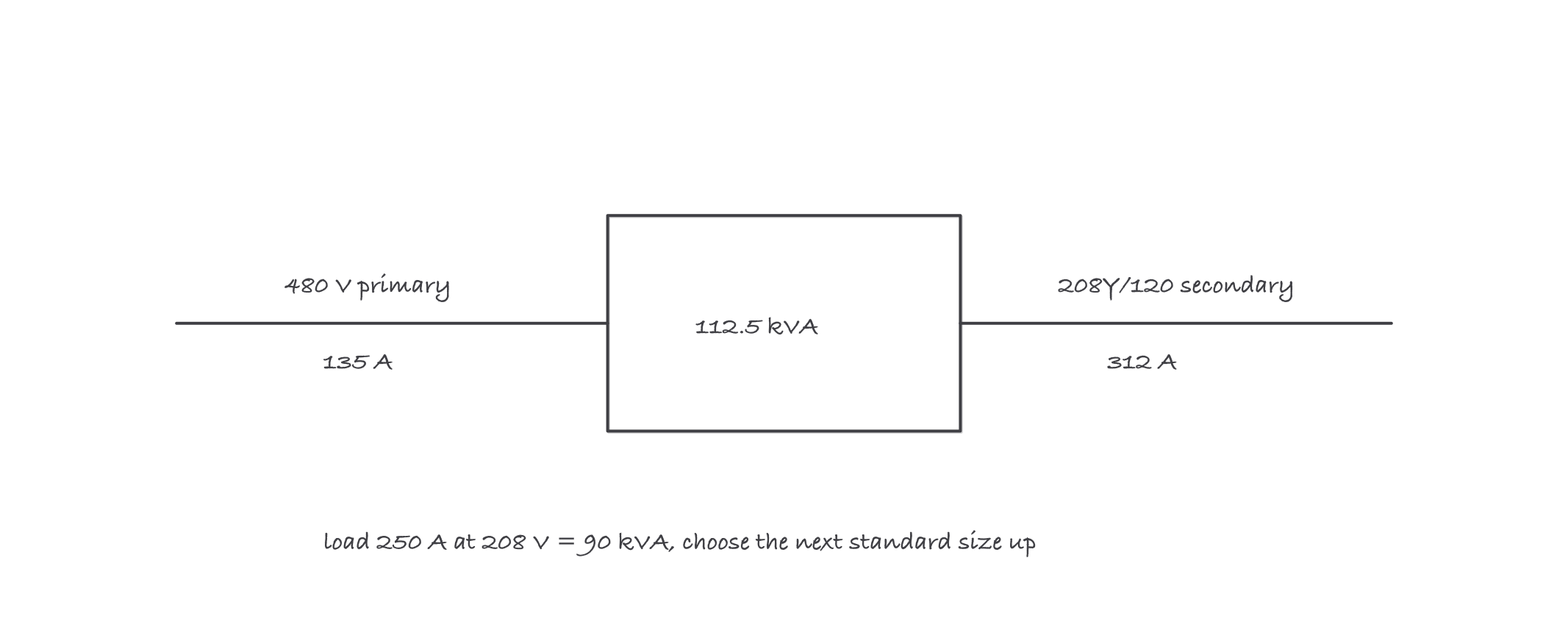
Load to kVA, kVA to the next standard size, then back to amps on each side: every later decision hangs off those two currents
Where it bites
- Primary protection does not protect the secondary conductors. The ratio scales the current down before the primary OCPD sees it. Treat the secondary as the start of a new protection story, every time.
- Inrush trips look like mystery faults. A breaker that trips only at energization, with everything testing clean, is often just seeing magnetizing inrush; the fix is protection selected per Article 450’s allowances, not a bigger hammer.
- kVA is not kW. Transformers are rated for current, so a low-power-factor load fills a transformer with amps at less useful power. Size against kVA demand, not the wattage on the equipment schedule.
- The standard-size ladder tempts rounding down. A computed 90 kVA against a 75 kVA unit “almost fits”, and runs hot for its whole shortened life. The ladder only rounds up.