Learn · Electrical
Code Cycles and State Adoption
Part of Journeyman Electrician Exam Prep · step 67 of 73 · next: Finding Code Answers Fast
In learning paths: Journeyman Electrician Exam Prep
Assumes you know: How the NEC Is Organized
The NEC is revised on a three-year cycle, 2017, 2020, 2023, 2026, but the edition that governs your work is not the newest one printed: it is the one your state or local jurisdiction has legally adopted, amendments included. Two electricians on opposite banks of a river can be working under different books, and both are right.
Why it matters on the job
Which edition applies decides real answers: whether a receptacle needs a certain protection, where surge protection is required, how a calculation runs. Bidding, inspecting, and exam-taking all key off the adopted edition, and assuming “latest book wins” causes both kinds of error: building to a requirement that is not yet law in your jurisdiction, or missing one that is. Journeymen who work across jurisdiction lines carry this awareness like a tool.
How the cycle and adoption actually work
The cycle. NFPA revises the NEC every three years through a public process: proposed changes, committee review, public comment, and issuance. Each edition lands with substantive changes, new requirements, renumbered articles, revised tables, which is why “what edition?” is the first question in any code discussion.
Adoption. The NEC has no force of law by itself. It becomes enforceable when a state legislature, state board, or local government adopts it into regulation, and each jurisdiction does this on its own schedule. Some states adopt a new edition within a year or two of issuance, others run several editions behind, and some leave adoption entirely to cities and counties. Adoption also commonly comes with amendments: the jurisdiction strikes, modifies, or adds requirements, so the governing document is “the adopted edition as amended here”, not the bare book.
The AHJ. The authority having jurisdiction, the state board, the city electrical inspector, enforces the adopted code and interprets it where interpretation is needed. Which edition is in force, and which local amendments ride on it, is published by the adopting authority: the state electrical board or licensing agency, or the local building department. That is always the source of truth; never a vendor site, never word of mouth, and never this or any training material.
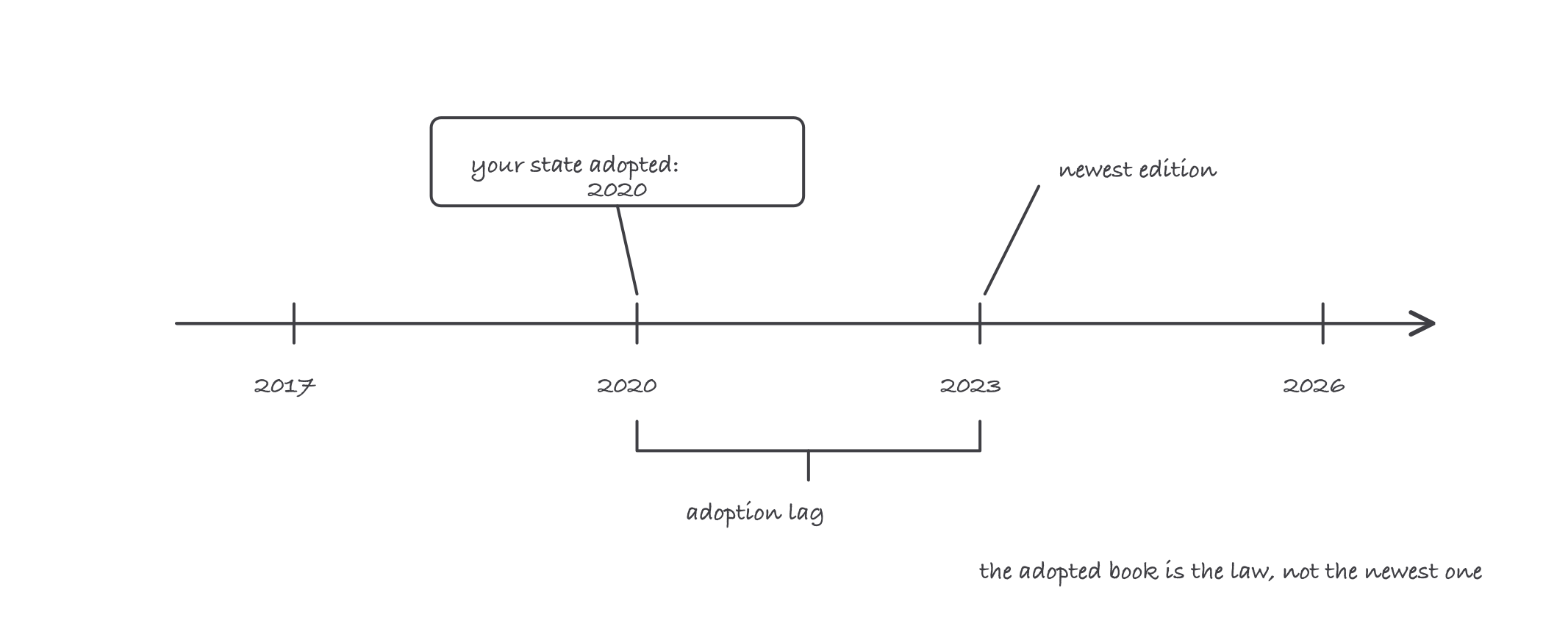
A new book every three years; the law in your jurisdiction is the one it adopted, not the one just printed
Worked example
You run jobs on both sides of a state line. State A has adopted the 2023 NEC with amendments; State B is still enforcing the 2020 edition. A requirement added in the 2023 cycle, say an expanded protection requirement, is live law on Monday’s job in State A and not yet law on Tuesday’s job in State B, while a State A amendment might delete a requirement the bare 2023 book contains.
The working procedure, every time you enter a new jurisdiction: confirm the adopted edition and amendments with the AHJ or the state board’s published adoption notice; match your code book, your calculations, and your material list to that edition; and when a plan reviewer cites a section, verify the citation against the adopted book, since section numbers migrate between editions. The pattern is fixed even though every jurisdiction’s answer is different, and the answer changes over time, so re-check on a cycle, not once per career.
Where it bites
- “Code-compliant” is meaningless without an edition. A panel schedule, a device listing claim, or an online answer that does not name its edition cannot be checked. Demand the edition, give the edition.
- Newest is not safest to assume. Building to the newest edition in a jurisdiction that has not adopted it is usually acceptable practice but can conflict with local amendments, and citing it to an inspector enforcing an older book wins no arguments.
- Amendments are invisible in the bare book. The NEC volume on your dash does not show what your state struck or added. The adoption regulation does; read it once per jurisdiction, keep it with the book.
- Renumbering breaks memorized citations across editions. The surge-protection move into Article 242 is the running example in this subject: same concept, different address depending on the adopted edition.
Exam relevance
Licensing exams are written against a specific NEC edition, named in the candidate bulletin, and it is not always the newest one: exam bodies and state boards lag the cycle just like adoption does. Confirm the referenced edition with your state board or exam provider before you study, buy and tab that edition, and drill in it, because table values and section numbers you practice must match the book you are allowed to carry into the exam room.
Verified requirements
| Where | Expires | Renewal | Continuing education |
|---|---|---|---|
| Texas | Yes | 1 year | 4 hours per annual renewal cycle |
Information comes from issuing-authority sources. Confirm current rules, fees and eligibility with the authority before acting.