Learn · Electrical
GFCI Protection
Part of Journeyman Electrician Exam Prep · step 42 of 73 · next: AFCI Protection
In learning paths: Journeyman Electrician Exam Prep
Assumes you know: The Effective Fault-Current Path
A GFCI does one comparison, continuously: current leaving on the hot against current returning on the neutral. Equal means every electron came home through the circuit. Unequal means current is returning some other way, through a fault path, through water, through a person, and at an imbalance of about 5 mA, a Class A GFCI opens the circuit in a fraction of a second.
Why it matters on the job
The GFCI is a people protector. Breakers and fuses guard wire from overload at 15 A and up; a lethal shock can ride 50 mA, a current three hundred times too small for any breaker to notice. The GFCI is the only device on the circuit watching at the scale where human hearts operate, and the code’s list of locations that require it, everywhere water and people meet, keeps growing with every edition. Hold this distinction for the next lesson too: GFCI protects people from shock, AFCI protects buildings from fire, and they are not substitutes for each other.
How the comparison works
Hot and neutral both pass through a small current-transformer ring inside the device. Current out and current back create opposing magnetic fields; when the circuit is healthy they cancel exactly, and the ring sees nothing. Any imbalance means current is escaping the hot/neutral loop, and the ring sees precisely the missing amount. At the Class A threshold of 4 to 6 mA, electronics trip the internal contacts, typically within a few tens of milliseconds.
The threshold is set by physiology: enough current to feel, below the level where muscles clamp and letting go becomes impossible, far below fibrillation territory. The speed matters as much as the level: current times time is what injures.
Notice what the comparison does not need: the equipment grounding conductor. The GFCI measures the imbalance itself, which is why a GFCI works on a two-wire circuit with no ground anywhere, and why the code-typical replacement pattern allows GFCI-protected ungrounded receptacles, labeled “No Equipment Ground”, where old two-wire circuits cannot be rewired.
Line, load, and where protection reaches
Every GFCI receptacle has line terminals (power in) and load terminals (protection out). Landing the incoming feed on line protects that device; everything wired onward from load inherits the protection, which is how one device covers a string of ordinary receptacles downstream. GFCI breakers protect the entire circuit from the panel instead.
Where GFCI is required follows one instinct, water: bathrooms, kitchens and sink-adjacent counters, garages, outdoors, unfinished basements, crawl spaces, laundry areas. The exact list is your code’s, it grows each cycle, and exam questions quote it precisely.
Worked example
Put numbers on a fault. A damaged drill cord leaks to a wet hand:
- Hot delivers 10.000 A to the running drill. Healthy return on neutral would be 10.000 A.
- The leak sends 6 mA through the user to ground. Neutral now returns 9.994 A.
- The ring sees the 6 mA difference, over the Class A window, and the GFCI opens in roughly 25 ms.
- The user feels a sharp jolt and lets go, because the event ended before muscle lock-in. Without the GFCI, 6 mA sustained is near the let-go boundary, and a worsening fault has no ceiling: the breaker would wait for 15 A, 2,500 times the trip level, indefinitely.
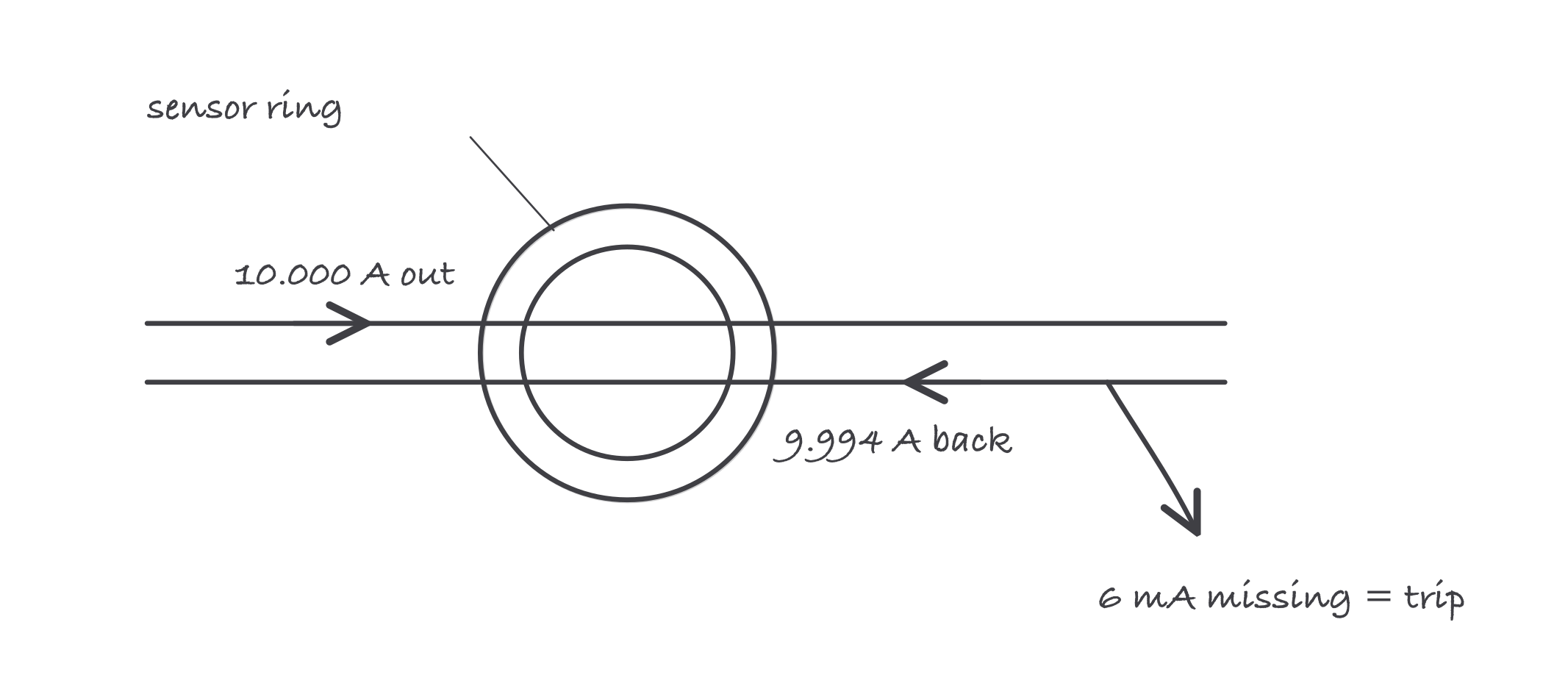
The whole device is a subtraction: out minus back should be zero, and about 5 mA of missing current is the Class A trip line
Where it bites
- GFCI is not overcurrent protection. It will happily pass 40 A on a balanced circuit; the breaker still owns overload duty. The two protections answer different questions.
- Line and load swapped. The receptacle still delivers power, its face may even protect, but the downstream string is bare and the test button lies about it. Landing the feed on load is the classic miswire; verify downstream with a tester after install.
- “Nuisance” trips usually are not. A GFCI that trips on the same appliance repeatedly is reporting real leakage current, often moisture in a heating element or a failing motor winding. Replacing the GFCI to silence it removes the messenger.
- No ground, no test-button substitute. On ungrounded circuits the internal test button works, but plug-in testers, which leak current to the ground pin, cannot trip it. Know which tool proves what.
- Protection scope assumptions. One GFCI in a bathroom does not certify the garage. Protection reaches exactly what is wired through load terminals or the protected breaker, nothing else.
Verified requirements
| Where | Expires | Renewal | Continuing education |
|---|---|---|---|
| Texas | Yes | 1 year | 4 hours per annual renewal cycle |
Information comes from issuing-authority sources. Confirm current rules, fees and eligibility with the authority before acting.