Learn · Electrical
Demand Factors
Part of Journeyman Electrician Exam Prep · step 26 of 73 · next: Residential Load Calculations
In learning paths: Journeyman Electrician Exam Prep
Assumes you know: Branch Circuit Calculations
A demand factor is the fraction of connected load a calculation actually has to carry, because real loads never all run at once. The code book’s demand tables convert the sum of everything installed into the smaller number the wiring must genuinely support. Demand factors are why a house full of appliances runs happily on a 150 A service.
Why it matters on the job
Size every feeder and service for the connected total and you will build absurdly, expensively oversized systems: no apartment building ever has all its ranges on broil simultaneously. Diversity is real, measured, and codified. The demand tables let you take credit for it, legally and predictably, and load calculations are mostly the disciplined application of these tables.
How demand factors work
The pattern is always the same: a threshold taken at 100 %, then a percentage applied past the threshold. The first slice of load is assumed to be fully in use; the further you go past it, the less likely each additional volt-ampere is to be drawn at the same moment.
The big ones from your code book’s tables:
- Dwelling general lighting and receptacles: first 3,000 VA at 100 %, the portion from 3,001 to 120,000 VA at 35 %.
- Household ranges: a single range up to 12 kW is charged 8 kW, and the per-range charge keeps falling as ranges are added; the range table is its own small world.
- Clothes dryers: 5,000 VA minimum each, 100 % for the first four, sliding down as the count grows.
- Fixed appliances (standard dwelling method): four or more fastened-in-place appliances → 75 % of their total.
- Nondwelling receptacles: first 10 kVA at 100 %, remainder at 50 %.
What never gets a demand factor matters just as much: continuous loads, most motor loads, and electric space heating are carried at full value or more.
Worked example
A 12-unit apartment building has a 12 kW range in every unit. What range load does the service calculation carry?
- Connected load: 12 × 12 kW = 144 kW.
- The range demand table, at 12 appliances, gives a demand of 27 kW.
- The service carries 27 kW, less than 19 % of what is bolted to the walls.
One range alone shows the same machinery: 12 kW connected, 8 kW demand. Even a single household cannot keep every burner, both ovens, and the broiler at maximum together, and the table knows it.
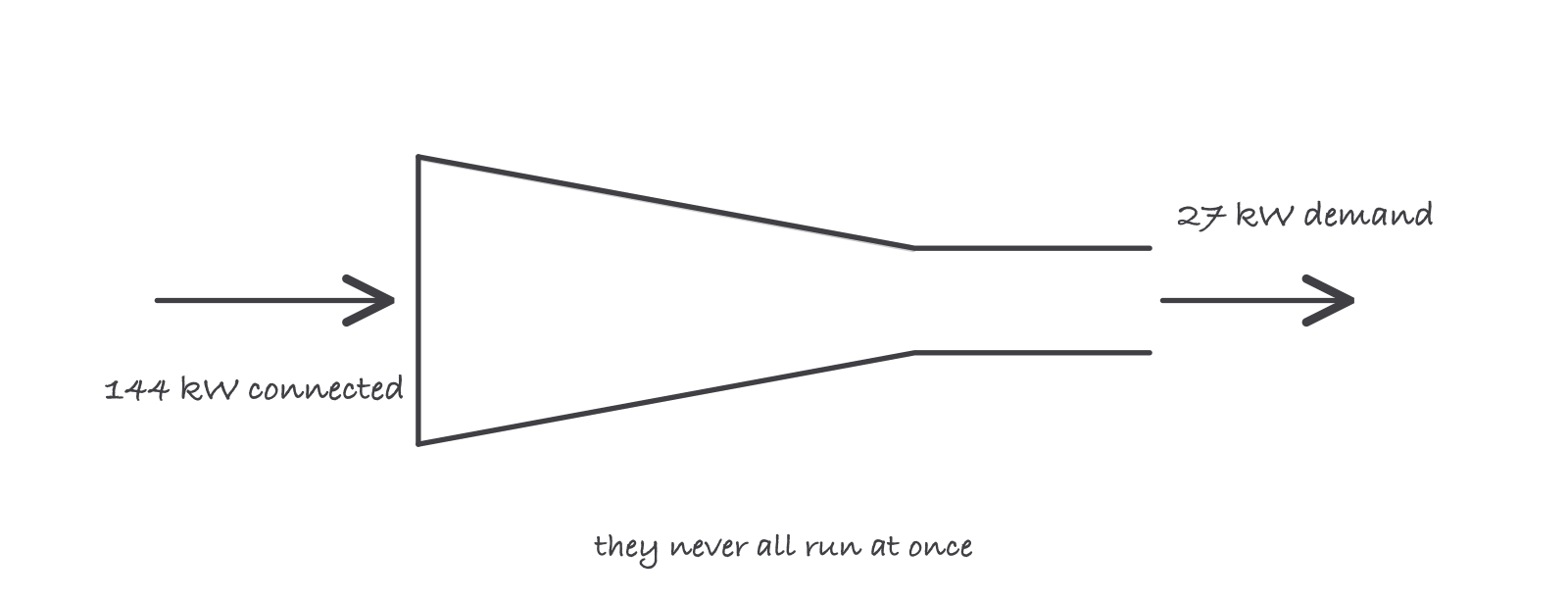
The demand table is a funnel: connected load in, the load the wiring must really carry out
Where it bites
- Demand factors only exist where a table grants them. There is no general “stuff never all runs” allowance. If the code book has no demand table for a load, it rides at 100 %, and continuous loads ride at 125 %.
- Thresholds are per calculation, not per circuit. The 3,000 VA dwelling threshold applies once to the whole general load, not once per circuit. Applying it repeatedly double-dips the discount.
- The range table has special rules at the edges. Ranges over 12 kW adjust the column value upward, and small ranges use percentage columns instead. Read the table’s notes; the notes are where exams live.
- Branch circuits get no demand factors. The circuit feeding the range must handle the range. Demand factors are a feeder and service concept; applying them one level too low undersizes real wiring.
Exam relevance
Demand factors are the heart of every load-calculation exam section. Examiners test the mechanics (apply 35 % past 3,000 VA correctly), the table edges (13 ranges, a 15 kW range), and the concept itself: which loads take demand factors and which never do. The tables are in the exam book; the discipline of applying them in order is what earns the marks.
Verified requirements
| Where | Expires | Renewal | Continuing education |
|---|---|---|---|
| Texas | Yes | 1 year | 4 hours per annual renewal cycle |
Information comes from issuing-authority sources. Confirm current rules, fees and eligibility with the authority before acting.