Learn · Electrical
MC and AC Cable
Part of Journeyman Electrician Exam Prep · step 30 of 73 · next: Service-Entrance Cable
In learning paths: Journeyman Electrician Exam Prep
Assumes you know: Conductor Types and Insulation
MC and AC are the armored cables: insulated conductors inside a spiral of interlocked metal. They look nearly identical on the reel, but they solve grounding in opposite ways, and that single difference drives almost every rule that separates them.
Why it matters on the job
Where NM cannot go, MC usually can. Commercial tenant fit-outs, ceilings above offices, and multifamily buildings run on MC cable the way houses run on NM: cut, strip, snap in a fitting, done. AC cable, the older cousin sold as BX, still fills existing buildings, and you must recognize which one is in your hand, because treating one like the other creates a grounding failure that works fine until the day it has to carry a fault.
Two cables, two ground paths
AC cable carries an internal bonding strip, a thin aluminum ribbon running under the armor in contact with it. Strip and armor together are listed to serve as the equipment grounding conductor. There is no green wire inside a standard AC cable; the armor is the ground. That is also why every AC termination gets an anti-short bushing, the little red insulator slipped between the conductors and the sharp cut edge of the armor: the armor is a circuit part, and the conductors must be protected where they exit it.
MC cable of the common interlocked type makes no such promise. Its armor is not listed as an equipment ground, so a green insulated grounding conductor runs inside with the circuit conductors. The armor is protection and nothing more; the ground path is the wire, terminated like any other EGC. (Specialty MC-AP styles with a bare aluminum ground under the armor blur this line, but only when the printing and the listing say so.)
Identification is fast: peel the armor back. Bond strip and no green wire, it is AC. Green wire inside, it is MC. Believe the cable, not the label on the box it came from.
Where each one lives
AC is a dry-location method, similar in territory to NM but permitted in more building types. MC has the widest territory of any cable: dry or wet locations when it wears a PVC jacket and uses fittings listed for the location, in cable tray, embedded where listed, and in most commercial construction. Fittings must be listed for the specific cable; an MC connector and an AC connector are not interchangeable parts, even when they look alike.
Securing the run
The pattern matches NM’s grammar with different numbers, and your code’s tables govern: secured within 12 in of every box, then intervals of 4.5 ft for AC and 6 ft for MC as the classic table values. Both cables also get the flexibility allowance at equipment: short unsecured lengths are permitted where flexibility is needed at a connection, which is why MC whips to light fixtures are legal.
Worked example
A tenant fit-out adds receptacles fed from a ceiling junction box, 20 ft away, using 12/2 MC:
- Peel and check: green insulated ground inside, so the armor is not the fault path. The green lands on the box ground screw with the branch EGC.
- Termination: MC connector listed for the cable, armor cut clean, no anti-short bushing required by listing, though many electricians fit one anyway as cheap insurance.
- Securing: within 12 in of each box, then intervals of 6 ft or less. About 19 ft separates the two end fastenings, and 19 ÷ 6 = 3.2, so the span needs 4 gaps, which means 3 intermediate fasteners. That spaces the supports at roughly 4.75 ft each: under the limit, evenly walked off.
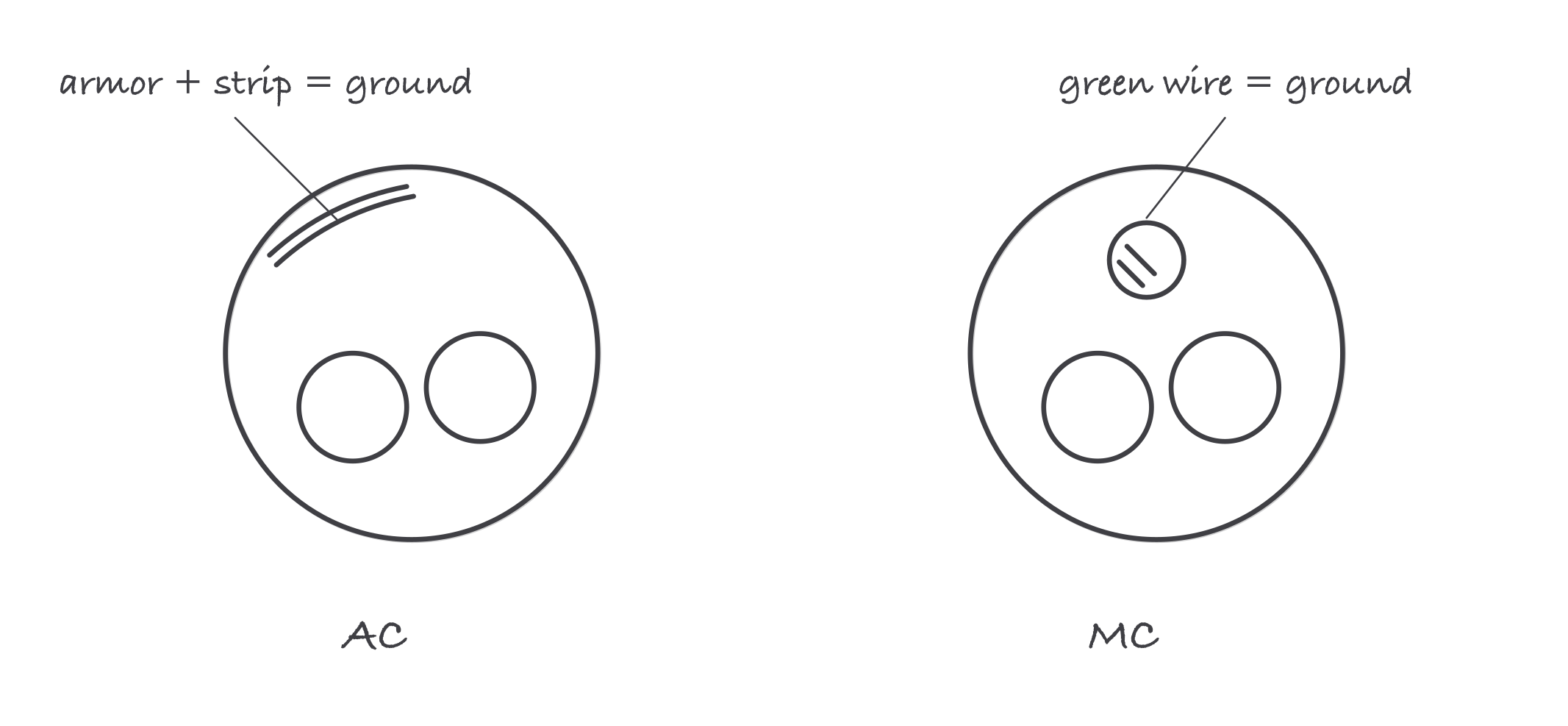
Same armor, opposite promise: AC grounds through its armor and bond strip, MC grounds through the green wire it carries inside
Where it bites
- Using MC armor as the ground. The armor conducts, a meter reads continuity, and the installation is still wrong: the interlocked spiral is a long, high-impedance helix that overheats under fault current. Only AC’s armor-plus-strip combination is listed for the job.
- The missing red head. Skipped anti-short bushings on AC are the inspection catch that never goes away. The armor edge is a cutting tool aimed at the conductor insulation.
- Wrong fitting, right cable. Connectors are listed per cable type and, outdoors, per location. A dry-location MC connector in a wet location fails the listing even if it threads on perfectly.
- Dikes on the armor. Cutting armor with diagonal pliers nicks conductor insulation. Use a rotary armor cutter and inspect the conductors every time.
Verified requirements
| Where | Expires | Renewal | Continuing education |
|---|---|---|---|
| Texas | Yes | 1 year | 4 hours per annual renewal cycle |
Information comes from issuing-authority sources. Confirm current rules, fees and eligibility with the authority before acting.