Learn · Electrical
Selective Coordination
Part of Journeyman Electrician Exam Prep · step 53 of 73 · next: Surge Protection
Part of Master Electrician Exam Prep · step 10 of 12 · next: Separately Derived Systems
In learning paths: Journeyman Electrician Exam Prep · Master Electrician Exam Prep
Assumes you know: Short-Circuit Current and AIC Ratings
Selective coordination means that when a fault happens, the overcurrent device nearest the fault opens, and every device upstream of it stays closed. One branch breaker trips; the feeder breaker, the main, and the rest of the building ride through. It is the difference between losing one circuit and blacking out a floor, and for certain systems the NEC makes it mandatory, not elegant.
Why it matters on the job
At master level you are the one signing distribution designs, and coordination is a design property: it exists or fails based on the devices you chose, and no inspector can see it in the field. The Code requires selective coordination for the systems where an unnecessary outage is dangerous, emergency systems (Article 700), legally required standby systems (Article 701), and critical operations power systems (Article 708), and owners increasingly demand it everywhere else because uptime is money.
Curves that must not touch
Every fuse and breaker has a time-current curve: how long it takes to open at every level of current, the inverse-time shape from Overcurrent Protection Fundamentals, drawn on log-log paper. Coordination is a geometry exercise: plot the downstream device’s curve and the upstream device’s curve on the same sheet. If, at every current level the system can deliver, the downstream device clears before the upstream device begins to operate, the pair is selectively coordinated. Where the curves cross or overlap, there is a band of fault current where both devices race, and the upstream one may win, taking out everything it feeds.
The hard region is the bottom of the chart: high-current, instantaneous territory, where both breakers want to trip in the same cycle. This is where the available-fault-current work from Short-Circuit Current and AIC Ratings feeds in: you coordinate up to the fault current actually available at each point, not to infinity. Fuse systems often coordinate by published selectivity ratios between fuse classes; breaker systems rely on curve studies and manufacturer coordination tables. Either way, the study is documentation you produce, keep, and hand the AHJ on request.
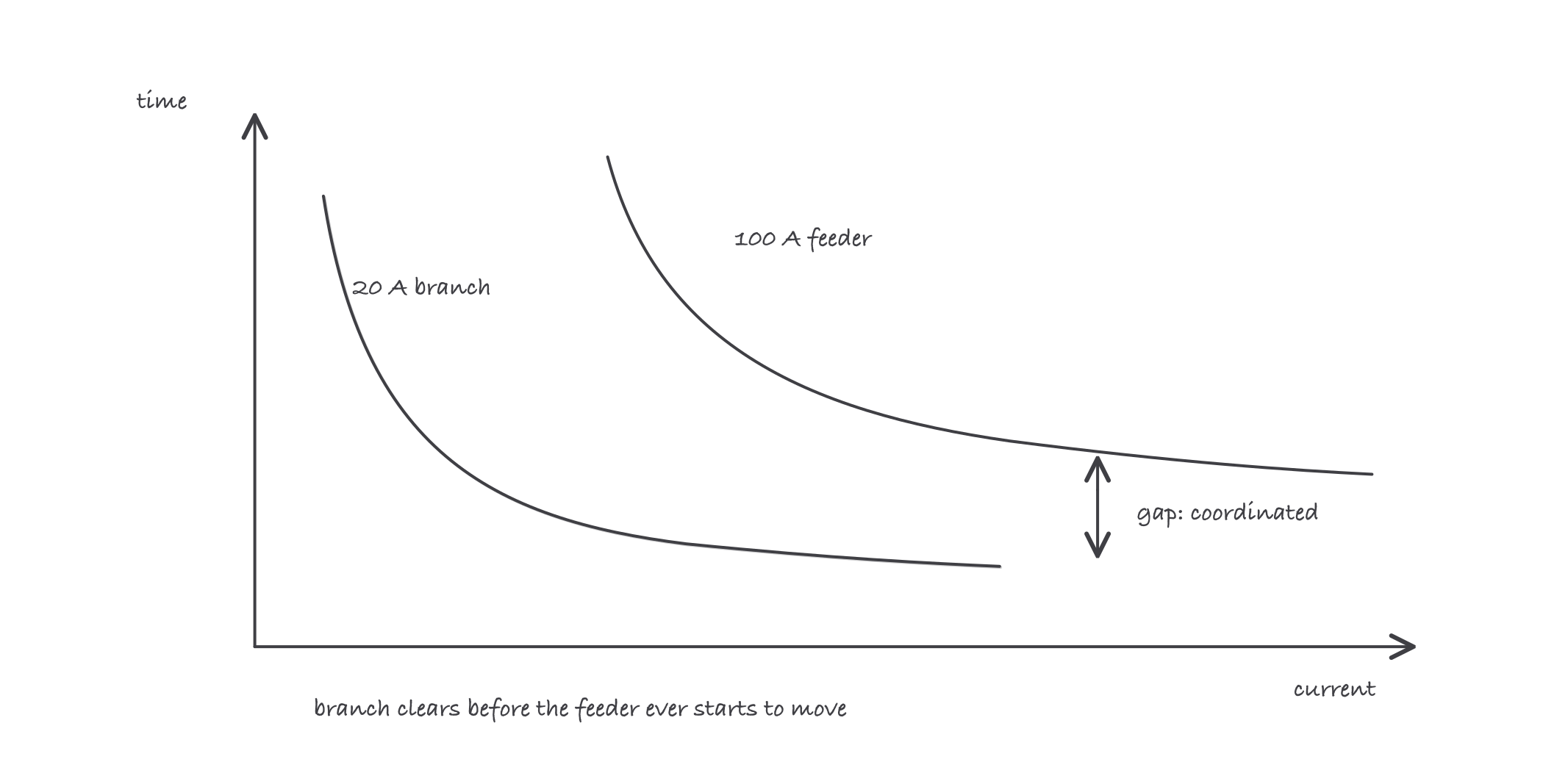
Coordinated means the curves never meet: the near device is always done before the far one starts
Worked example
A fault of 1,500 A hits a branch circuit fed through three layers: a 20 A branch breaker, a 100 A feeder breaker, a 400 A main.
Express the fault as multiples of each rating: 1,500 ÷ 20 = 75 times the branch rating, 1,500 ÷ 100 = 15 times the feeder, 1,500 ÷ 400 = 3.75 times the main. The same fault sits at a different depth in each device’s curve: far into the branch breaker’s instantaneous region, into the feeder’s instantaneous threshold territory, and only in the overload-to-short transition for the main.
If the branch breaker’s instantaneous trip clears the fault within its first cycle, before the feeder breaker’s mechanism commits, only the branch opens: coordinated. But if the feeder breaker’s instantaneous pickup is set at, say, 10 times its rating (1,000 A) with the same speed, both devices see an instantaneous-level fault at 1,500 A and both may open. The fix is device selection: a feeder breaker with a short-time delay, a higher instantaneous setting verified against the curves, or a fuse pairing with a published ratio. The arithmetic that framed the problem is yours; the curves that resolve it come from the manufacturers’ data.
Where it bites
- A coordinated pair at one fault level may not coordinate at another. Coordination must hold across the full range of available fault current. “Selective up to X amps” is the honest, and sometimes required, statement.
- Coordination and protection pull in opposite directions. Slowing upstream devices to achieve selectivity increases let-through energy, which collides with equipment SCCR and arc-flash energy. Master-level design is balancing the two.
- Swapping a breaker model kills a study silently. Coordination lives in the specific curves of specific devices. A same-rating substitution at the supply house can un-coordinate a system with no visible change.
- Where the Code requires it, “mostly coordinated” fails. For the Article 700, 701 and 708 systems, selective coordination is a listed design requirement reviewed on documents. Budget for the study, not just the gear.