Learn · Electrical
Switches and Switching Circuits
Part of Journeyman Electrician Exam Prep · step 40 of 73 · next: Terminations and Splices
In learning paths: Journeyman Electrician Exam Prep
Assumes you know: Boxes and Enclosures
A switch interrupts the hot conductor, never the neutral. Hold that single rule and the whole family unfolds: the single-pole switch breaks one hot, the 3-way pair steers it between two paths, and the 4-way crosses the paths in the middle. The names count terminals, not locations.
Why it matters on the job
Switching is where circuit tracing becomes a daily skill. Three-way circuits confuse more homeowners, and fail more journeyman practical questions, than any other residential wiring, and the confusion always has the same root: not knowing which terminal is the common. Meanwhile the never-switch-the-neutral rule is a safety boundary: a light controlled by a switched neutral turns off convincingly while its socket stays hot.
The family, by terminal count
Single-pole: two brass terminals plus ground, marked ON and OFF. The hot enters one terminal and leaves the other when closed.
3-way: three terminals plus ground, no ON/OFF marking, because either toggle position can be on. One terminal is the common, identified by its darker screw and its position alone at one end of the device; the other two are travelers, interchangeable with each other. Two 3-ways control a light from two locations: hot feeds the first common, two travelers connect the pairs, and the second common feeds the light. Each switch connects its common to one traveler or the other; the light is on whenever both switches select the same traveler.
4-way: four traveler terminals plus ground, wired into the travelers between the two 3-ways. In one toggle position it passes the travelers straight through; in the other it crosses them. Every additional control location is one more 4-way spliced into the traveler pair; the two 3-ways always bookend the run.
Neutral at the switch box: the modern code pattern requires a grounded conductor at most switch locations, because dimmers, timers, and smart switches are electronics that need a return path to run their own brains. The white looped down in old switch-loop wiring, re-marked as a hot, is exactly what current practice is moving away from.
Worked example
Trace a 3-way hallway circuit, power arriving at the first switch:
- Panel hot lands on the common of switch 1, the odd-colored screw.
- Two travelers leave switch 1 on the interchangeable pair, run through 3-wire cable to switch 2’s traveler pair. Either traveler to either terminal: no polarity between them.
- Switch 2’s common continues as the switched hot to the luminaire. Neutral runs unbroken from panel to luminaire, and a neutral lands in each switch box per the modern pattern.
- Check the logic: both switches selecting traveler A, circuit complete, light on. Switch 1 flips to traveler B, path broken, light off. Switch 2 also flips to B, path complete again, light on. Any single toggle always changes the state, which is the definition of a working 3-way.
- Add a third location later: break the travelers anywhere between the 3-ways and insert a 4-way.
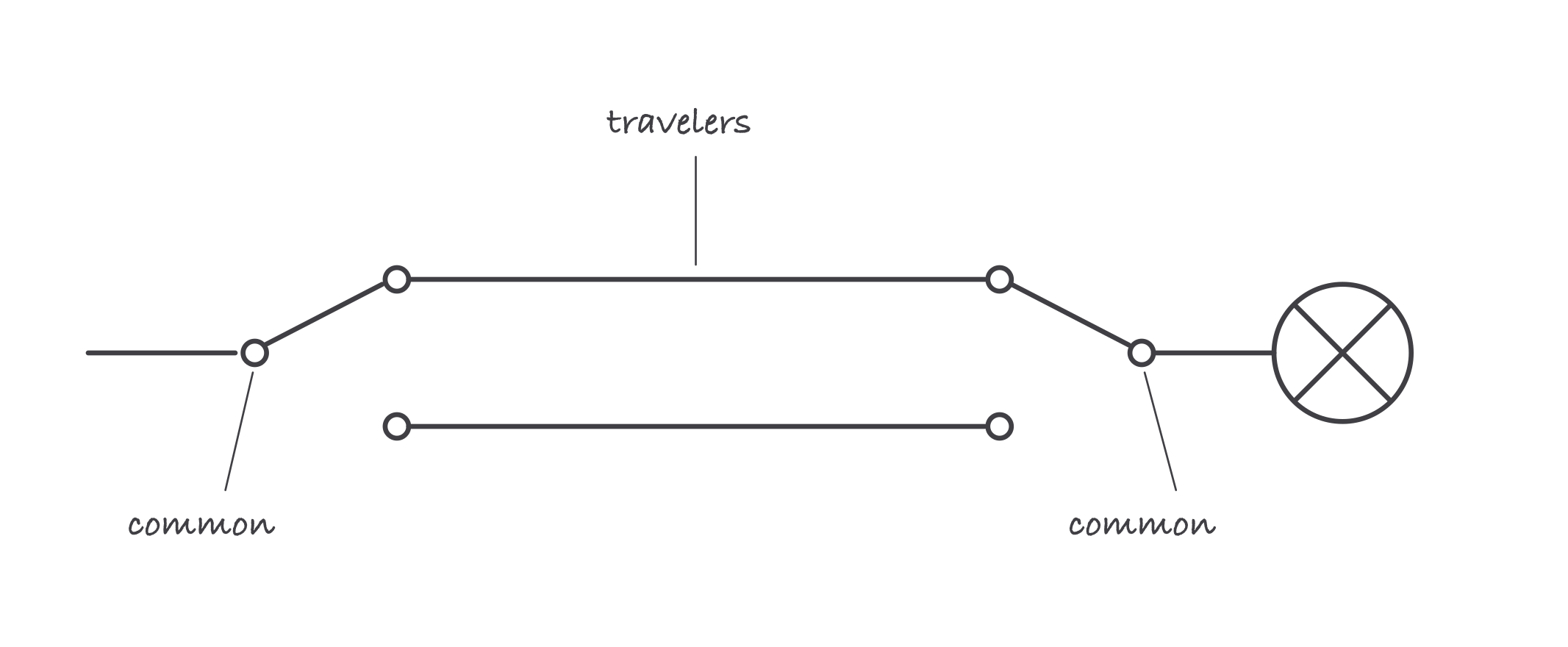
The hot enters at one common, rides whichever traveler both switches agree on, and leaves from the other common to the light
Where it bites
- Guessing the common. The dark screw and the lone-position terminal identify it, and on a replacement, the wire on the old common gets marked before anything comes apart. Wiring a traveler to the common produces the classic works-from-one-end-only 3-way.
- Switched neutrals. Old installs and bad repairs sometimes break the white instead of the black. The light obeys the switch, and the fixture is live at the socket the whole time. Kill and verify at the fixture, not at the switch.
- 4-way on the wrong pair. A 4-way spliced onto a common instead of between travelers half-works in ways that defy casual troubleshooting. The 4-way’s terminals are two marked pairs; keep each cable’s travelers on one pair.
- No neutral for the smart switch. A retrofit dimmer that needs a neutral meets a switch loop that does not have one. Check the box before promising the customer anything.
- ON/OFF markings as identification. A 3-way has no ON/OFF because it cannot promise one; a marked toggle in a multi-location circuit means someone installed a single-pole where a 3-way belongs, and the circuit now only works from one place.
Verified requirements
| Where | Expires | Renewal | Continuing education |
|---|---|---|---|
| Texas | Yes | 1 year | 4 hours per annual renewal cycle |
Information comes from issuing-authority sources. Confirm current rules, fees and eligibility with the authority before acting.