Learn · Electrical
Transformer Connections (Delta and Wye)
Part of Master Electrician Exam Prep · step 4 of 12 · next: Short-Circuit Current and AIC Ratings
In learning paths: Master Electrician Exam Prep
Assumes you know: How Transformers Work, Three-Phase Power
Three-phase transformation uses three windings per side, and each side can be connected one of two ways: delta, the windings joined end-to-end in a closed triangle, or wye, one end of each winding tied to a common neutral point. Which shape you choose on each side decides the voltages available, whether a neutral exists, and which loads the bank can serve.
Why it matters on the job
The connection is the difference between a service that can feed 120 V receptacles and one that cannot. Reading 208Y/120 or 480Y/277 on a nameplate, knowing where the neutral comes from, and recognizing a high leg before your meter does are master-level fundamentals, and mistakes here put the wrong voltage on whole panels at once.
Wye: the neutral maker
In a wye, each winding sits between one line and the common neutral point. Line-to-neutral voltage is the winding (phase) voltage; line-to-line voltage is the phase voltage times the square root of 3 (about 1.732), because the two windings you are measuring across are 120 degrees out of step, as Three-Phase Power showed.
That factor builds the two service voltages you see everywhere: windings of 120 V give 208 V line-to-line (208Y/120), and windings of 277 V give 480 V line-to-line (480Y/277). One connection, two usable voltage levels, and a neutral for the low one.
Delta: the closed triangle
In a delta, line-to-line voltage IS the winding voltage, there is no neutral point in the triangle. The square root of 3 moves to the current instead: line current is winding current times 1.732. Delta secondaries suit three-phase power loads that need no neutral.
One variation earns special caution: the center-tapped delta, where one winding’s midpoint is grounded to create a neutral for 120 V loads. Two lines then sit 120 V from neutral, but the third line, the high leg, sits at 120 × 1.732 = 208 V from neutral. The NEC requires the high leg to be identified, orange is the familiar marking, and it must never feed a line-to-neutral load expecting 120 V.
The most common building arrangement is a delta primary with a wye secondary: for example 480 V delta in, 208Y/120 out, the delta side needing no neutral from the source, the wye side creating one for the loads.
Worked example
A wye secondary wound for 120 V per winding: line-to-line = 120 × 1.732 = 208 V. A wye wound for 277 V: 277 × 1.732 = 480 V. Working backward from a nameplate: 480Y/277 must be a wye, because 480 / 277 = 1.732.
Now a 240 V center-tapped delta: line-to-line is 240 V everywhere, and the two lines flanking the grounded midpoint each read 120 V to neutral. The third line reads 120 × 1.732 = 208 V to neutral. Same three wires, three different line-to-neutral answers, which is exactly why you meter every leg to neutral before landing single-phase circuits.
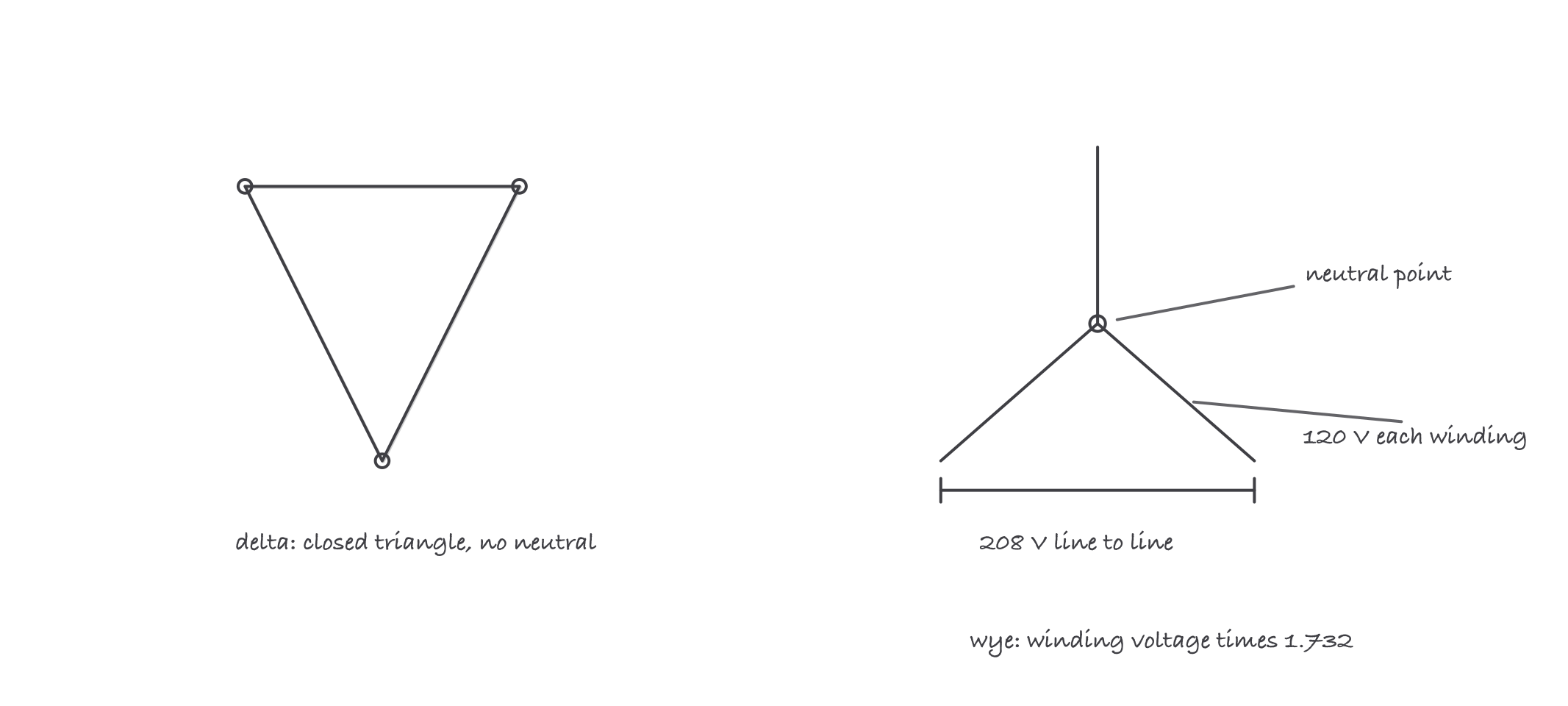
Delta closes the triangle with no neutral; wye ties a common point and multiplies winding voltage by 1.732 between lines
Where it bites
- The square root of 3 attaches to voltage in wye and to current in delta. Putting it on both, or the wrong one, is the most common calculation error in this territory.
- The high leg does not announce itself. On a center-tapped delta, a meter from line to line reads a healthy 240 V on every pair. Only line-to-neutral readings expose the 208 V leg. Meter to neutral first, every leg, every unfamiliar panel.
- 208 V is not “about 240 V”. Equipment rated 240 V runs weak and hot on 208 V unless it is rated for both. The nameplate of the load decides, not the similarity of the numbers.
- A wye nameplate voltage names both numbers for a reason. 208Y/120 tells you the system and the neutral voltage in one string; learn to read the notation and half the connection questions answer themselves.