Learn · Electrical
Panelboards and Load Centers
Part of Journeyman Electrician Exam Prep · step 46 of 73 · next: Feeders
In learning paths: Journeyman Electrician Exam Prep
A panelboard is the distribution hub: one set of incoming conductors lands on bus bars, and breakers tap those buses to create the branch circuits that feed everything in the building. A load center is the residential-grade version of the same thing, the gray box in the garage. The NEC covers both in Article 408, and to the Code they are all panelboards.
Why it matters on the job
You will spend more hours in panels than in any other single piece of equipment: roughing in new circuits, ripping out doubled-up neutrals, balancing loads, replacing breakers. Understanding what the bus structure actually is, two hot legs and a neutral in a typical dwelling, turns the panel from a wall of breakers into a diagram you can read at a glance.
Anatomy of a panel
Main breaker or main lugs. A main-breaker panel includes its own disconnect and overcurrent protection. A main-lug-only (MLO) panel has none: incoming conductors land straight on the bus, so its protection must live upstream, which is the usual arrangement for the subpanels covered next in this group.
Bus bars. In a 120/240 V single-phase panel there are two hot buses, leg A and leg B, fed from opposite ends of the utility transformer winding. Adjacent breaker positions alternate legs down the panel. A one-pole breaker taps one leg: 120 V to neutral. A two-pole breaker taps both legs: 240 V across them, which is why 240 V breakers occupy two spaces.
Neutral bar and ground bar. The neutral bar takes the grounded conductors, the ground bar takes equipment grounding conductors. Whether the two are bonded together depends on whether the panel is service equipment, the exact issue the Subpanels lesson is built around.
Panels are rated by bus ampacity (100 A, 200 A) and by spaces, the number of breaker positions.
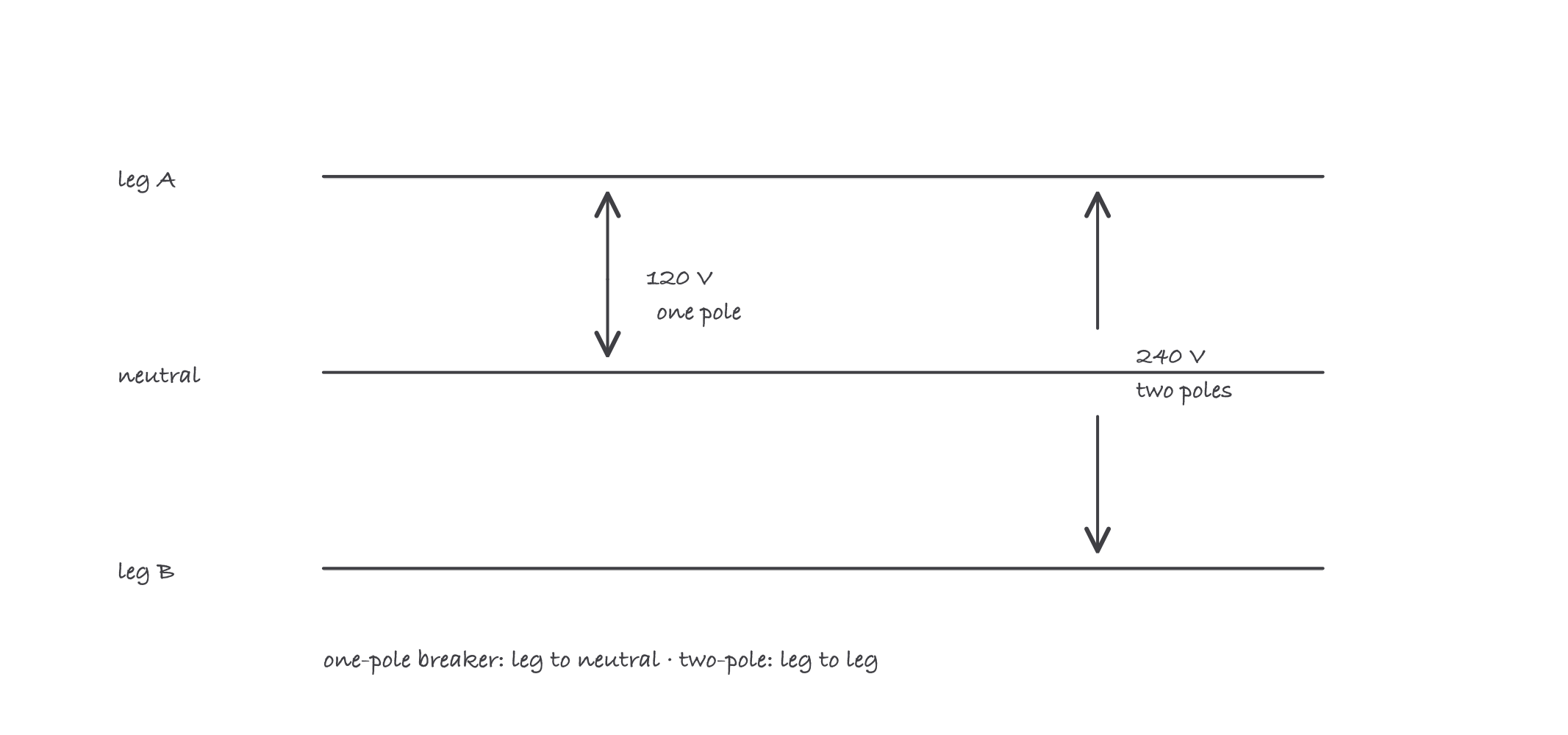
Alternating legs down the bus: one pole reaches 120 V, two poles reach 240 V
Worked example
Balance check on a 120/240 V load center. Add up the running loads on each leg: leg A carries 62 A, leg B carries 48 A. The neutral carries only the imbalance: 62 − 48 = 14 A back to the source.
Now move a 10 A, 120 V circuit from leg A to leg B: leg A drops to 52 A, leg B rises to 58 A, and the neutral current falls to 58 − 52 = 6 A. Same total load, cooler neutral, more even bus heating. That is why you distribute 120 V circuits across both legs instead of stacking them on one side.
Where it bites
- One neutral per lug, unless listed otherwise. Doubled neutrals under one screw is one of the most common panel citations. Check the panel’s labeling for what each lug accepts.
- Breakers must be listed for the panel. The buses and breaker stabs are a matched, listed system. A breaker that physically snaps on is not automatically legal, look for the panel label’s accepted types.
- Spaces are not circuits. Marketing names like “20-space, 40-circuit” mean the panel accepts listed tandem breakers in some positions. The label, not the sticker price, says where.
- MLO does not mean unprotected. The overcurrent protection for a main-lug panel exists, it is just upstream. Find it before you work.