Learn · Electrical
Motor Troubleshooting
Part of Journeyman Electrician Exam Prep · step 62 of 73 · next: How the NEC Is Organized
In learning paths: Journeyman Electrician Exam Prep
Assumes you know: Motor Protection
Motor troubleshooting is a process of elimination across three territories: the supply, the motor, and the load. Nearly every dead, tripping, or overheating motor falls to a fixed sequence of measurements, and the sequence keeps you from swapping a healthy motor to cure a supply problem, the most expensive wrong answer in the trade.
Why it matters on the job
At master level you are the person called after the reset button has already been pushed five times. A motor that trips its overload is telling you a true story about current and heat; your job is to find which territory the story starts in. Random parts-swapping on motor circuits wastes cranes, downtime, and motors, and the misdiagnosis rate is high precisely because a supply-side fault and a winding fault can produce identical symptoms at the motor.
Work the sequence
1. Supply first, under load. Measure all three line-to-line voltages at the motor terminals with the motor running (or trying to). You are looking for two things: voltage well off nameplate, and imbalance between phases. One low or missing phase points upstream: a blown fuse, a worn contactor pole, a loose lug heating and dropping voltage.
2. Compute the voltage unbalance. Average the three readings, find the largest deviation from the average, and divide deviation by average. Even a few percent of unbalance drives a disproportionate amount of extra heat in the windings, trade training uses the rule of thumb that percentage extra temperature rise is roughly twice the square of the percent unbalance, so small unbalance numbers are worth chasing.
3. Current per phase, against the nameplate. Clamp each line. All three high and balanced: the load is demanding too much, look at the machine. One phase at zero with the others high: single-phasing, go back upstream. Currents unbalanced far more than the voltages: suspect the motor’s windings.
4. Motor electrical checks, de-energized and disconnected. Winding-to-winding resistance on a three-phase motor should be low and closely matched across the three; one high or open reading is a failed winding, one much lower can be shorted turns. Insulation resistance from windings to frame with a megohmmeter (an insulation tester using several hundred to a thousand volts) tells you whether the insulation is failing to ground; a healthy motor reads high, a wet or cooked one reads low. Follow the tester manufacturer’s procedure and the plant’s acceptance values.
5. Mechanical last, and by hand. With everything locked out, turn the shaft. Grinding, roughness, or a shaft that will not turn is a bearing or load problem no electrical part will fix. Uncouple the load and compare: motor free but machine seized tells you where the work order really goes.
Worked example
A 460 V motor trips its overload relay every afternoon. Terminal voltages read 470 V, 460 V, and 430 V.
Average = (470 + 460 + 430) / 3 = 453 V. Largest deviation = 453 − 430 = 23 V. Unbalance = 23 / 453 = 5.1%.
By the rule of thumb, extra temperature rise is roughly 2 × (5.1)² ≈ 52% more heat than the motor was built for. The motor is innocent. Tracing the low phase upstream finds one contactor pole burned and resistive: it drops voltage under load, which is why mornings were fine and loaded afternoons tripped. Replacing the motor would have changed nothing.
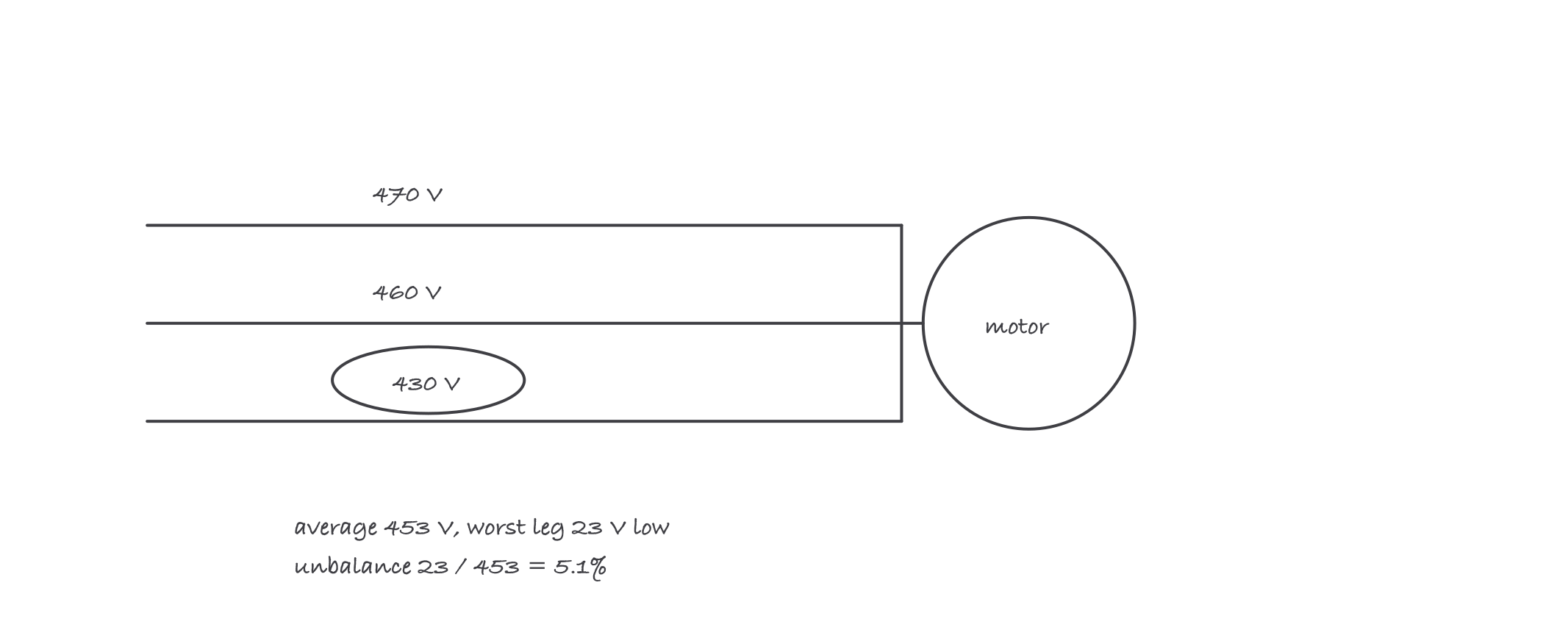
Three readings, one average, one deviation: the 430 V leg convicts the supply before the motor cover ever comes off
Where it bites
- A tripped overload does not mean a bad overload relay. Jumping out or upsizing the relay to stop trips removes the motor’s only thermal protection and converts a diagnosis into a burnout.
- Voltage checks at the starter can pass while the motor terminals fail. A resistive connection between starter and motor only shows its voltage drop under load, at the motor end. Measure where the motor lives, while it is working.
- Megohmmeter voltage cooks electronics. Disconnect the motor from its drive or starter electronics before an insulation test; the test voltage that is harmless to windings destroys VFD output stages.
- Heat has a memory. A motor that has been severely overheated may test fine today and fail in a month; note the event, because the insulation life is already spent.