Learn · Electrical
Derating and Adjustment Factors
Part of Journeyman Electrician Exam Prep · step 22 of 73 · next: Box Fill Calculations
In learning paths: Journeyman Electrician Exam Prep
Assumes you know: Ampacity
Derating is the correction you apply when a conductor’s real conditions are worse than the conditions its table ampacity assumes: more than 3 current-carrying conductors bundled together, or ambient hotter than 30 °C (86 °F). The table number is a starting point; adjustment and correction factors multiply it down to what the wire can actually carry.
Why it matters on the job
Wires in a bundle heat each other. A conduit through an attic starts the day hot before any current flows. The ampacity table cannot know your conduit is stuffed with nine conductors and runs over a roof, so the code book hands you multipliers and makes the correction your job. Skip it and every wire in that raceway runs beyond its heat budget, invisibly, for years.
The method
Start from the 90 °C column. This is where THHN’s 90 °C rating finally earns its keep. Derating math begins at the conductor’s own insulation rating, even though terminations limit the final answer to the 75 °C value. From your code book’s table, 90 °C copper: #12 = 30 A, #10 = 40 A, #8 = 55 A.
Multiply by the adjustment factor for conductor count. More than 3 current-carrying conductors in a raceway or cable bundle: 4 to 6 conductors → 80 %, 7 to 9 → 70 %, 10 to 20 → 50 %. Neutrals that carry only unbalanced current and equipment grounds do not count.
Multiply by the temperature correction factor. For ambient above 30 °C, the correction table gives a multiplier under 1. For a 90 °C conductor in 96 to 104 °F ambient the factor is 0.91; hotter bands drop further.
Compare the result to the load, and cap at the 75 °C value. The corrected ampacity must cover the load, and the final usable number can never exceed what the terminations allow.
Worked example
Nine #12 THHN current-carrying conductors share one EMT run through a ceiling space that reaches 100 °F. They feed receptacle circuits, each loaded to 16 A on 20 A breakers.
- Start: #12 THHN at 90 °C = 30 A.
- Nine current-carrying conductors → 70 %: 30 × 0.70 = 21.0 A.
- 100 °F ambient → 0.91: 21.0 × 0.91 = 19.1 A.
- 19.1 A covers the 16 A load, but a 20 A breaker cannot protect a 19.1 A conductor, and the next-size-up allowance is off the table for multioutlet receptacle circuits. Fail.
Upsize to #10 THHN and rerun the stack:
- Start: #10 at 90 °C = 40 A.
- 40 × 0.70 = 28.0 A.
- 28.0 × 0.91 = 25.5 A.
- 25.5 A ≥ 20 A. The 20 A breakers stand, on #10 wire.
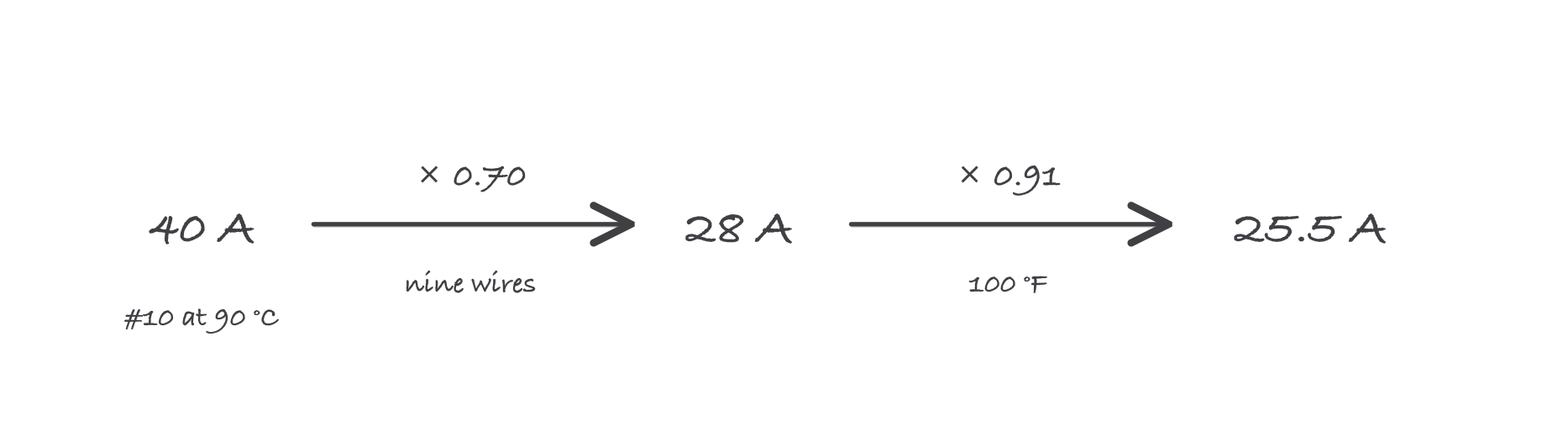
The derating stack: table value in, one multiplier per bad condition, real ampacity out
Where it bites
- Starting from the 75 °C column throws wire away. The whole reason to buy 90 °C insulation is the taller starting number for this math. Derate from 30 A, not 25 A, for #12 THHN.
- Counting conductors wrong is the classic miss. Count current-carrying conductors, not wires. A 3-wire circuit with a true neutral counts as 2 in most cases; grounds never count. Nine circuits of 2-wire cable through one bored hole in a stud bay can trigger the same bundling factor as conduit.
- Both factors apply together. Heat from bundling and heat from ambient stack; so do the multipliers. Applying only the worse one is not a shortcut, it is a violation.
- The small-conductor caps still stand. Derating never lets a #12 land on a breaker above 20 A, no matter how favorable the math.
Exam relevance
Derating questions are pure method: examiners give the conductor count, the ambient, and the insulation, and every wrong option is one skipped step. Work the stack in writing, start at 90 °C, adjustment then correction, and check the answer against the termination value and the breaker. Multi-step, but the factors are printed in the exam’s code book; nothing needs memorizing except the order.
Verified requirements
| Where | Expires | Renewal | Continuing education |
|---|---|---|---|
| Texas | Yes | 1 year | 4 hours per annual renewal cycle |
Information comes from issuing-authority sources. Confirm current rules, fees and eligibility with the authority before acting.