Learn · Electrical
Transformer Calculations
Part of Master Electrician Exam Prep · step 8 of 12 · next: Transformer Sizing and Protection
In learning paths: Master Electrician Exam Prep
Assumes you know: How Transformers Work
Transformer calculations all descend from one identity: power in equals power out. A transformer trades voltage for current at a fixed ratio, so kVA stays the same on both windings while volts and amps swap places. Every sizing task, primary conductors, secondary conductors, protection, is this one identity plus a table lookup.
Why it matters on the job
Transformers are where systems change voltage, 480 V distribution down to 208Y/120 V for receptacles and lighting, and each side needs conductors and protection sized to its own current. The currents differ by the turns ratio, so a mistake here is never small: confuse the sides and you are wrong by a factor of two or more.
The formulas
Single-phase: current = (kVA × 1,000) ÷ volts.
Three-phase: current = (kVA × 1,000) ÷ (volts × 1.732), where volts is line-to-line and 1.732 is √3.
Work each winding independently at its own voltage. The kVA is the same number both times; only the voltage changes, and the current follows.
Protection comes from your code book’s transformer table. The everyday case for 600 V and under: with protection in both primary and secondary, the secondary device at up to 125 % of secondary current, with the primary device then allowed up to 250 %; with primary-only protection, the primary device at up to 125 % of primary current. Where 125 % misses a standard rating, the next size up is permitted.
Worked example
A 75 kVA three-phase transformer steps 480 V down to 208Y/120 V.
- Primary current: 75,000 ÷ (480 × 1.732) = 75,000 ÷ 831.4 = 90.2 A.
- Secondary current: 75,000 ÷ (208 × 1.732) = 75,000 ÷ 360.3 = 208.2 A.
- Same 75 kVA, both sides: 831.4 × 90.2 ≈ 360.3 × 208.2 ≈ 75,000. The identity checks.
- Secondary conductors must carry 208.2 A: from the 75 °C copper column, 4/0 AWG at 230 A.
- Secondary protection at 125 %: 208.2 × 1.25 ≈ 260 A → next standard size, a 300 A device is permitted; many designs choose 250 A and load accordingly.
A single-phase check, no √3: a 25 kVA transformer, 480 V to 240 V. Primary: 25,000 ÷ 480 = 52.1 A. Secondary: 25,000 ÷ 240 = 104.2 A. Halve the voltage, double the current.
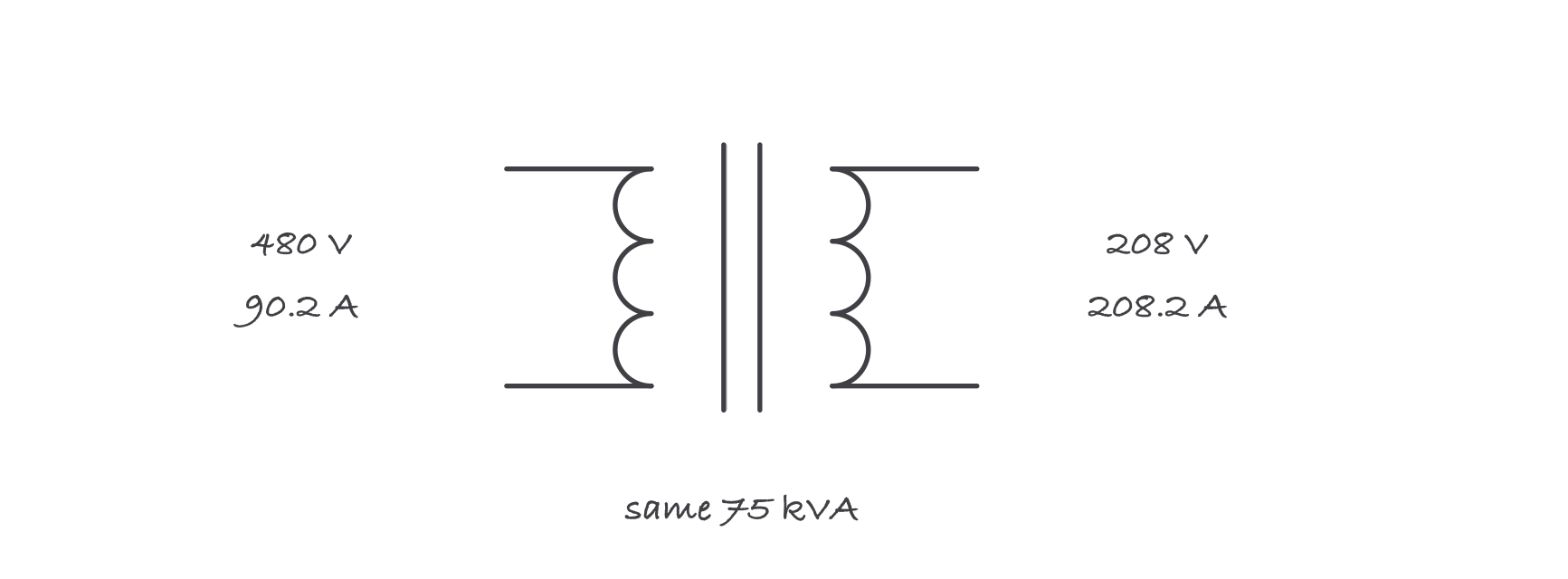
The kVA never changes sides: what the voltage gives up, the current takes
Where it bites
- A handy coincidence, not a law: at 208 V three-phase, amps ≈ kVA × 2.78, which is why a 75 kVA transformer lands near 208 A. Use it to sanity-check, but show the real division on paper and on exams.
- Line-to-line voltage goes in the three-phase formula. Using 120 V because the secondary serves 120 V loads inflates the current by 1.732. The wye’s 120 V is line-to-neutral; the formula wants 208.
- Transformer protection does not protect the secondary conductors. Secondary conductors get their own protection rules, and the 10-foot and 25-foot tap rules usually govern the run to the first panel. Sizing wire to the transformer’s primary breaker is the classic miss.
- Inrush is real here too. Energizing a transformer draws a magnetizing surge, which is why the table tolerates generous primary percentages. A primary device sized tight to 100 % will nuisance-trip on energization.
Exam relevance
Transformer current is among the most reliable calculation questions on master exams and common on journeyman ones: given kVA and voltages, find primary or secondary current, then a conductor or device. The marks are lost on √3, on grabbing line-to-neutral voltage, and on solving the wrong side. Write both currents down first, every time; the rest of the problem is table lookups.
Verified requirements
| Where | Expires | Renewal | Continuing education |
|---|---|---|---|
| Texas | Yes | 1 year | 4 hours per annual renewal cycle |
Information comes from issuing-authority sources. Confirm current rules, fees and eligibility with the authority before acting.