Learn · Electrical
Fuses
Part of Journeyman Electrician Exam Prep · step 50 of 73 · next: Circuit Breakers
In learning paths: Journeyman Electrician Exam Prep
Assumes you know: Overcurrent Protection Fundamentals
A fuse is the simplest overcurrent device there is: a calibrated metal link that melts when too much current heats it, opening the circuit. No mechanism, no moving parts, no reset. When it operates you replace it, and that one-shot nature is both its weakness (trips cost a trip to the supply house) and its strength (a new fuse is a new device, at factory calibration, every time).
Why it matters on the job
Fuses did not disappear when breakers took over houses. They dominate motor circuits, machine control panels, disconnects for HVAC equipment, and services where high interrupting ratings matter. You will select them, replace them, and, critically, replace them with the right ones, because a fuse holder full of the wrong class or speed of fuse is a defect you create with your own hands.
How a fuse works, and the kinds you will meet
Current passes through the element, a link sized so normal current warms it harmlessly and overcurrent melts it. In cartridge fuses the element sits in a filler, typically quartz sand, that quenches the arc as the link opens. Because melting is a thermal event, a fuse is inherently inverse-time: modest overloads take minutes, huge faults melt the link in a fraction of a cycle. Current-limiting fuses open so fast on major faults that they cut the fault off before its first peak, limiting the energy let through downstream.
The distinctions that matter in the field:
Time-delay vs fast-acting. A time-delay (dual-element) fuse tolerates brief inrush, then protects normally. Motors demand it. Fast-acting fuses protect sensitive loads where inrush is not a factor.
Plug vs cartridge. Edison-base plug fuses live in old residential fuse panels; Type S adapters add size rejection so a 30 A fuse cannot land in a 15 A circuit. Cartridge fuses, ferrule or blade, cover everything from 1 A control fuses to thousands of amps.
Class. Cartridge fuses carry class letters (Class H, RK5, RK1, J, T, L and others) defining physical size, interrupting rating, and current-limiting performance. Classes with rejection features keep lesser fuses out of holders designed for better ones.
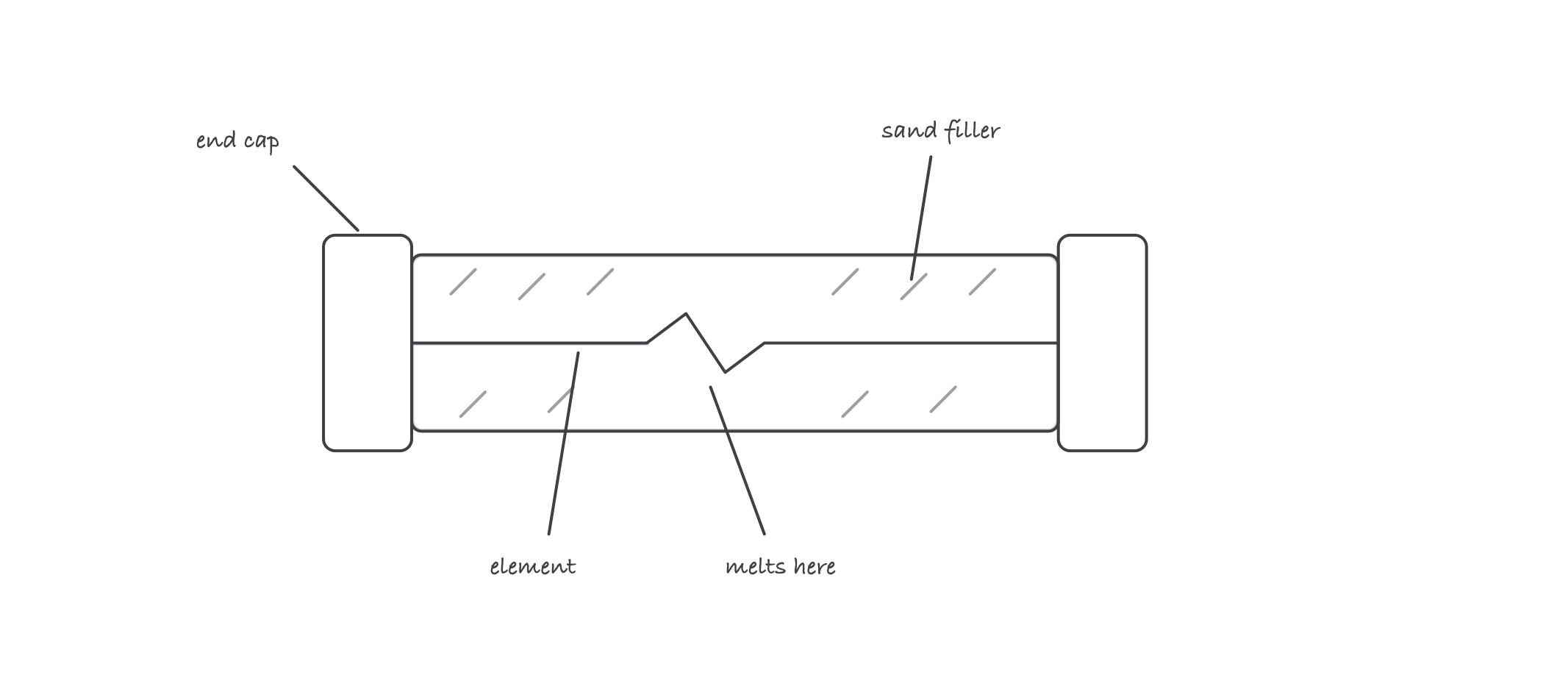
The whole device is the element: current melts it here, the sand puts out the arc
Worked example
A 10 A full-load-current motor starts across the line. Motor inrush runs about 6 times full-load current: 6 × 10 = 60 A, lasting a second or two as the motor comes up to speed.
Put a fast-acting 15 A fuse ahead of it: 60 A is 60 ÷ 15 = 4 times the fuse rating, held for seconds. The element melts, the motor never starts, and no fault existed. Swap in a 15 A time-delay fuse: its overload element is built to carry that same 4× surge for the seconds inrush lasts, then it settles at 10 A, protecting the circuit exactly as intended. Same rating, different speed, opposite outcome. Speed class is not a detail.
Where it bites
- A blown fuse is evidence. Something melted it. Find the overload or fault before installing the replacement, or you will blow the replacement.
- Never bridge or upsize. Pennies behind plug fuses burned houses down for a century. The modern version is stuffing a 30 A fuse where a 15 belonged; rejection features exist because people did exactly this.
- Replace like for like: class and speed, not just amps. A 30 A RK1 and a 30 A Class H look interchangeable in the hand and are worlds apart in interrupting and current-limiting performance.
- One blown fuse on a multi-phase circuit means single-phasing. A three-phase motor running on two fuses cooks itself. Find out why one leg opened, and always replace fuses as a set on motor circuits.