Learn · Electrical
Conduit Fill Calculations
Part of Journeyman Electrician Exam Prep · step 24 of 73 · next: Branch Circuit Calculations
In learning paths: Journeyman Electrician Exam Prep
Assumes you know: Conductor Sizing
Conduit fill is an area calculation: the conductors’ combined cross-sectional area may only occupy a fixed percentage of the raceway’s internal area. Three or more conductors, the everyday case, are allowed 40 % of the conduit’s cross section. The rest is air, and the air is not optional.
Why it matters on the job
Fill limits exist for two reasons: pulling and heat. An overfilled conduit turns a pull into a friction fight that scars insulation on every coupling, and conductors packed tight cannot shed heat into the raceway air. Fill is also the calculation you run backwards constantly on real work: not “does this fit” but “what size pipe do I order”.
The method
Know the fill percentages. From your code book: 1 conductor → 53 %, 2 conductors → 31 %, 3 or more → 40 %. The odd-looking 31 % for two exists because two round wires nest badly.
Look up conductor areas. The code book tables give area per conductor by insulation type, because insulation thickness varies. THHN copper: #12 = 0.0133 in², #10 = 0.0211 in², #8 = 0.0366 in².
Look up the raceway’s allowed area. The raceway tables list each conduit type and trade size with its total internal area and the precomputed 40 % column. EMT: ½ inch = 0.122 in² at 40 %, ¾ inch = 0.213 in², 1 inch = 0.346 in². Conduit types differ; ½-inch EMT and ½-inch PVC do not have the same interior.
Compare. Sum the conductor areas, check them against the allowed area, and go up a trade size if they do not fit. For a pull of identical conductors, the code book’s appendix tables have done the division for you: maximum number of a given wire in a given conduit.
Worked example
How many #12 THHN conductors fit in ½-inch EMT?
- Allowed area at 40 %: 0.122 in².
- Each #12 THHN: 0.0133 in².
- 0.122 ÷ 0.0133 = 9.17 → 9 conductors.
- Check: 9 × 0.0133 = 0.1197 in² ≤ 0.122 in². Ten would need 0.133 in², over the limit.
Now run it forward for a mixed pull: three #8 and four #12 THHN. Area = 3 × 0.0366 + 4 × 0.0133 = 0.1098 + 0.0532 = 0.163 in². Over ½-inch EMT’s 0.122 in², inside ¾-inch EMT’s 0.213 in². Order ¾ inch.
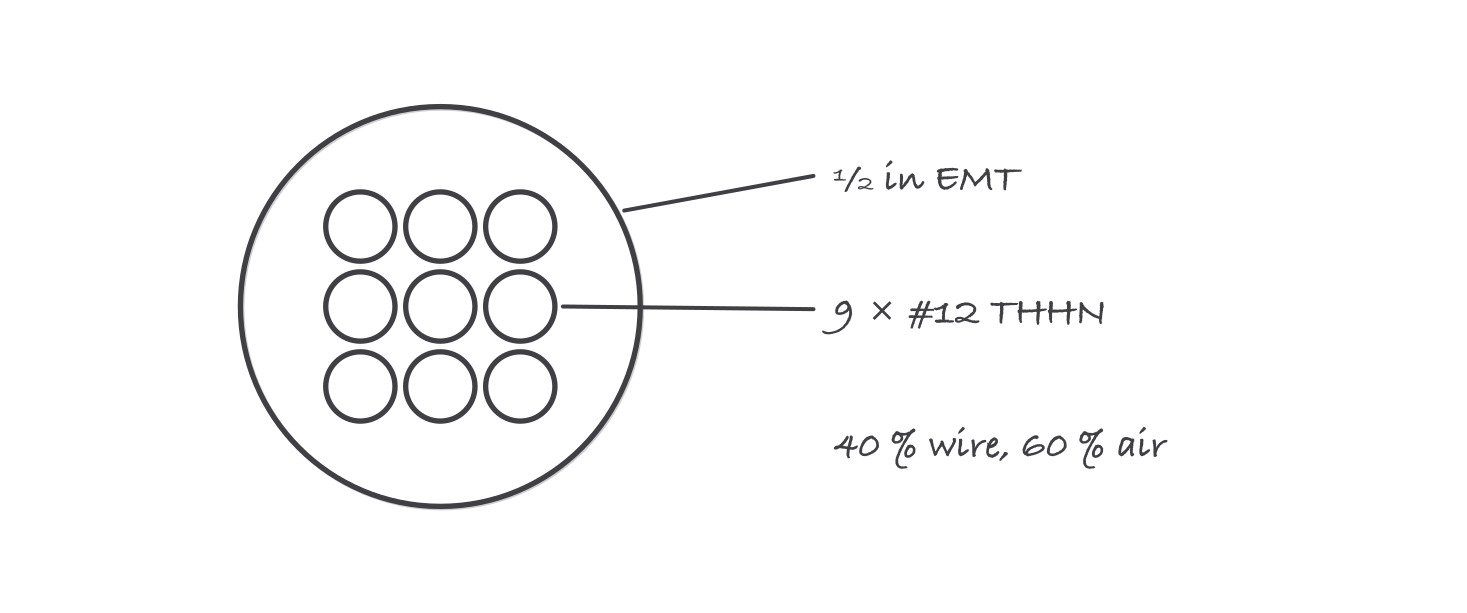
Forty percent wire, sixty percent air: the air is what lets you pull it and what carries the heat
Where it bites
- Fill and derating are different limits that trigger together. Nine #12s fit in ½-inch EMT by area, but nine current-carrying conductors also means a 70 % ampacity adjustment. Passing fill does not mean the conductors survived; run both checks.
- The appendix shortcut tables only work for one wire type and size. The moment a pull mixes sizes or insulation types, you are back to adding areas by hand. Using the shortcut on a mixed pull is a classic exam trap and a real-world one.
- Equipment grounds count toward fill. A ground occupies area like any other wire even though it never counts for derating. The two rules count different things for different reasons.
- Nipples get a break. Raceways 24 inches or shorter are allowed 60 % fill, and no ampacity adjustment applies. Knowing this saves money at gutters and panel stub-ups.
Exam relevance
Conduit fill questions come in both directions: maximum conductors in a given pipe, or minimum pipe for a given pull. The tables are provided; the marks hinge on picking the right conduit type’s table, the right insulation column, and remembering 40 % versus the 60 % nipple allowance. Mixed-conductor problems must be summed by hand, and examiners write the options to punish anyone who reached for the shortcut table.
Verified requirements
| Where | Expires | Renewal | Continuing education |
|---|---|---|---|
| Texas | Yes | 1 year | 4 hours per annual renewal cycle |
Information comes from issuing-authority sources. Confirm current rules, fees and eligibility with the authority before acting.