Learn · Electrical
Test Before Touch
Assumes you know: Safe Work Practices
A circuit is live until a working tester on your own two leads says otherwise, and the discipline that makes that sentence trustworthy is live-dead-live: prove the tester on a known source, test the circuit, then prove the tester again. The middle reading means nothing without the two readings around it. This page teaches the reasoning; performing verification on real equipment is qualified-person work done under your employer’s procedures.
Why it matters on the job
The circuits that kill electricians are rarely the ones they knew were hot. They are the ones that were “off”: the mislabeled breaker, the panel fed from two sources, the neighbor’s circuit sharing the box, the disconnect that opened three poles out of, unfortunately, four. Absence of voltage is a fact you establish, never a fact you inherit from a label, a switch position, or someone else’s word.
Why the sandwich
Test instruments fail, and they fail quiet. A blown internal fuse, a broken lead, a dead battery, a meter set to the wrong function: each produces the same reading on a live circuit that a healthy meter produces on a dead one. Zero. The most dangerous number in the trade is a zero you did not earn.
The live-dead-live sequence closes that trap:
- Live: verify the tester on a known energized source, a proving unit or a verified live circuit of similar voltage. It reads voltage: the tester, leads, battery, and your settings are all working right now.
- Dead: test the circuit you intend to touch. Test every conductor against every other conductor and each against ground. On a single-phase 240 V circuit that is small; on a three-phase system it is every phase pair plus each phase to ground and neutral where present. A circuit is not dead until every combination reads dead.
- Live: return to the known source and verify the tester again. It still reads voltage, which proves it did not fail somewhere between step one and the middle. Only now does the middle zero mean absent.
The instrument itself matters. A contact tester rated for the system voltage, with a category rating (CAT III or CAT IV for distribution-level work) matched to where in the system you are measuring, leads inspected before use. Non-contact pens are useful for a first indication and worthless as proof: they miss shielded conductors, DC, and unlucky geometry. Proof is contact measurement inside the sandwich.
Worked example: verifying one 240 V circuit dead
An air-conditioner disconnect is open and locked out; you intend to work on the load side. Proving unit in hand:
- Tester on the proving unit: reads live. Tester proven.
- Load side, L1 to L2: 0 V. L1 to ground: 0 V. L2 to ground: 0 V. Three combinations, three zeros.
- Tester back on the proving unit: reads live. The zeros were real.
Six readings, under a minute, and the difference between believing and knowing. Had the disconnect failed with one pole welded closed, step 2 would have caught it at L2 to ground before your hand did.
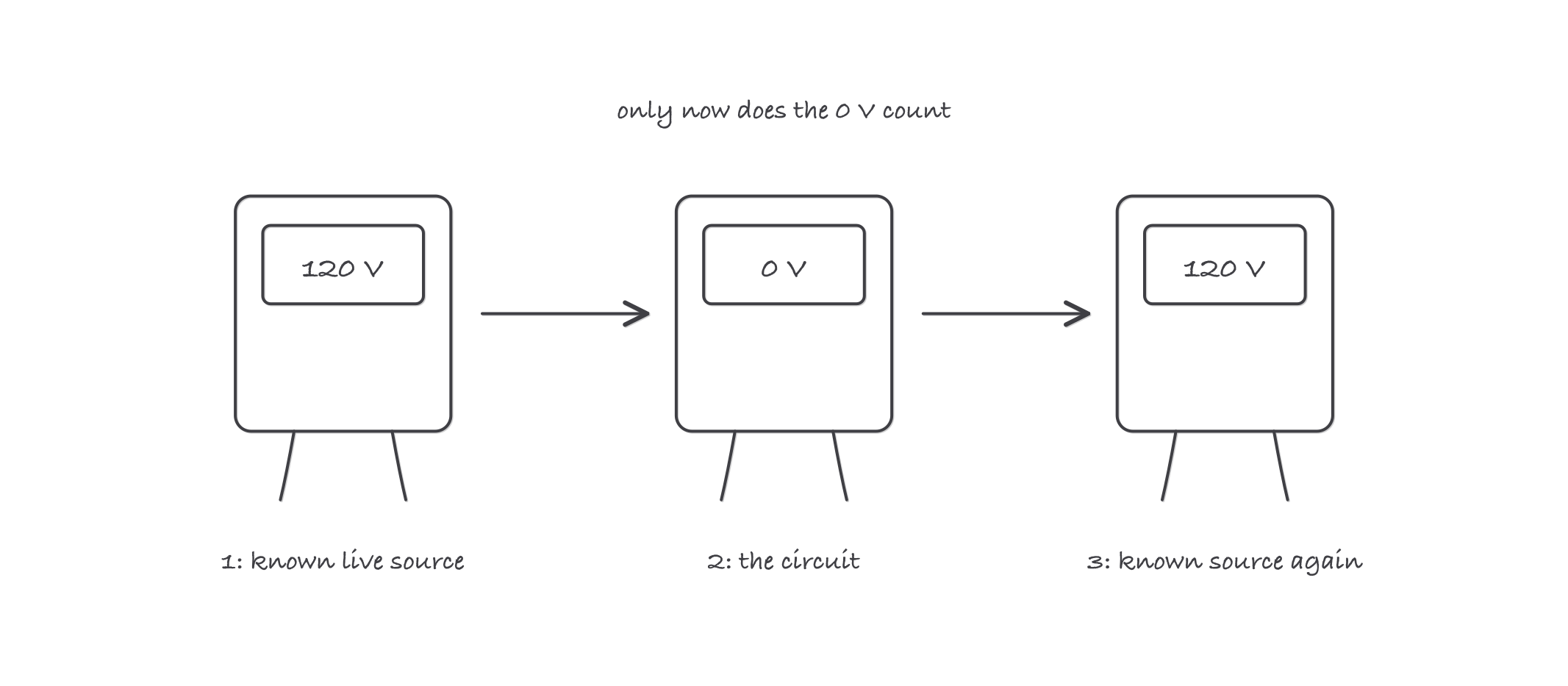
The sandwich that makes zero mean something: a tester proven before and after is the only witness to a dead circuit worth believing
Where it bites
- Voltage can come back. A verified-dead circuit protects you only while lockout/tagout holds the isolation open. Verification and LOTO are two halves of one control; neither substitutes for the other.
- Backfeed is real. Generators, solar inverters, control transformers wired backwards, and capacitors all put voltage on “dead” conductors from the wrong direction. Test every conductor, including the ones your mental model says cannot be hot.
- The breaker handle is not evidence. Handles break internally, labels lie, and multi-wire circuits share neutrals across breakers. The tester is the only witness that counts.
- Wrong-range readings deceive. A meter on DC volts shows near zero on an AC circuit; autoranging meters mask a lead in the wrong jack until the moment of truth. Setting check is part of step one, every time.