Learn · Electrical
Voltage Drop Calculations
Part of Journeyman Electrician Exam Prep · step 21 of 73 · next: Derating and Adjustment Factors
In learning paths: Journeyman Electrician Exam Prep
Assumes you know: How Ohm's Law Works, Conductor Sizing
Voltage drop is the voltage a circuit loses in its own conductors before it reaches the load. Every foot of wire has resistance, and Ohm’s law collects its toll on every foot. Long runs on undersized conductors deliver low voltage, hot wire, and equipment that struggles, and the fix is arithmetic you can do on a job box.
Why it matters on the job
A motor at low voltage draws more current and runs hot. Electronics brown out. A well pump 300 feet from the panel does none of the things its nameplate promises. The Code treats recommended limits for voltage drop as informational, but inspectors, spec books and call-backs treat them as real: the widely used targets are 3 % on a branch circuit or feeder, 5 % total from service to load.
The calculation
For a single-phase circuit, the working formula is:
VD = (2 × K × I × L) / CM
- VD, volts dropped in the conductors
- 2, the current travels out and back
- K, resistivity constant: about 12.9 for copper, 21.2 for aluminum (ohms-cmil per foot at operating temperature)
- I, load current in amperes
- L, one-way circuit length in feet
- CM, conductor area in circular mils, from the code book’s conductor properties table
Percent drop = VD ÷ source voltage × 100.
Worked example
A 120 V branch circuit feeds a 16 A load 150 feet from the panel on #10 AWG copper (10,380 CM).
- VD = (2 × 12.9 × 16 × 150) / 10,380
- Numerator: 2 × 12.9 × 16 × 150 = 61,920
- VD = 61,920 / 10,380 = 5.97 V
- Percent: 5.97 / 120 = 5.0 %, twice the 3 % recommendation.
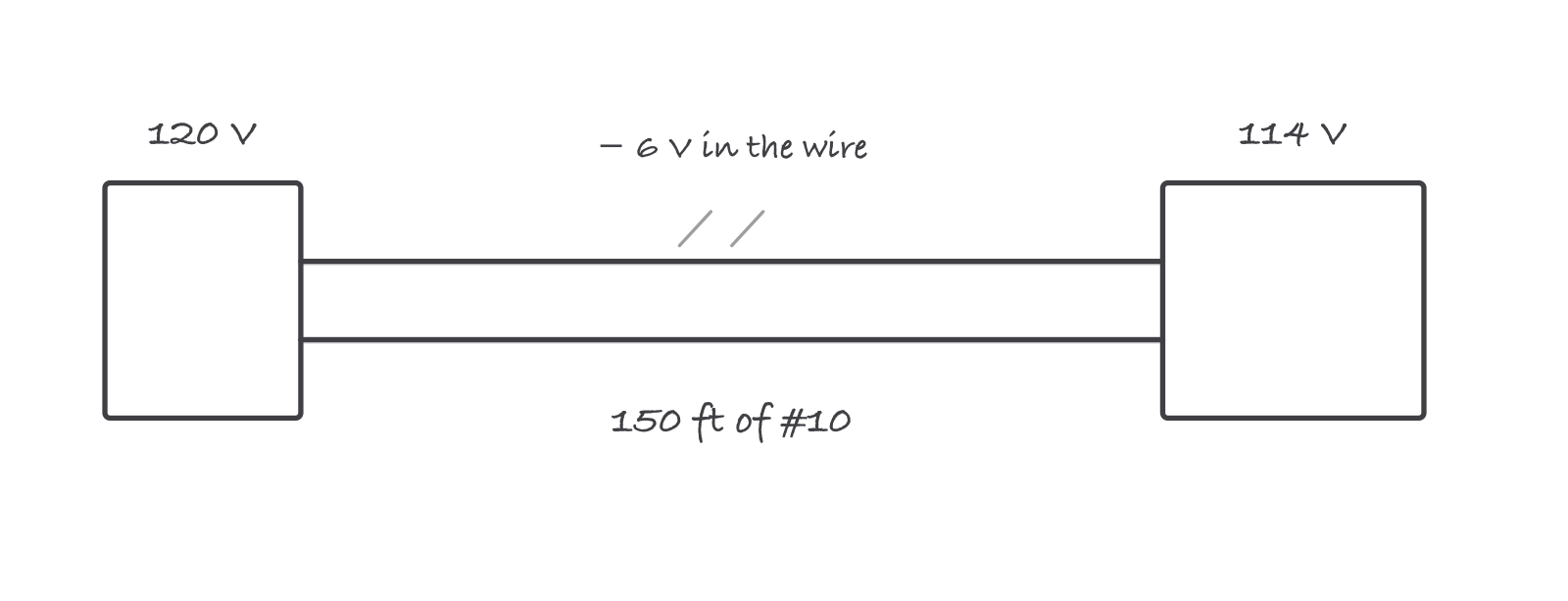
The ×2 is the round trip: the current loses voltage in the copper going out and coming back
Fix it by upsizing. Try #8 AWG (16,510 CM):
- VD = 61,920 / 16,510 = 3.75 V = 3.1 %, right at the line.
Try #6 AWG (26,240 CM):
- VD = 61,920 / 26,240 = 2.36 V = 2.0 %, comfortably inside it.
That is the whole method: compute, compare to the target, upsize until it passes. Notice ampacity never entered it; #10 carries 16 A easily. Distance, not ampacity, drove the conductor size here, and that is the point of the topic.
Where it bites
- Ampacity and voltage drop are separate checks. A conductor can be perfectly legal for the load and still hopeless over the distance. Long runs need both checks, every time.
- Use one-way length, then let the 2 do its work. Doubling the length yourself and keeping the 2 is the classic doubled-error.
- Three-phase changes the formula. The multiplier becomes √3 (about 1.732) instead of 2. Applying the single-phase formula to a three-phase feeder overstates the drop.
- K is an approximation. Precise work uses the actual resistance values from the conductor properties table; K ≈ 12.9 copper is fine for sizing decisions and exams that allow it, but know which method your exam or spec expects.
Exam relevance
A staple of journeyman and master exams, usually as: will this run meet 3 %, or what size conductor makes it pass. The arithmetic is simple; the marks are lost on the 2 vs √3 multiplier, one-way vs round-trip length, and reading CM from the wrong row under time pressure. Practice with the code book’s own table.
Verified requirements
| Where | Expires | Renewal | Continuing education |
|---|---|---|---|
| Texas | Yes | 1 year | 4 hours per annual renewal cycle |
Information comes from issuing-authority sources. Confirm current rules, fees and eligibility with the authority before acting.