Learn · Electrical
Motor Current Calculations
Part of Journeyman Electrician Exam Prep · step 59 of 73 · next: Motor OCPD and Conductor Sizing
In learning paths: Journeyman Electrician Exam Prep
Assumes you know: How Motors Work
Motor current calculations answer one question with two different numbers: how much current does this motor draw. The physics answer comes from the horsepower formula. The code answer comes from the full-load current tables in your code book, and the tables, not the nameplate and not your arithmetic, are what you size conductors and breakers from.
Why it matters on the job
Motors are the loads that punish sloppy current numbers. They draw six times their rated current at start, run at whatever the shaft load demands, and cook their windings if protection is sized to fantasy figures. Every motor circuit rule downstream, conductors, overloads, short-circuit protection, begins with getting the right current from the right place.
The two sources of motor current
The table value (FLC). Your code book carries full-load current tables by horsepower, voltage, and phase. These are deliberately conservative standardized values. The rule: use the table FLC for sizing conductors and short-circuit protection, so the wiring does not depend on which motor the mechanical contractor actually bolts down. Values worth recognizing: a 10 hp, 230 V single-phase motor = 50 A; a 25 hp, 460 V three-phase motor = 34 A.
The nameplate value (FLA). The current this particular motor draws at rated load. The rule: use the nameplate FLA for one job only, sizing the overload protection that guards the motor’s windings.
When you have no table and no nameplate, the physics gets you close. Output power is hp × 746 W. Feed in efficiency and power factor and solve for current:
I = (hp × 746) ÷ (V × efficiency × PF) for single-phase; add × 1.732 in the denominator for three-phase.
Worked example
Estimate the current of a 10 hp, 230 V single-phase motor with 85 % efficiency and 0.85 power factor, then compare to the table.
- Output: 10 × 746 = 7,460 W.
- Current: 7,460 ÷ (230 × 0.85 × 0.85) = 7,460 ÷ 166.2 = 44.9 A.
- The code book’s table says 50 A. The table sits above the physics on purpose: it covers the least efficient motor you might install, so the wiring never comes up short.
Three-phase check: a 25 hp, 460 V motor at 90 % efficiency, 0.85 PF: 18,650 ÷ (460 × 1.732 × 0.90 × 0.85) = 18,650 ÷ 609.5 = 30.6 A, against a table value of 34 A. Same pattern.
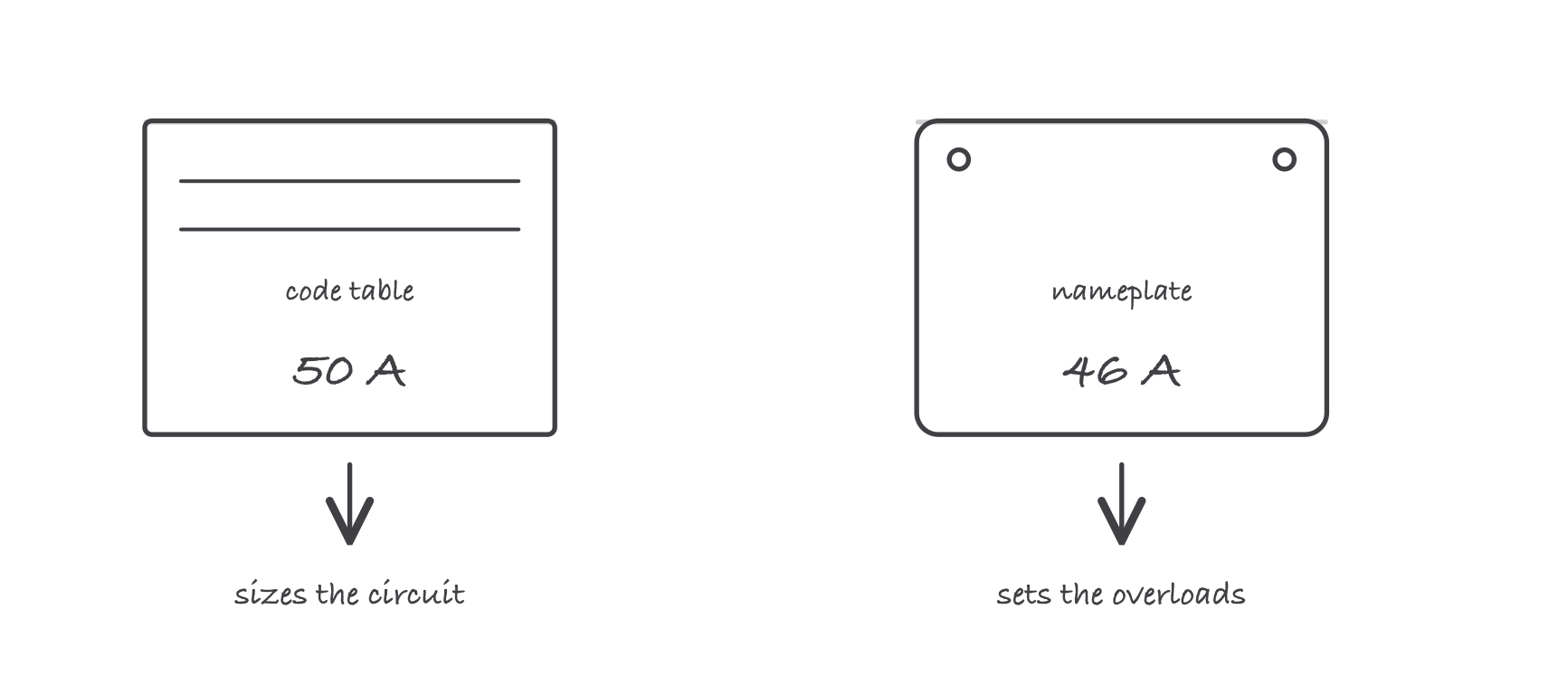
Two numbers for one motor: the table sizes the circuit, the nameplate sizes the overloads
Where it bites
- Sizing conductors from the nameplate is the signature motor mistake. The nameplate may read 46 A where the table says 50 A; the circuit built on 46 A is legal for that motor and wrong the day maintenance swaps in a less efficient one. Table for the circuit, nameplate for the overloads.
- Starting current is its own universe. Locked-rotor current runs roughly 6 times FLC. It does not size conductors, but it explains why motor breakers are allowed to be so large, which the next lesson covers.
- Voltage rows are exact, not approximate. The table’s 230 V row and 208 V row differ; a motor on a 208 V system uses the 208 V figure. Grabbing the familiar row instead of the right row shifts every downstream number.
- The physics formula is an estimate. Efficiency and power factor vary motor to motor. Use it to sanity-check, quote, or fill gaps, never to override the table where the table governs.
Exam relevance
Nearly every motor question on a licensing exam starts with a table lookup, and the exam provides the tables. The tested skill is knowing which number feeds which rule: FLC to conductors and breakers, FLA to overloads. Expect at least one question built entirely on that distinction, and expect the 10 hp / 230 V / 50 A single-phase motor: it is the exam’s favorite specimen.
Verified requirements
| Where | Expires | Renewal | Continuing education |
|---|---|---|---|
| Texas | Yes | 1 year | 4 hours per annual renewal cycle |
Information comes from issuing-authority sources. Confirm current rules, fees and eligibility with the authority before acting.