Learn · Electrical
Branch Circuit Calculations
Part of Journeyman Electrician Exam Prep · step 25 of 73 · next: Demand Factors
In learning paths: Journeyman Electrician Exam Prep
Assumes you know: Conductor Sizing
A branch circuit calculation matches one circuit to the load it serves: convert the load to amperes, inflate any continuous portion by 125 %, and land on a standard circuit rating that covers it. It is the smallest unit of load calculation, and every bigger calculation, feeders, services, is built by stacking these.
Why it matters on the job
Every circuit you rough in is a small design decision: how many receptacles, how much lighting, what rating of breaker and wire. Get the arithmetic wrong and the circuit nuisance-trips at full song or, worse, runs loaded to its edge for hours at a time. The branch circuit rules are how the code book keeps a circuit’s normal day inside its thermal comfort zone.
The method
Convert the load to amps. Loads arrive in watts or volt-amperes; current = VA ÷ volts. A 1,920 VA lighting load at 120 V is 16 A.
Classify continuous versus noncontinuous. Continuous means the maximum current runs for 3 hours or more: commercial lighting, signs, EV charging, water heaters in practice. The circuit rating and conductor must cover 125 % of the continuous load plus 100 % of the noncontinuous load.
Land on a standard rating. Branch circuits serving general loads come in standard sizes: 15, 20, 30, 40, and 50 A. Multi-outlet general-purpose circuits are limited to 15 and 20 A.
Count receptacles where required. In dwellings, general-purpose receptacles are covered by the square-footage lighting load and are not counted individually. In commercial work, each receptacle outlet is charged 180 VA, and that number sets how many fit on a circuit.
Worked example
A retail store needs circuits for its display lighting, which draws 1,920 VA at 120 V and runs all day, and for a wall of receptacles.
Lighting circuit:
- Current: 1,920 ÷ 120 = 16 A, continuous.
- Required rating: 16 × 1.25 = 20 A.
- A 20 A circuit with #12 copper covers it exactly. 16 A is also the most continuous load a 20 A circuit may carry: 20 ÷ 1.25 = 16.
Receptacle circuit:
- A 20 A, 120 V circuit provides 20 × 120 = 2,400 VA.
- Each commercial receptacle outlet is charged 180 VA: 2,400 ÷ 180 = 13.3.
- Round down: 13 receptacle outlets maximum on the circuit.
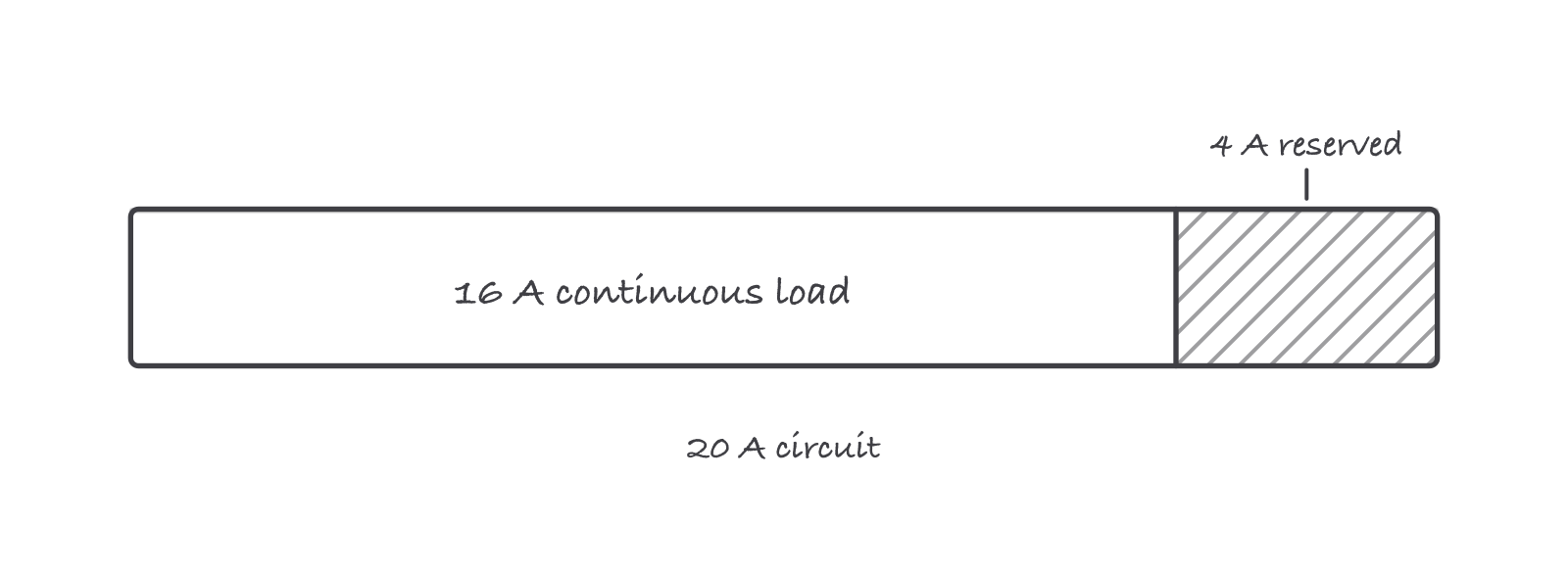
A 20 amp circuit only rents out 16 of its amps to a continuous load; the rest is mandatory headroom
Where it bites
- The 125 % works both directions. Given the load, multiply by 1.25 to find the circuit. Given the circuit, divide by 1.25 to find the maximum continuous load. Exams and plan reviews use both, and mixing them up flips the error direction.
- Round receptacle counts down, always. 13.3 receptacles means 13. Rounding up puts the circuit over its VA budget by design.
- Dwelling receptacles are not 180 VA each. Applying the commercial per-outlet charge to a house double-counts load the square-footage method already covered. Know which occupancy you are in before you count anything.
- The breaker, the wire, and the devices must agree. A 20 A circuit is a 20 A breaker, #12 copper, and devices rated for the circuit. Upsizing one piece alone buys nothing and can create its own violation.
Exam relevance
Branch circuit items are quick two-step problems: VA to amps, then the 125 % in one direction or the other. The receptacle-count question, how many 180 VA outlets on a 20 A circuit, appears on nearly every journeyman exam, and 13 is worth remembering as a sanity check even though the arithmetic is trivial. Read whether the occupancy is dwelling or commercial before touching the receptacle rules.
Verified requirements
| Where | Expires | Renewal | Continuing education |
|---|---|---|---|
| Texas | Yes | 1 year | 4 hours per annual renewal cycle |
Information comes from issuing-authority sources. Confirm current rules, fees and eligibility with the authority before acting.